


By Joanna Bogle
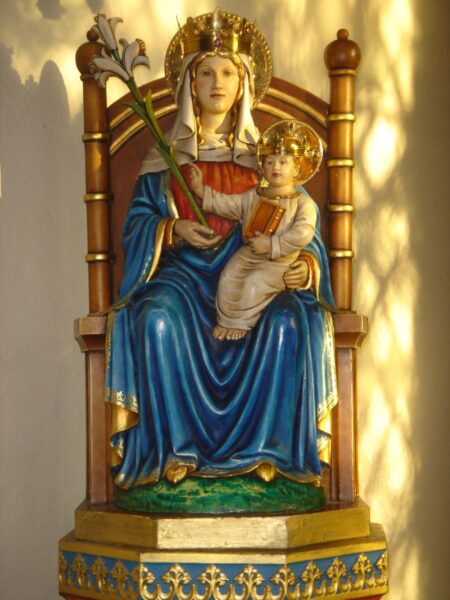
This summer, as in so many summers past, I will make a pilgrimage to Walsingham. This Norfolk village is home to England’s national shrine to Our Lady, and I will travel there by coach from London, recounting the story of the shrine along the way.
One consequence of our country’s complicated history is that many Catholics—both here at home and abroad—do not know the story of some of our ancient shrines, abbeys, and churches. Better known is the modern story that begins with Henry VIII’s destruction in the 1530s, with the resulting horror and heroism, and the moving—and it must be said, overwhelmingly beautiful—sight of great ruined arches amid a glorious and silent countryside.
The story of Walsingham begins with the vision of a lady—her name has come down to us as Richeldis—who lived in this part of Norfolk, about ten kilometers from the sea, in the eleventh century. The year was 1061, and it was a time of uncertainty. Who would be the next king?
Edward the Confessor has no heir. There are rumors that the throne has been promised to William of Normandy. Meanwhile, Christendom itself feels threatened. The Muslim religion has spread across what were once the central Christian lands of the Middle East, and the Holy Land, where Christ himself lived and walked, may soon be in their hands. The pilgrimages that have been made for centuries are now dangerous.
In the vision, Richeldis heard Our Lady ask that her house, the Holy House of Nazareth, be rebuilt in Walsingham. Richeldis set to work—she had been given the exact specifications—but the workmen struggled to make the measurements fit. Nothing seemed to come together. They withdrew to rest after a few exhausting days with the work unfinished. That night, everyone slept soundly. The next morning, the sun rose over a perfectly completed house.
Through all the years that followed—through the Norman Conquest and into the sixteenth century—pilgrims flocked to Walsingham, filling the paths and roads summer after summer. The village flourished: a great priory was built, along with a Franciscan house and, of course, many taverns that welcomed travelers from across Europe.
Then came the destruction under Henry, and long years of neglect and silence, and afterward the restoration—begun by a local Anglican vicar—and the new story began.
Traveling by coach is the main way modern pilgrims reach Walsingham: there is no train station. Much more pleasant is a pilgrimage on foot, with overnight stays in pleasant villages and glorious walks along country paths.
I have done it in the traditional style—sleeping on the floors of parish halls and the like—and also with greater comfort, staying overnight in comfortable rooms. Like so many other pilgrims, I have memories of prayers said in forest clearings and picnics in sunny meadows, and the sense of triumph upon arrival, especially if the timing has worked out and we reach the main pilgrims’ Mass on a Sunday, forgetting sore feet as we join in enthusiastic singing and prayers of thanksgiving.
I have also attended some of the great events held at Walsingham in recent years: the great New Dawn gatherings with hundreds of families camping in the neighboring fields, the Youth 2000 pilgrimages with a new generation beginning the new evangelization of our country at the start of a new millennium.
And I have been in Walsingham when coaches arrive from parishes or dioceses or from various ethnic groups, in particular the Tamil pilgrimage, with a delicious meal cooked upon arrival and generously offered to all.
But my main reason for writing about all this for an American Catholic audience is something specific, in this year when the United States celebrates its 250th anniversary.
As our coach heads from London to Walsingham through Cambridgeshire, we will effectively pass through a little piece of the United States along the way. Not literally: that stretch of land is sovereign British territory.
But at one point, the great flag of the stars and stripes waves against the sky, and the entrance leads along broad gardens toward row after row of solemn white headstones. Here lie buried some 3,000 American servicemen from the Second World War. They died helping Britain in a savage war, and helped preserve our freedom. I am grateful.
The cemetery is enormous: I had not realized that so many men who served did not return to their homes in the United States. In addition to the graves, there are panels listing some 5,000 men classified as missing.
This is not a call for the United States to become involved in foreign wars. On the contrary: our prayers should be for peace, and for wisdom and prudence on the part of our leaders. I simply want to point out that the men buried here are part of something greater than they themselves knew.
The history of England is long. Two hundred fifty years does not seem like much time when one reflects on the history of Walsingham, which is far older. In the year 2061 we will celebrate the thousand years of the shrine’s history.
But in the soil of Cambridgeshire—in a particularly glorious stretch of countryside that reaches to Madingley and Grantchester, and to the ancient University of Cambridge—lie the bodies of men who served with honor, and whose sacrifice helped ensure that this land could be a safe place for Christian pilgrims.
Theirs is a moving testimony to the history of Walsingham.

About the author
Joanna Bogle is the author of some 20 books, including several historical biographies and A Book of Seasons and Celebrations, with information on traditions and customs that mark the liturgical year. Her most recent book is John Paul II: Man of Prayer, together with her colleague Clare Anderson, which explores the spiritual life of St. John Paul the Great. She broadcasts regularly with EWTN and founded the popular “Catholic History Walks” in London.