


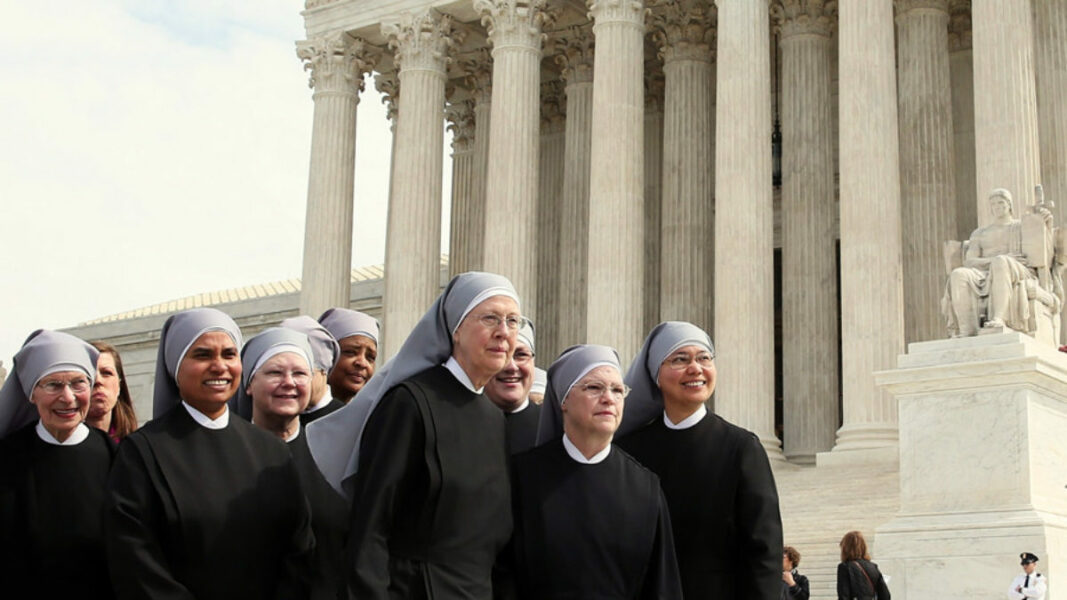
The Little Sisters of the Poor have appeared before the United States Court of Appeals for the Third Circuit in a new chapter of the legal battle they have maintained for fifteen years to preserve their right not to fund contraceptives in their employees’ health insurance for reasons of conscience.
The congregation, dedicated to the care of poor elderly people, years ago challenged the so-called contraceptive mandate approved during the Obama Administration to implement the Affordable Care Act (Affordable Care Act), known as Obamacare, which required employers to include contraceptive coverage in the health plans offered to their workers.
Although the United States Supreme Court ruled in favor of the religious sisters on two occasions and confirmed both the federal Government’s obligation to protect religious freedom and its authority to establish exemptions to the mandate, the states of Pennsylvania and New Jersey keep the litigation open to annul those exemptions.
Pennsylvania and New Jersey question the exemptions
According to EWTN, during the hearing held in Philadelphia, the legal representative of both states, Aimee Thomson, argued that the exemptions approved by the first Trump Administration are “arbitrary and capricious” because they extend not only to religious institutions but also to employers who allege moral objections.
She maintained that the regulation goes beyond what is required by the Religious Freedom Restoration Act (Religious Freedom Restoration Act, RFRA) and could allow some employers to request exemptions without their objections being genuine.
Thomson also argued that forcing female employees to challenge the sincerity of those objections in court would impose a disproportionate burden.
The defense invokes religious freedom
Mark Rienzi, president of the Becket organization, spoke on behalf of the Little Sisters, arguing that the federal Government sought to reconcile the contraceptive mandate with the protection of religious freedom following the guidelines set by the Supreme Court.
“None of that can be described as arbitrary or capricious,” he stated, rejecting the idea that an exemption broader than what is strictly required by the RFRA could be considered illegal.
The position of the religious sisters was also supported by the United States Department of Justice. Deputy Attorney General Eric McArthur defended that the Administration chose to review the regulation completely and concluded that establishing exemptions constituted “the most appropriate administrative response” to religious and moral objections, even though federal legislation did not expressly require it.
He added that, if the court were to consider the scope of the exemptions excessive, it could modify specific aspects of the regulation without the need to annul it entirely, as Pennsylvania and New Jersey are requesting.
“We only want to continue serving”
After the oral hearing, the superior of the congregation, Mother Loraine Marie Maguire, lamented that the religious sisters have spent fifteen years defending in court a mission they have carried out for nearly two centuries.
“This is the mission that God has entrusted to us. For nearly two hundred years we have welcomed poor and dying elderly people into our homes. With the rapid growth of the elderly population, we cannot allow a government lawsuit to prevent us from continuing to fulfill that mission,” she stated.
The religious sister concluded with a message directed at the plaintiff states: “Pennsylvania and New Jersey may continue litigating if they so wish. We only want to continue serving.”
The Court of Appeals is expected to issue its ruling before the end of the year.