


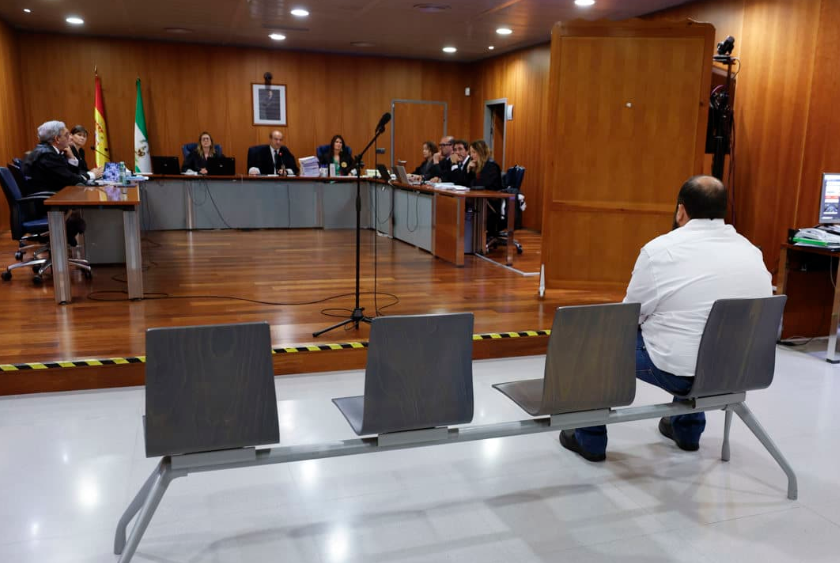
The Provincial Court of Malaga has sentenced the priest from the Diocese of Malaga known as “Father Fran” to 52 years in prison for drugging and sexually assaulting four women between 2014 and 2018. The ruling, made public this Wednesday, finds him guilty of three continued offences of sexual abuse with penetration and a fourth continued offence of sexual abuse, all aggravated by abuse of trust, as well as four continued offences of discovery and disclosure of secrets.
In addition to the prison sentences, the court imposes restraining orders against the victims, a period of supervised release once the sentence has been served, and payment of €403,129 in compensation for the moral damages and psychological after-effects suffered by the four women.
The judicial decision adds an element of particular relevance to the Diocese of Malaga: it holds the Bishopric vicariously liable for the payment of the compensation, considering that the facts cannot be separated from the convicted man’s priestly status or from the exercise of his ministry.
The Court rejects the thesis defended by the Diocese
Before the trial began, the Bishop of Malaga, Mons. José Antonio Satué, publicly maintained that the Diocese should not assume vicarious civil liability in this case.
“Our lawyers are going to argue that the Diocese of Malaga should not be held liable,” he stated last May, asserting that the Bishopric “has neither encouraged nor condoned nor looked the other way when these extremely serious accusations came to light.”
The Provincial Court has now rejected that argument.
In the judgment, the magistrates emphasise that the four women maintained a relationship with the priest that originated in the pastoral sphere and that it was precisely that condition which enabled the accused to gain their trust.
“His conduct cannot be dissociated from his status as a priest,” the ruling states. It adds that it was his “religious or pastoral function” that initially linked him to the victims and which he used “to dispel any distrust” and ensure that “they saw no danger or risk in him.”
For that reason, the court concludes that “they cannot accept, as the Diocese sought, to separate what occurred from his priestly status or to compartmentalise it according to the acts or moments.”
The judgment questions the Bishopric’s conduct
The ruling also devotes several passages to the Diocese’s actions.
The magistrates maintain that the priest’s behaviour was “utterly disordered from the outset” and that there were “at the very least rumours that had reached the Church.”
In that context, they consider the Diocese’s “ignorance” of those behaviours “unacceptable,” at a time when it was led by Mons. Jesús Catalá.
The Court likewise states that “nothing excludes the Bishopric’s liability” and criticises its failure to exercise its supervisory functions adequately.
“Not only did the Bishopric fail to carry out its supervisory duties properly, but it also failed to select the right person to perform the functions of parish priest,” the judgment notes.
Drugs, loss of consciousness and recordings
According to the facts established by the court, the priest exploited the relationship of trust built during religious and pastoral activities to administer to the victims a substance that could not be identified but which caused them a deep state of drowsiness and loss of consciousness.
The ruling concludes that the substance “necessarily constituted a toxic substance” that nullified the women’s capacity to react and enabled the accused to commit the sexual assaults “without the victim’s consent being recorded.”
The magistrates also consider it proven that the priest recorded part of the abuses and took photographs of the victims while they remained unconscious.
For the court, those images have “unquestionable” evidentiary value, as they allow both the accused and the locations where the events occurred—all linked to ecclesiastical premises—to be identified.
The discovery of the hard drive triggered the investigation
The investigation began in 2023 after the priest’s then-partner found a hard drive in the home they shared in Melilla containing photographs and videos of women who appeared to have been drugged and sexually assaulted.
According to the judgment, the woman initially reported the discovery to another priest and to the accused himself before bringing the matter to the attention of a National Police officer, which led to the investigation.
The magistrates consider it “somewhat incomprehensible” that the complaint was not lodged immediately with the State Security Forces, although they note that this circumstance does not affect the validity of the evidence obtained.
It was during the investigation that the four victims became aware of the assaults they had suffered, as none of them remembered what had happened due to the state of unconsciousness caused by the substance which, according to the judgment, the priest administered to them.
Canonical response pending
Following the priest’s arrest in September 2023, the Diocese opened a canonical procedure that was suspended pending the outcome of the civil proceedings.
During the pre-trial hearing, Mons. Satué reiterated his request for forgiveness “to all those who, in this and other similar situations, have not found in the Church the understanding and support they should have received,” while announcing the Diocese’s willingness to collaborate in the reparation of the victims should a conviction ultimately be handed down.
With the judgment now issued by the Provincial Court of Malaga, the criminal proceedings are resolved at first instance, without prejudice to any appeals that may be lodged, while the Church must decide the next steps in the canonical sphere regarding the convicted priest.