


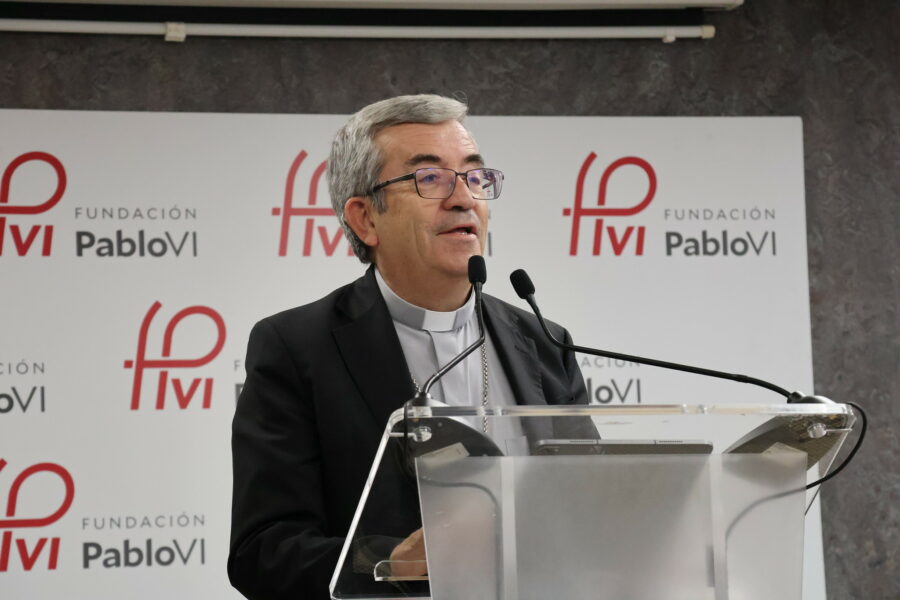
The president of the Spanish Episcopal Conference, Mons. Luis Argüello, used the closing lecture of the CEE Summer School to offer a broad reflection on the ethical and anthropological challenges that, in his view, Western democracies are facing. During his address, titled «The response of democracies to the ethical and anthropological challenges of society», the Archbishop of Valladolid analyzed issues such as the demographic winter, individualism, international policies on birth rates, the role of the State, freedom of the press, and the responsibility of citizens in the renewal of public life.
The course, held from July 7 to 9 at the Pablo VI Foundation under the title «The collapse of democracy. The opportunity for a geopolitics at the service of the human person», was organized by the Spanish Episcopal Conference in collaboration with the Pontifical University of Salamanca and the Pablo VI Foundation. Among the participants were the Apostolic Nuncio to Spain, Mons. Piero Pioppo; the Minister of Foreign Affairs, José Manuel Albares; former minister José Manuel García-Margallo; philosopher Victoria Camps; and the Secretary General of the CEE, Mons. Francisco César García Magán.
Although the event was presented under the idea of the “collapse” of democracy, Argüello preferred to speak of a crisis that can still be addressed. “It is under discussion whether there are really possibilities of regenerating democracies,” he stated at the beginning of a lecture in which he placed the anthropological question at the center of the debate.
«The bread of our children» does not justify tax fraud
After recalling Saint Augustine’s well-known statement that “when a State forgets ethics, it becomes a band of thieves,” Argüello argued that democratic renewal does not depend solely on the behavior of institutions, but also on the moral responsibility of citizens themselves.
In that context—drawing a parallel between responsibilities of a different nature—he maintained that ethical demands cannot be directed exclusively at those who hold public office.
«It is not enough to say that our political leaders should stand there; they have a different responsibility. But if we have now cheated at solitaire when filing our tax return because we think the bread of our children comes first, or if we ask for an invoice under the table, watch out, because ethical standards apply to everyone».
The president of the CEE explicitly acknowledged that those in government have “a different responsibility,” but insisted that a solid democracy also requires citizens committed to their duties and not only to the defense of their rights.
The appeal to individual responsibility was part of a broader reflection on the anthropological crisis that, in the view of the Archbishop of Valladolid, Western democracies are undergoing, and which manifests itself both in public policies and in the priorities of international organizations.
The demographic winter and the priorities of the United Nations
Argüello identified the decline in birth rates as one of the clearest signs of this anthropological crisis. He recalled that, for the first time in history, Western societies are living in a situation in which “more people die than are born,” and pointed out that the decision not to have children has taken on a cultural dimension unknown until now, although he also acknowledged the weight of economic factors such as job insecurity or access to housing.
From that perspective, he linked his remarks to a critique of the policies promoted by the United Nations. He recalled a reflection by the then-Cardinal Joseph Ratzinger on the Millennium Development Goals, according to which the international community would have stopped trusting in feeding all of humanity in order to direct its efforts toward reducing birth rates.
He explained that when, in 2015, the degree of compliance with those goals was reviewed, the only area that was progressing as planned was that of so-called reproductive health.
«The planned steps were to extend antinatalism and pro-abortion policies».
He lamented, however, that the goal of eradicating hunger was once again postponed.
The president of the CEE went further by attributing this orientation to a strategy driven by major international foundations.
«Global capitalism has a strategy carried out mainly by its large foundations, which arise from laboratories that are fundamentally American, and which have then had their accomplices, their hitmen, in the European left, in carrying out this project of reducing the number of diners at the table».
From the individual to the person
The critique of demographic policies was embedded in a broader reflection on the evolution of modern thought. Argüello argued that contemporary culture has moved from a conception of the person, understood as an essentially relational reality, to one centered on the autonomous individual, detached from any prior reference.
“It is possible to have an ‘I’ if someone has not said ‘you’ to you. From the very womb we are relation and the fruit of a relation,” he stated to explain that personal identity is born within a family and a community.
In his view, reducing the person to the individual hinders the transmission of life, weakens the family, and makes the construction of stable coexistence more complex.
«There is an anthropological confessionalism»
From this conception of the person, the archbishop questioned whether the State maintains true neutrality on issues related to life, sex, or identity.
«There is no anthropological neutrality. There is an anthropological confessionalism, and if you step out of line, criminal law».
As an example, he mentioned legislation on gender identity, stating that it consolidates so-called affirmative therapies while considering conversion therapies the accompaniment of people experiencing conflicts related to their sex or identity. He also included in this reflection laws concerning abortion and euthanasia.
«The first thing that needs to be regenerated is the people»
One of the central themes of the lecture was the importance of the demos as the foundation of democracy. For Argüello, the institutional crisis cannot be understood without the crisis of the people themselves.
«The first thing that needs to be regenerated is the demos».
The president of the Spanish episcopate maintained that democracy needs a community capable of sharing bonds, duties, and a common horizon. In that context, he placed the specific contribution that, in his view, the Church can make.
«The great contribution that the Church can make to democratic life is to offer a people».
That people, he explained, lives fraternity not only as a political ideal, but as a reality that arises from recognizing themselves as children of the same Father.
Rule of law, freedom of the press, and subsidiarity
In the final part of his address, Argüello applied these reflections to the institutional sphere. He defended the need to respect the rules of the rule of law, guarantee the separation of powers, present budgets, comply with the Constitution, and ensure “a genuine freedom of the press” that does not depend on institutional advertising.
He also upheld the principle of subsidiarity and warned of the risk that the State might progressively replace the initiative of civil society through a model based on permanent aid.
«We must prevent the State from becoming a secular Caritas that gives alms».
Addressing the impact that artificial intelligence may have on employment, he acknowledged that certain public benefits might be necessary in the future, but rejected the idea that the response should consist in replacing work with permanent subsidies.
«It is not enough to simply say, I’ll give you a little allowance and you stay calm, because that implies an anthropological mutation».
A proposal for democratic renewal
Argüello concluded his address by calling for a citizenry aware that human dignity is the source of both rights and duties. Drawing inspiration from the recent interventions of Leo XIV, he advocated for greater presence of the laity in public life through the exercise of “social and political charity.”
As a synthesis of his proposal, he encouraged rebuilding the social fabric by strengthening the family, promoting citizen participation, and offering an ethical reference that makes dialogue possible. At the same time, he called for the exercise of power to respect the basic rules of the rule of law and urged facing current challenges “brick by brick” and “without demonizing anyone.”