


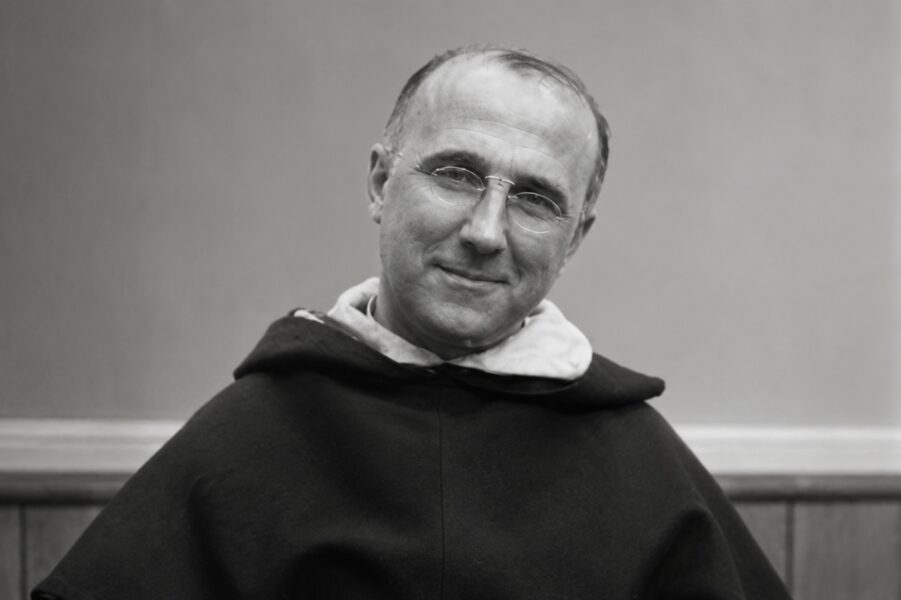
by Fr. Reginald Garrigou-Lagrange, O.P. Translated from the French into English by Suzanne M. Rini (Catholic Family News Reprint Series, no. 309). Spanish version based on that English translation.
Editor’s Note [from Catholic Family News]: Catholic Family News proudly presents its exclusive English translation of Fr. Garrigou-Lagrange’s landmark work, «La nouvelle théologie où va-t-elle?», first published in 1946 in the Angelicum of Rome, one of the world’s most prestigious theological journals. Fr. Garrigou-Lagrange, O.P., one of the greatest Thomistic theologians of this century, warned that the “New Theology” of Maurice Blondel, Henri de Lubac, etc., is nothing other than a revitalized modernism. This same new theology was later condemned by Pope Pius XII in Humani Generis. This article, by its depth, is meant not only to be read but to be studied. It is hoped that the publication of this work will help dispel the widespread confusion of our time, especially since, by the admission of its own adherents, this modernist “new theology” has become “the official theology of Vatican II.”
In a recent book, Conversion et grâce chez S. Thomas d’Aquin¹ (“Conversion and Grace in St. Thomas Aquinas”), Fr. Henri Bouillard writes: “Since the mind evolves, an immutable truth can be maintained only by virtue of a simultaneous and correlative evolution of all ideas, each proportionate to the other. A theology that is not current [that does not cease to change — SMR] will be a false theology.”²
And in the pages that precede and follow [the above quotation], the author demonstrates that the theology of St. Thomas, in several of its most important sections, is not current. For example, St. Thomas’s idea of sanctifying grace was that of a form (a basic principle of supernatural operations, from which the infused virtues and the seven gifts have their origin). “The ideas employed by St. Thomas are simply Aristotelian notions applied to theology.”³
And further on: “By renouncing the Aristotelian system, modern thought abandoned the ideas, the design, and the dialectical opposites that had meaning only as functions of that system.”⁴ Thus, modern thought abandoned the notion of form.
How, then, can the reader escape the conclusion that, since it is no longer current, the theology of St. Thomas is a false theology?
But then, why have the Popes so often commanded us to follow the doctrine of St. Thomas? Why does the Church say in her Code of Canon Law, can. 1366, n. 2:
“Professors must treat in their entirety the studies of rational philosophy and of theology, and the formation of students in these matters, according to the method, doctrine, and principles of the Angelic Doctor (the Angelic Doctor), and adhere to them sacredly”?⁵
Moreover, how can “an immutable truth” be maintained if the two notions joined by the verb to be are essentially variable or changing?
An immutable relation can be conceived as such only if there is something immutable in the two terms it unites. Otherwise, for all practical purposes, it is like saying that the waves of the sea can be stapled to one another.
Of course, the two ideas that are joined in an immutable affirmation are sometimes confused at first and then distinguished from one another, as the ideas of nature, person, substance, accident, transubstantiation, Real Presence, sin, original sin, grace, etc. But if these are not fundamentally immutable, how will the affirmation that unites them by the verb “to be” be immutable? How can it be maintained that the Real Presence of the substance of the Body of Christ in the Eucharist requires transubstantiation, if the ideas are fundamentally variable? How can it be affirmed that original sin occurred in us by a voluntary fault of the first man, if the notion of original sin is essentially unstable? How can it be maintained that the particular judgment after death is eternally irrevocable, if these ideas are said to change? Finally, how can it be maintained that all these propositions are invariably true if the very idea of truth must change, and if the traditional definition of truth (the conformity of the judgment with intuitive reality and with its immutable laws) must be replaced by what the philosophy of action has proposed in recent years: the conformity of the judgment with the requirements of action, or with human life, which is always evolving?
★ ★ ★ ★
1. Do the dogmatic formulas themselves retain their immutability?
Fr. Henri Bouillard⁶ answers: “The affirmation expressed in them remains.” But he adds:⁷
“Perhaps one might ask whether it is still possible to affirm the contingency of the ideas involved in conciliar definitions. Would this not compromise the irreformable character of those definitions? The Council of Trent (sess. 6, chap. 7, can. 10) par excellence, in its teaching on justification, employs the idea of formal cause. Therefore, did this term not consecrate and confer definitive character on the idea of grace as form? Not at all. Certainly it was not the intention of the Council to canonize an Aristotelian idea, nor even a theological idea conceived under the influence of Aristotle. It simply wished to affirm, against the Protestants, that justification is an interior renewal. To this end, it used some shared theological ideas of the time. But they can be replaced by others, without modifying the sense of its teaching.” (Emphasis mine.)
Undoubtedly, the Council did not canonize the Aristotelian idea of form with all its relations to the other ideas of the Aristotelian system. But it approved it as a stable human idea, in the sense in which we speak of all that formally constitutes a thing (in this case, justification).⁸ In this sense, it speaks of sanctifying grace as distinct from actual grace, saying that it is a supernatural gift, infused, inherent in the soul and by which man is formally saved.⁹ If the Council defined faith, hope, and charity as permanently infused virtues, their radical principle (habitual or sanctifying grace) must also be a permanently infused gift and, therefore, distinct from actual grace or a transitory divine action.
But how can the sense of this teaching of the Council of Trent be maintained, namely, that “sanctifying grace is the formal cause of salvation”? I do not say whether “it is replaced by a verbal equivalent”; I say, with Fr. Henri Bouillard, “if it is replaced by another idea.”
If it is another idea, then it is no longer that of formal cause: then it is no longer true to say with the Council: “Sanctifying grace is the formal cause of salvation.” One would have to be content with saying that grace was defined in the time of the Council of Trent as the formal cause of salvation, but that today it is necessary to define it otherwise, and that this past definition is no longer current and, therefore, no longer true, because a doctrine that is no longer current, as was said, is a false doctrine.¹⁰
The answer will be: the idea of formal cause can be replaced by another equivalent idea. Here one is content with mere words (insisting first on another and then on equivalent), especially since it is not a question of verbal equivalence: it is, rather, another idea. What then becomes even of the idea of truth?¹¹
Thus, the gravest question keeps reappearing: is the conciliar proposition true by conformity with the object outside the mind and with its immutable laws, or rather by conformity with the requirements of human life, which is always changing?¹²
One sees the danger of the new definition of truth: no longer the adequacy of the intellect and reality, but the conformity of the mind and life.¹³ When Maurice Blondel proposed this substitution in 1906, he did not foresee all the consequences for the faith. Would he himself not be terrified, or at least very troubled?¹⁴ What does “life” mean in this definition: “conformity of the mind and life”? It means human life. And then, how can one avoid the modernist definition: “Truth is no more immutable than man himself, since it evolves with him, in him and through him”?¹⁵ (Denz. 2058) One understands why Pius X said of the modernists: “they pervert the eternal concept of truth.”¹⁶ (Denz. 2080)
It is very dangerous to say: “Ideas change, the affirmation remains.” If even the idea of truth changes, affirmations do not remain true in the same way nor according to the same sense. Then the sense of the Council is no longer maintained, as one would have wished.
Unfortunately, the new definition of truth has spread among those who forget what Pius X had said: “We warn professors to keep well in mind that they cannot depart from St. Thomas, especially in metaphysical questions, without grave detriment.”¹⁷ A small error in the beginning, says the Angelic Doctor, is a great error in the conclusion. (Encyclical Pascendi)
Moreover, no new definition of truth is offered in the new definition of theology: “Theology is nothing but a spirituality or religious experience that found its intellectual expression.” And thus assertions like these follow: “If theology can help us understand spirituality, spirituality, at best, will explode our theological categories, and we will be obliged to formulate different types of theology… Because to each great spirituality corresponded a great theology.” Does this mean that two theologies can be true, even though their principal theses are contradictory and opposed? The answer will be no if one adheres to the traditional definition of truth. The answer will be yes if one adopts the new definition of truth, conceived not in relation to being and immutable laws, but relative to different religious experiences. These definitions only seek to reconcile us with modernism.
It must be remembered that on December 1, 1924 the Holy Office condemned 12 propositions taken from the philosophy of action, among them number 5, or the new definition of truth: “Truth is not found in any particular act of the intellect in which there would be conformity with the object, as the scholastics say, but truth is always in a state of becoming, and consists in a progressive adequation of the intellect with life, namely, a certain perpetual process by which the intellect strives to develop and explain what experience presents or action requires: a principle according to which, moreover, as in all progression, nothing ever remains determined or fixed.”¹⁸ The last of these condemned propositions is: “Even after faith has been received, man must not rest in the dogmas of religion, nor adhere to them fixedly and immovably, but must always be solicitous to advance toward a deeper truth and even to evolve toward new notions, and even correcting what he believes.”¹⁹
Many, who did not heed these warnings, have now returned to these errors.
But then, how can it be maintained that sanctifying grace is essentially supernatural grace, gratuitous, in no way due to human nature or to angelic nature?
In the light of Revelation, St. Thomas clearly articulated this principle: the faculties, the “habits,” and their acts are specified by their formal object; that is, the formal object of the human intellect, and even that of the angelic intellect, are immensely inferior to the proper object of the divine intellect.²⁰ But if all metaphysics is set aside, to be content with historical study and psychological introspection, the text of St. Thomas becomes unintelligible. From this point of view, what will remain of the traditional doctrine according to which the distinction [between the natural and the supernatural] is not contingent, but necessary by virtue of the order of grace and of nature?
On this subject there is the recent book by Fr. Henri de Lubac, Surnaturel (Études historiques) [“The Supernatural (Historical Studies)”],²¹ on the probable impeccability of the angels in the natural order, in which he writes: “St. Thomas says nothing of the distinction that a certain number of Thomistic theologians would later forge between ‘God author of the natural order’ and ‘God author of the supernatural order’… as if natural beatitude… in the case of the angels had to result from an infallible, non-sinning activity.”²²
On the contrary, St. Thomas often distinguishes the supernatural ultimate end from the natural ultimate end,²³ and regarding the devil he says:²⁴ “The sin of the devil did not consist in anything that belongs to the natural order, but according to something supernatural.”²⁵
Thus, one would completely lose interest in the pronuntiata maiora (major pronouncements) of the philosophical doctrine of St. Thomas, that is, in the 24 Thomistic theses approved in 1916 by the Sacred Congregation of Studies.
Moreover, Fr. Gaston Fessard, S.J., in Les Études [“Studies”], November 1945,²⁶ speaks of the “drowsy welcome that protects canonized Thomism but which also, as Péguy said, ‘buried it,’ while the school of thought dedicated to the contrary is full of life.”
In the same review, in April 1946, it was said that neo-Thomism and the decisions of the Biblical Commission are “a handrail, but not an answer.” And it was proposed to replace Thomism, as if Leo XIII, in the encyclical Aeterni Patris, had been deceived; as if Pius X, in reviving this same recommendation, had taken a false route. And on what path did those who were inspired by this new theology end up? Where, if not on the path of skepticism, fantasy, and heresy? His Holiness Pius XII recently said, in a speech published in L’Osservatore Romano of December 19, 1946:
“Much is said (but without the necessary clarity of concept) of a ‘new theology,’ which must be in constant transformation, following the example of all other things in the world, which are in a constant state of flux and movement, never reaching their term. If we were to accept such an opinion, what would become of the immutable dogmas of the Catholic faith; and what would become of the unity and stability of that faith?”²⁷
★ ★ ★ ★
2. Application of the new principles to the doctrines of original sin and of the Eucharist
Some will doubtless say that we exaggerate, but even a small error about the first ideas and the first principles has incalculable consequences, unforeseen by those who have equally allowed themselves to be deceived. The consequences of the new conceptions, some of which we have already examined, have gone far beyond the forecasts of the authors we have cited. It is not difficult to see these consequences in certain typewritten papers that have been sent (some since 1934) to clerics, seminaries, and Catholic intellectuals; in them are found the most singular affirmations and negations about original sin and the Real Presence.
Sometimes, in these same circulating papers, before proposing such novelties, the reader is conditioned by being told: this will seem madness at first; but, if one looks closely, it is not illogical. And many end up believing it. Those of superficial intelligence will adopt it, and the dictum “A doctrine that is not current is no longer true” will make its way. Some are tempted to conclude: “It seems that the doctrine of the eternal punishments of hell is no longer current, and therefore no longer true.” It is said in the Gospel that one day charity will grow cold in many hearts and they will be seduced by error.
It is a strict obligation of conscience for traditional theologians to respond. Otherwise, they gravely neglect their duty, and for this they will have to give an account before God.
★ ★ ★ ★
In the papers copied and circulated in France in recent years (at least since 1934; this author possesses some of them) the most fantastic and false doctrines about original sin are taught.
In these same papers, the act of Christian Faith is not defined as a supernatural and infallible belief in the truths revealed by the authority of God who reveals them,²⁸ but as a belief of the spirit in relation to a general perspective on the universe. This perspective reflects what is possible and the most probable, but not demonstrable. Faith becomes a set of probable opinions. From this point of view, Adam appears not as an individual man from whom the human species descends, but as a collective.
Thus, from that point of view, it becomes impossible to maintain the revealed doctrine of original sin as St. Paul explains it, Rom 5:18: “Therefore, as by the offense of one condemnation came upon all men, so also by the justice of one justification of life came upon all men.”²⁹ All the Fathers of the Church, who were authorized interpreters of Scripture in their constant sacred teaching, always understood that Adam was an individual man, as Christ was afterward, and not a collective.³⁰ But what is now proposed to us is a probability contrary to the sense of the teaching of the Councils of Orange and of Trent, Denz. 175, 789, 791, 793.³¹
Furthermore: from this new point of view, the Incarnation of the Word would be merely a moment of universal evolution.
The hypothesis of the material evolution of the world is extended to the spiritual order. The supernatural world is evolving toward the full coming of Christ.
Sin, insofar as it affects the soul, is something spiritual and, therefore, timeless. Thus, it matters little to God whether it took place at the beginning of the history of humanity or in the course of history.
The desire, then, is to change not only the expository mode of theology, but even the nature of theology, as well as that of dogma. The point of view of faith infused by divine Revelation and interpreted by the Church in her Councils is no longer considered. It is no longer a question of the Councils, but of their replacement by a biological point of view, tortuously conceived with a faint artificial light, only to arrive at the most fantastic points of view, reminiscent of those of Hegelian evolutionism, which allows Christian dogmas to be preserved only in name.
This, then, is the path of the rationalists, the school most desired by the enemies of the faith, which reduces everything to mere changing opinion, so that no value remains in it. What remains of the word of God given to the world for the salvation of souls?
In the articles titled “How I Believe” one reads:³²
“If we others, Christians, wish to preserve in Christ the qualities that are the basis of his power and of our adoration, we can do nothing better, nor even anything more, than to accept completely the most modern ideas of Evolution. Under pressure the union of Science and philosophy takes place, and the World imposes itself more and more on our experience and on our thought as a system linked by activities that gradually raise us toward freedom of conscience. The only satisfactory interpretation of this process is to consider it irreversible and convergent. Thus, before we arrived, a universal cosmic Center had already arrived, where everything leads, where Everything is felt, or where everything merges into one another. Ah, it is the physical pole of the universal. Evolution is necessary to locate and recognize the fullness of Christ… By discovering the apex of the world, evolution makes Christ possible, and everything that He gave in service of giving meaning to the world, and also makes evolution possible.
“I am perfectly aware of the dizzying proportions of this idea… but, imagining a parallel wonder, I can do nothing but note, in terms of physical reality, the juridical expressions in which the Church deposited her faith… I have come without hesitation to the conviction that I can only go in that direction which seems capable of making me progress and, consequently, of saving my Faith.
“First of all, Catholicism disappointed me with its narrow definitions of the World and with its inability to understand the role of Matter. Now I recognize that, through the Incarnation of God, it was revealed to me that I can only save myself by uniting myself to the universe. And my deepest “pantheistic” hopes are guided, calmed, and fulfilled by this same impulse (toward the universe). The World that surrounds me becomes divine…
“A general convergence of religions toward a universal-Christ who, in the end, satisfies all: this seems to me the only possible conversion of the World, and the only imaginable form for the Religion of the future.”³³
Thus, the material world would have evolved toward spirit, and the world of spirit would evolve naturally, that is, toward the supernatural order and toward the fullness of Christ. Thus, the Incarnation of the Word, the mystical body, the universal Christ, would be moments of Evolution and, on the basis of this vision of constant progress from the beginning, it would seem that there was no fall at the beginning of the history of humanity, but a constant progress of good triumphing over evil according to the same laws of evolution. Original sin in us would be the result of the faults of men, who would have exercised a mortal influence on humanity.
See, then, what remains of the Christian dogmas of our Creed in this theory, which departs from it to the extent that it approaches Hegelian evolutionism.
In the cited work, the writer said: “I have taken the only path that seems possible to me to progress and, consequently, to save my Faith.” This means, then, that Faith is saved only if it progresses, and changes so much that the Faith of the Apostles, nor that of the Fathers nor that of the Councils, can no longer be recognized. It is a way of applying the principle of the new theology: “A doctrine that is no longer current is no longer true,” and for some it is enough that it is no longer current in certain circles. From this it follows that truth is always in fieri, never immutable. Faith is the conformity of the judgment, not with being and its necessary laws, but with life, which is constantly and perpetually evolving. Here is exactly where the propositions condemned by the Holy Office on December 1, 1924, which we cited above, lead:³⁴ “No abstract proposition can have immutable truth in itself. Even after faith has been received, man must not rest in the dogmas of religion, nor adhere to them fixedly and immovably, but must always be solicitous to advance toward a deeper truth and even to evolve toward new notions, and even correcting what he believes.”³⁵
★ ★ ★ ★
We have another example of the same deviation in the typewritten papers on the Real Presence, which have been circulating among the clergy for some months. These say that, formerly, the true problem of the Real Presence was not well posed: “The answer to all the difficulties that were raised was: Christ is present in the manner of a substance… This explanation did not touch the true problem. We add that, with its deceptive clarity, it suppressed the religious mystery. Strictly speaking, there is no longer mystery there; there is only a prodigy.”
Thus, it is St. Thomas who did not know how to pose the problem of the Real Presence, and his solution —the presence of the Body of Christ by mode of substance³⁶— would be illusory; its clarity, a deceptive clarity.
We are warned that the new explanation proposed “evidently implies that the method of reflection replaces the scholastic by the Cartesian and the Spinozian.”
A little further on, regarding transubstantiation, one reads: “This word is not free from inconveniences, like that of original sin. It responds to the way in which the scholastics conceived and defined this transformation, and its definition is inadmissible.”
Here the writer distances himself not only from St. Thomas, but from the Council of Trent,³⁷ because the latter (the Council) defined transubstantiation as a truth of faith, and even said: “a change which the Catholic Church very appropriately calls transubstantiation”.³⁸ Today these new theologians say:
“Not only is this word inconvenient,… it corresponds to an inadmissible concept and definition.”
“In the scholastic perspective, in which the reality of the thing is ‘the substance,’ the thing cannot really change if the substance does not change… by transubstantiation. According to the current conception, in which, by virtue of the offering made according to a rite determined by Christ, the bread and wine became the efficacious symbol of the sacrifice of Christ and, consequently, of the spiritual presence, and their religious being changed, not only their substance.”³⁹ And also: “This is what we can designate by transubstantiation.”
But it is clear that it is no longer a question of the transubstantiation defined by the Council of Trent, “that singular conversion of the whole substance of the bread into the body, and of the whole substance of the wine into the blood, only the species of bread and wine remaining”.⁴⁰ It is evident that the sense of the Council is not maintained with the introduction of these new notions. The bread and wine have become only “the efficacious symbols of the spiritual presence of Christ.”
This brings us singularly close to the modernist position, which does not affirm the Real Presence of the Body of Christ in the Eucharist, but only says, from a religious and practical point of view: behave before the Eucharist in the same way that you behave with respect to the humanity of Christ.
In these same circulating papers practically the same is done with the mystery of the Incarnation: “Although Christ is truly God, it cannot be said that, because of Him, God was present in the land of Judea… God was not more present in Palestine than in any other place. The efficacious sign of this divine presence was manifested in Palestine in the first century of our era, and this is all that can be said.”⁴¹
Finally, the same writer adds: “The problem of the causality of the sacraments is a false problem, born of a false method of posing the question.”
★ ★ ★ ★
We do not think that the writers we have commented on have abandoned the doctrine of St. Thomas. Rather, they never adhered to it, nor ever understood it very well. This is sad and disturbing.
Will it not be that with this type of teaching only skeptics can be formed, since nothing certain is proposed in place of St. Thomas? Moreover, they claim to submit to the directives of the Church, but what is the substance of this submission?
A professor of theology wrote to me:
“Indeed, the very notion of truth has been called into question and, without fully realizing it, modernism is thus being revised both in thought and in action. The writings of which you have spoken to me are widely read in France. It is true that they exert an enormous influence on the average type of soul. They have little effect on serious persons. It is necessary to write for those who have the sincere desire to be enlightened.”
Certainly, the Church not only recognized the authority of St. Thomas in the domain of theology but, by extension, also in philosophy. Contrary to their assertions, the encyclical Aeterni Patris of Leo XIII speaks above all of the philosophy of St. Thomas. Likewise, the 24 Thomistic theses proposed in 1916 by the Sacred Congregation of Studies are of a philosophical order, and if these pronunciata maiora of St. Thomas are not certified, how can his theology have value, since they are constantly reiterated in philosophy? Finally, we have already cited Pius X, who wrote: “We warn professors to keep well in mind that they cannot depart from St. Thomas, especially in metaphysical questions, without grave detriment.”¹⁷ A small error in the beginning, says the Angelic Doctor, is a great error in the conclusion. (Encyclical Pascendi)
Where do these tendencies come from? A good analyst wrote to me:
“We are reaping the fruits of attending university courses without caution. Those who attempted to attend the classes of the masters of modernist thought in order to convert them, have allowed themselves to be converted by them. Little by little they come to accept their ideas, their methods, their disdain for scholasticism, their historicism, their idealism and all their errors. If this is the result for those already formed, it is certainly dangerous for the others.”
★ ★ ★ ★
Conclusion: Where is the new theology going?
It returns to modernism. Because it accepted the proposition that was intrinsic to modernism: that of replacing, as if it were illusory, the traditional definition of truth —aequatio rei et intellectus (the adequacy of the intellect and reality)— by the subjective definition: adaequatio realis mentis et vitae (the adequacy of the intellect and life). This was affirmed more explicitly in the proposition already cited, which arose from the philosophy of action and was condemned by the Holy Office on December 1, 1924: “Truth is not found in any particular act of the intellect in which there would be conformity with the object, as the scholastics say, but truth is always in a state of becoming, and consists in a progressive adequation of the intellect with life, namely, a certain perpetual process by which the intellect strives to develop and explain what experience presents or action requires: a principle according to which, moreover, as in all progression, nothing ever remains determined or fixed.”¹⁸ (cf. Monitore ecclesiastico, 1925, vol. I, p. 194.)
Truth is no longer the conformity of the judgment with intuitive reality and its immutable laws, but the conformity of the judgment with the requirements of action and of human life, which continues to evolve. The philosophy of being or ontology is replaced by the philosophy of action, which defines truth no longer in function of being, but of action.
Thus modernism is taken up again: “Truth is no more immutable than man himself, since it evolves with him, in him and through him.”⁴² Likewise, Pius X said of the modernists: “they pervert the eternal concept of truth.”
This is what our mentor, Fr. M. B. Schwalm, foresaw in his articles in the Revue thomiste (1896 to 1898)⁴³ on the philosophy of action, on the moral dogmatism of Fr. Laberthonnière, on the crisis of contemporary apologetics, on the illusions of idealism and on the dangers that all this implied for the Faith.
But while many thought that Fr. Schwalm had exaggerated, little by little they granted the right to cite the new definition of truth, and more or less ceased to defend the traditional definition of truth, as well as the conformity of the judgment with intuitive being and with the immutable laws of non-contradiction, of causality, etc. For them, truth is no longer what is, but what becomes, and changes constantly and perpetually.
Thus, ceasing to defend the traditional definition of truth, allowing it to be considered illusory, later obliges one to replace it with the vitalist and evolutionist definition. This then leads to complete relativism, and it is a very grave error.
Moreover, this leads to saying what the enemies of the Church wish to lead us to say. When one reads their recent works, one sees that they are completely satisfied and that they themselves propose interpretations of our dogmas, whether on original sin, the cosmic evil, the Incarnation, the Redemption, the Eucharist, the final universal reintegration, the cosmic Christ, the convergence of all religions toward a universal cosmic center.⁴⁴
One understands why the Holy Father, in his recent speech published in L’Osservatore Romano of September 19, 1946, said, speaking of the “new theology”: “If we were to accept such an opinion, what would become of the immutable dogmas of the Catholic faith; and what would become of the unity and stability of that Faith?”
Moreover, since Providence permits evil only for a good, and since we see around us an excellent reaction against the errors we have here underlined, we can then hope that these deviations will be the occasion of a true doctrinal renewal, achieved through a profound study of the works of St. Thomas, whose value becomes ever more evident when compared with the intellectual disorder of our days.⁴⁵
Notes
- 1944, p. 219.
- Emphasis added.
- Ibid., p. 213 ff.
- p. 224.
- “Philosophiae rationalis ac theologiae studia et alumnorum in his disciplinis institutionem professores omnino pertractent ad Angelici Doctoris rationem, doctrinam, et principia, eaque sancte teneant.” Code of Canon Law, can. 1366, n. 2 [CIC 1917].
- Op. cit., p. 221.
- Ibid.
- I have explained this more fully in Le Sens commun, la philosophie de l’être et les formules dogmatiques [“Common Sense: the Philosophy of Being and Dogmatic Formulas”], 4th ed., 1936, p. 362 ff.
- Cf. Denzinger, 799, 821.
- Moreover, it is defined that the infused virtues (especially the theological virtues), which derive from habitual grace, are qualities, permanent principles of supernatural and meritorious operations; it is therefore necessary that habitual or sanctifying grace (by which we are in state of grace), from which these virtues proceed as from their source, be itself a permanently infused quality and not at all a movement, like actual grace. Thus, long before St. Thomas, faith, hope, and charity were conceived as infused virtues. What could be clearer? Why return to the pre-Thomistic era under the pretext of anticipating these questions, and call into question the most certain and fundamental truths? To do so is an indication of the intellectual disorder of our time.
- Maurice Blondel wrote in Les Annales de Philosophie chrétienne [“The Annals of Christian Philosophy”], June 15, 1906, p. 235: “To the abstract and chimerical adaequatio rei et intellectus is substituted methodical research, l’adaequatio realis mentis et vitae.” It is not without great responsibility that the traditional definition of truth, defined for centuries in the Church, is called “chimerical,” and that one speaks of replacing it with another, in all the domains that theological Faith comprises. Did Blondel’s later works correct this deviation? We cannot be sure. He also says in L’Être et les êtres, 1935, p. 415: “No intellectual evidence, not even that of the absolute principles in themselves, which have ontological value, imposes itself on us with a form of constrained certainty.” To admit the ontological value of these principles one must make a free choice, and through this choice their ontological value thus becomes only probable. But it is necessary to admit it according to the necessity of action, secundum conformitatem mentis et vitae. It cannot be otherwise if one replaces the philosophy of being or ontology by the philosophy of action. Thus truth was defined not in function of being, but of action. Everything was changed. An error about the first idea of truth gives rise to an error about everything else. See also Blondel’s La Pensée (1934), vol. I, pp. 39, 130-136, 347, 355; and vol. II, pp. 65 ff., 90, 96-196.
- Per conformitatem cum ente extramentali et legibus eius immutabilibus, an per conformitatem cum exigentiis vitae humanae quae semper evolvitur? (Note of the editors [of CFN]: whenever Fr. Garrigou-Lagrange used Latin, we have placed the translated text in the body and the Latin in the footnote.)
- “No longer adaequatio rei et intellectus, but conformitas mentis et vitae.”
- Another theologian, whom we will cite later, asks us to say that in the time of the Council of Trent transubstantiation was conceived as the change, the conversion of the substance of bread into that of the Body of Christ, but that today one has come to think of transubstantiation without this change of substance, in the sense that the substance of bread, without changing, becomes the efficacious sign of the Body of Christ. And with this one claims to preserve the sense of the Council!
- “Veritas non est immutabilis plusquam ipse homo, quippe quae cum ipso, in ipso et per ipsum evolvitur.” (Denz. 2058)
- “Aeternam veritatis notionem pervertunt.” (Denz. 2080)
- “Magistros autem monemus, ut rite hoc teneant Aquinatem vel parum deserere, praesertim in re metaphysica, non sine magno detrimento esse. Parvus error in principio, sic verbis ipsius Aquinatis licet uti, est magnus in fine.” (Encyclical Pascendi)
- “Conformitas cum obiecto, ut aiunt scholastici, sed veritas est semper in fieri, consistitque in adaequatione progressiva intellectus et vitae, scil. in motu quodam perpetuo, quo intellectus evolvere et explicare nititur id quod parit experientia vel exigit actio: ea tamen lege ut in toto progressu nihil unquam ratum fixumque habeatur.” The last of these condemned propositions is: “Etiam post fidem conceptam, homo non debet quiescere in dogmatibus religionis, eisque fixe et immobiliter adhaerere, sed semper anxius manere progrediendi ad ulteriorem veritatem, nempe evolvendo in novos sensus, immo et corrigendo id quod credit.”
- These condemned propositions are found in Monitore ecclesiastico, 1925, p. 194; in Documentation catholique, 1925, vol. I, p. 771 ff., and in the Praelectiones Theologiae naturalis of Fr. Descoqs, 1932, VI, p. 150; vol. II, p. 287 ff.
- The Deity or the Intimate Life of God, cf. 1a, q. 12, a. 4.
- 1946, p. 254.
- Ibid., p. 275.
- Cf. 1a, q. 23, a. 1: “Finis ad quem res creatae ordinatur a Deo est duplex. Unus, qui excedit proportionem naturae creatae et facultatem, et hic finis est vita aeterna, quae in divina visione consistit: quae est supra naturam cuiuslibet creaturae, ut supra habitum est [1a, q. 12, a. 4]. Alius autem finis est naturae creatae proportionatus, quem scil. res creata potest attingere sec. Virtutem suae naturae.” Item 1a. IInd, q. 62, a. 1: “Est autem duplex hominis beatitudo, sive felicitas, ut supra dictum est [q. 3. A. 2 ad 4; 1. 5, a. 5]. Una quidem proportionata humanae naturae, ad quam scil. homo prevenire potest per principia suae naturae. Alia autem est beatitudo, naturam hominis excedens.” — Item de Veritate, q. 14, a. 2: “Est autem duplex hominis bonum ultimum. Quorum unum est proportionatum naturae… haec est felicitas de qua philosophi locuti sunt… Aliud est bonum naturae humanae proportionem excedens.” If one no longer admits the classical distinction between the order of nature and that of grace, one will say that grace is the normal and obligatory realization of nature, and the granting of such a favor is no less, it is said, free, like creation and all that follows from it, because creation is not necessary either. To which Fr. Descoqs, S.J., in his small book Autour de la crise du Transformisme [“Around the Crisis of Transformism”], 2nd ed., 1944, p. 84, responds very legitimately: “This explanation seems to us in direct opposition to the most explicit Catholic teachings. It also contains an evidently erroneous conception of grace. Creation is never a grace in the theological sense of the word: grace can only be granted to the created being in relation to nature. In such a perspective, the supernatural order disappears.”
- De malo, q. 16, a. 3.
- “Peccatum diaboli non fuit in aliquo quod pertinet ad ordinem naturalem, sed secundum aliquid supernaturale.” Item 1a, q. 63, a. 1, ad 3.
- pp. 269-270.
- “Plura dicta sunt, at non satis explorata ratione ‘de nova theologia’ quae cum universis semper volventibus rebus, una volvatur, semper itura, numquam perventura. Si talis opinio amplectenda esse videatur, quid fiet de numquam immutandis catholicis dogmatibus, quid de fidei unitate et stabilitate?”
- Propter auctoritatem Dei revelantis.
- “Sicut per unius delictum in omnes homines in condemnationem, sic et per unius iustitiam in omnes homines in justificationem vitae. Sicut enim per inoboedientiam unius peccatores constituti sunt multi, ita et per unius oboeditionem justi constituentur multi.” Rom. V, 18.
- Cf. L’Épître aux Romains [“The Epistle to the Romans”], by Fr. M. J. Lagrange, O.P., 3rd edition, commentary on chapter V.
- The difficulties for the positive sciences and for prehistory were set forth in the article “Polygénisme” of the Dict. de théol. cath. The authors of this article, A. and J. Bouyssonie, clearly distinguished, section 2536, the domain of philosophy as that “where the naturalist, as such, is incompetent.” It would have been good if, in that same article, the question had been treated from three points of view: the positive sciences, philosophy, and theology, particularly in relation to dogma and original sin. According to several theologians, the hypothesis that before Adam there were men on earth who were not of the human race is not contrary to faith. But, according to Scripture, the human species that dispersed over the whole earth derives from Adam: Gen. III, 5…20; Wis. X, 1; Rom. V, 12.18.19; Acts XVII, 26. — Also, from the philosophical point of view, a free intervention of God was necessary to create the human soul, and even to prepare the body to receive it. The generation of an inferior nature cannot, however, produce this superior state of its species; the greater does not come from the lesser, against the principle of causality. Finally, as in the cited article, col. 2535: “According to the mutationists (of today), a single seed gave origin to the new species. The species began by an exceptional (superior) individual.”
- p. 15.
- Emphasis added. The same type of almost fantastic ideas is found in an article by Fr. Teilhard de Chardin, “Life and Planets,” published in les Études, May 1946, especially pp. 158-160 and 168. — See also Cahiers du Monde nouveau [“Notebooks of the New World”], August 1946, also by Fr. de Chardin, “Un grand Événement qui se dessine: la Planétisation humaine” [“A great event is taking shape: human planetization”]. [Note of the English translator: without reading this article, it is difficult to know what Teilhard meant by “human planetization,” which could mean anything from something as banal as “space travel” to, more exotically, the “teleportation of consciousness,” which would be commensurate with his notions of man evolving toward “pure mind” or the noosphere. — SMR] — I have also recently cited a work by the same author, taken from Études, 1921, vol. II, p. 543, where he spoke of “the impossibility of determining an absolute beginning in the order of phenomena.” — To which Messrs. Sale and Lafont legitimately responded in L’Évolution régressive [“Regressive Evolution”], p. 47: “Is not creation an absolute beginning?” Faith tells us that God daily creates the souls of children, and that in the beginning He created the spiritual soul of the first man. For Him, the miracle is not an absolute beginning repugnant to reason. — Cf. on this point P. Descoqs, S.I., Autour de la crise du transformisme, 2nd ed., 1944, p. 85. — Finally, as Fr. Descoqs observed, ibid., pp. 2 and 7, theologians should not speak so much of evolutionism and transformism, since the best minds, like P. Lemoine, professor at the Museum [of Natural History], write: “Evolution is a kind of dogma in which its priests no longer believe, but which they maintain for their people. It is necessary, therefore, to have the courage to say it, so that the men of the next generation may orient their research otherwise.” Cf. Conclusion of vol. 5 of L’Encyclopédie française (1937). Dr. H. Rouvière, professor at the Faculty of Medicine of Paris, member of the Academy of Medicine, also writes in Anatomie philosophique, La finalité dans l’Évolution [“Philosophical Anatomy: Finality in Evolution”], p. 37: “The doctrine of transformism collapses upon itself… The majority of biologists have distanced themselves from it because the defenders of transformism have never brought the slightest proof in support of their theory, and everything that is known of evolution contradicts their assertions.”
- “Nulla propositio abstracta potest haberi ut immutabiliter vera.” “Etiam post fidem conceptam, homo non debet quiescere in dogmatibus religionis, eisque fixe et immobiliter adhaerere, sed semper anxius manere progrediendi ad ulteriorem veritatem, nempe evolvendo in novos sensus, immo et corrigendo id quod credit.” Cf. Monitore ecclesiastico, 1925, p. 194.
- Cf. Monitore ecclesiastico, 1925, p. 194.
- Praesentia corporis Christi per modum substantiae.
- Sess. XIII, chap. 4 and can. 2 (Denz. 877, 884).
- “Quam quidem conversionem catholica Ecclesia aptissime transsubstantiationem appellat.”
- In the same article we read: “In the scholastic perspective, the idea of thing-sign was lost. In an Augustinian universe, where a material thing is not only itself, but also bears a sign of spiritual realities, it can be said that a thing, being by the will of God the sign of another thing, which was so by its nature, [that thing] could become another without changing appearance.” — In the scholastic perspective, the idea of thing-sign is not lost at all. St. Thomas says, 1a, q. 1, a. 10: “Auctor S. Scripturae est Deus, in cuius potestate est, ut non solum voces ad significandum accommodet (quod etiam homo facere potest) sed etiam res ipsas.” Thus, Isaac, who was prepared to be sacrificed, is a figure of Christ, and manna is a figure of the Eucharist. St. Thomas notes this when speaking of this sacrament. But in the eucharistic consecration bread does not merely become a sign of the Body of Christ, and wine a sign of His Blood, as the sacramentarians among the Protestants thought (cf. D.T.C., art. Sacramentaire); but, as was formally defined at the Council of Trent, the substance of bread was changed into that of the Body of Christ, which became present per modum substantiae under the species of bread. And this is not only something proper to the theologians of the time of the Council regarding consecration: it is the immutable truth defined by the Church.
- “Conversio totius substantiae panis in Corpus et totius substantiae vini in Sanguinem, manentibus duntaxat speciebus panis et vini.” Denz. 884.
- St. Thomas clearly distinguished the three presences of God: first, the general presence of God in all creatures that He brought into existence (1a, q. 8, a. 1); second, the special presence of God in the just by grace: He is in them as in a temple, recognized by a quasi-experienced object (q. 43, a. 3); third, the presence of the Word in the humanity of Jesus by the hypostatic union. It is therefore certain that after the Incarnation God was more present in the land of Judea than in other places. But when one thinks that St. Thomas did not even know how to pose these problems, then one launches into all sorts of flights of fancy and returns to modernism with the levity that can be read on each of these pages.
- “Veritas non est immutabilis plusquam ipse homo, quippe quae cum ipso, in ipso et per ipsum evolvitur.” (Denz. 2058)
- 1896, p. 36, section 413; 1897, pp. 62, 239, 627; 1898, p. 578.
- Authors like Téder and Papus, in their explanation of the Martinist doctrine, teach a mystical pantheism and a neognosticism by which everything comes forth from God by emanation (there is then a fall, a cosmic evil, an original sin sui generis), and everything aspires to be reintegrated into the divinity, and everything will arrive there. This is found in many recent occultist works on the modern Christ and the fullness in terms of astral light, ideas that are in no way those of the Church and that constitute blasphemous inversions, because they are always the pantheistic negation of the true supernatural, and often even the negation of the distinction between moral good and moral evil, in order to admit that that which results as useful or desired —including cosmic or physical evil— will disappear with the reintegration of everything, without exception.
- Certainly we admit that true mystical experience, which proceeds in the just from the gifts of the Holy Spirit, and especially from the gift of wisdom, confirms faith, because it shows us that the revealed mysteries correspond to our deepest hopes and awaken the highest of those hopes. We recognize that there is a truth of life, a conformity of the spirit with the life of the man of good will, and a peace that is the sign of truth. But this mystical experience presupposes infused faith, and the act of faith in turn presupposes the revealed mysteries. — Likewise, as the Vatican Council expresses it, we can have, by the natural light of reason, the certainty that God exists as author of nature. Precisely for this reason it is necessary that the principles of these proofs —in particular that of causality— be true per conformitatem ad ens extramentale, and that they be demonstrable by sufficiently objective proofs (subject a priori to the free choice of men of good will), and not only by a subjectively sufficient proof, like the Kantian proof of the existence of God. — Finally, the practical truth of prudence (per conformitatem ad intentionem rectam) presupposes that our intention is truly and strictly fixed on the ultimate end of man, and the judgment about the end of man must be true secundum mentis conformitatem ad realitatem extramentalem. Cf. I-II, q. 19, a. 3, ad 2.
This article was reprinted from the August 1998 issue of Catholic Family News (M.P.O. Box 743, Niagara Falls, NY 14302, USA), a Roman Catholic monthly.
Fr. Reginald Garrigou-Lagrange, O.P. (1877-1964)
Fr. Reginald Garrigou-Lagrange, O.P. (1877-1964) was a philosopher and theologian of great wisdom, erudition, and holiness, one of the greatest theologians of the twentieth century. Born in Auch, France, he studied medicine as a young man at the University of Bordeaux before entering the Dominican Order in 1897. He completed his ecclesiastical studies under the direction of A. Gardeil. From 1909 to 1960 he taught fundamental, dogmatic, and spiritual theology at what is today the Pontifical University of St. Thomas Aquinas (the Angelicum) in Rome, and during the latter part of his career served as consultor to the Holy Office and other Roman congregations. Beginning at approximately age twenty-seven he wrote more than five hundred books and articles, many of which have been translated from the original French or Latin into other languages.
Fr. Garrigou-Lagrange was a zealous defender of the doctrine of St. Thomas Aquinas as expounded by the classical commentators of the Dominican school: Cajetan (Tommaso de Vio), Báñez, John of St. Thomas, and Charles Billuart. He combined a great respect for the past with understanding and appreciation of the intellectual and spiritual needs of his own time. His principal theses are systematically set forth in his La Synthèse thomiste (Reality: A Synthesis of Thomistic Thought [“The Thomistic Synthesis”]). In philosophy, his first outstanding work was Le sens commun, la philosophie de l’être et les formules dogmatiques suivi d’une étude sur la valeur de la critique moderniste des preuves thomistes de l’existence de Dieu (1909), written against modernism and its conception of the evolution of dogma. In it he reaffirmed the validity of the philosophy of being. Of moderate realism, and of Aristotelian-Thomistic metaphysics, which is simply the development of elementary and primordial ideas by the natural intelligence. Turning then to the dogmatic formula, which he did not wish to bind to any philosophical system, he showed its rational value and its stability. Knowledge of dogma and of dogmatic expressions and formulas can progress, but dogma always remains immutable in itself. Fr. Garrigou-Lagrange’s most important philosophical work was Dieu, son existence et sa nature (God: His Existence and His Nature. Thomistic Solution of Certain Agnostic Antinomies); in this work he placed great emphasis on the Thomistic doctrine on the identity of essence and existence in God and the real distinction of essence and existence in the creature.
Most of Fr. Garrigou-Lagrange’s work, however, was theological. His classic work titled De revelatione ab ecclesia proposita (1918, rev. ed. 1932) presented apologetics as a theological rather than a philosophical science, as a rational defense of divine revelation made by reason under the positive direction of Faith. He strove to safeguard the notion of Faith as an essentially supernatural gift that far transcends the elaborations of human thought and that cannot be the fruit of a rational syllogism, which cannot carry the mind beyond the judgment of credibility; at the same time he sought to avoid the pitfall of a fideism that ignored reason and human study. Fr. Garrigou-Lagrange’s masterful commentary (7 vols.) on the Summa Theologiae of St. Thomas Aquinas is a development and exhaustive treatment of the truths of faith according to the theology of St. Thomas Aquinas.
It is probably his theology of the spiritual life that has made Fr. Garrigou-Lagrange best known; in spiritual theology, the main points of his doctrine were established in the light of Thomistic teaching. Adopting the position of Fr. John Arintero, O.P., he vigorously insisted on the universal call to holiness and, therefore, to infused contemplation and the mystical life as the normal paths of holiness or Christian perfection. Among his most fundamental works in this field are Christian Perfection and Contemplation, Les Trois conversions et les trois voies (“The Three Conversions and the Three Ways of the Spiritual Life”), The Love of God and the Cross of Jesus, The Three Ages of the Interior Life, De sanctificatione sacerdotum secundum exigentias temporis nostri (“The Priesthood and Perfection”) and De unione sacerdotis cum Christo Sacerdote et Victima (“The Priest in Union with Christ”). He also wrote a book titled Mère Françoise de Jésus, fondatrice de la Compagnie de la Vierge, as well as numerous articles for La Vie Spirituelle and the Angelicum.
Other books by Fr. Garrigou-Lagrange translated into English (besides those cited) include: Christ the Savior; The Theological Virtues — vol. 1: Faith, Grace; Life Everlasting; The One God; Our Savior and His Love for Us; Predestination; Providence; The Trinity and God the Creator; The Mother of the Savior and Our Interior Life; Beatitude (moral theology on human acts and habits), and his retreat conferences published posthumously as The Last Writings of Reginald Garrigou-Lagrange (“The Last Writings of Reginald Garrigou-Lagrange”).
Taken from The New Catholic Encyclopedia.