


The excommunication was consummated after the consecration of four bishops in the Priestly Fraternity of Saint Pius X. The Church of dialogue with all has responded with unexpected harshness to those who should have been part of its flock.
Little can be added to the great range of contributions of every shade that we have been reading for months. On all this, and on Rome’s reaction, this portal has been reporting with the courage and justice that no other has shown in Spain.
Since I can add nothing personally, I will once again turn to John Senior, who is always important to read. A few weeks ago, in this column, in view of the Episcopal Consecrations and the consequent possible excommunication of the Priestly Fraternity of Saint Pius X, we published an essay entitled “The Glass Confessional,” which appeared in 1988 in the newspaper The Remnant and forms part of the work “The Final Essays of John Senior,” published in 2013.
In the prologue, John Senior’s son, Andrew, places these texts chronologically and explains the circumstances his father went through with the changes in the Church after the Second Vatican Council. Senior had converted (to Catholicism) in the 1960s, while teaching at Cornell University. “The fateful Council had just taken place,” Andrew Senior states; “some small changes were being introduced here and there and, more importantly, a change of philosophy, to which he resisted with all his strength. He committed himself to the struggle for the restoration of tradition.”
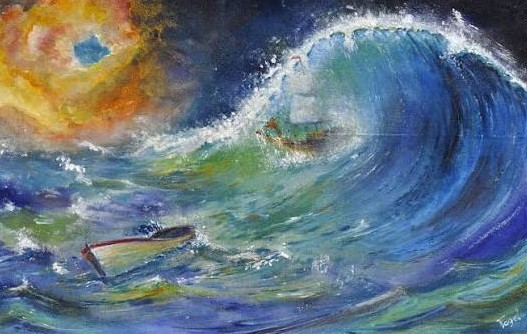
Along with The Glass Confessional, whose translation we already published in May, Senior wrote, at the same time as the 1988 consecrations, another article, Lost at Sea, which we present today.
***
Cum sero esset, erat navis in medio mari, et Jesu solus in terra.
St. Bede comments on this verse from the Gospel of Mark, chapter six. The boat, he says, is the Church, which seems to be abandoned by Our Lord in the midst of the storms of external persecution and internal corruption. “And it is well said that the boat is in the midst of the sea and He alone on the shore: for sometimes the Church not only suffers great oppression from the pagans, but is corrupted (foedata est), so that, if it were possible, it would seem that the Redeemer had completely abandoned her for a time.” Nevertheless, let us take comfort, he says, because, although Our Lord delays the hour, He will come, having destroyed His adversaries as He calmed the raging sea. Meanwhile, the faithful cry out with the words of David: “Ut quid, Domine, recessisti longe, despicis in opportunitatibus, in tribulatione? Why, O Lord, have You gone so far away? Why do You despise us in our needs, in times of distress?”
When, in the face of a clear and present danger, a captain gives orders harmful to the safety of the ship, the crew must disobey—which is not mutiny, but obedience to the office in which the man has failed. The law remains in force: the crew must follow the captain’s orders; it is not a question of law, but of facts that contradict it: Is the danger clear and present? Is the captain the cause? Thus, in the present Church, the debate does not revolve around papal authority and schism, but around the gravity of the crisis and whether the conciliar popes have provoked it. Catholics, as a rule, of course, do not question authority because, in a monarchical society, government is not a matter for the laity.
Excluding the willfully ignorant who overlook the current chaos in the Church because they have a personal interest in excusing sinful behavior by citing the changes, most good Catholics have accepted the Council and its consequences because it has the approval of three successive popes and the bishops in communion with them. There are naïve faithful who make the best of the changes, joining charismatic prayer groups, waving banners, distributing communion as lay ministers, but most accept it reluctantly, deploring the excesses, never volunteering, yet enduring the change to the point of overlooking scandals in the clergy, assuming the Pope is doing all he can and blaming some bishops, perhaps, when scandals come to light, but applauding passages in ecclesiastical decrees that seem to reaffirm (ignoring others that are contrary or ambiguous) and, ultimately, considering everything—good and bad—as essentially good, grateful for what remains of the saving essence.
Against the usual Catholic docility, a small number of dissidents, convinced that it is the popes themselves who are sinking the ship, have taken to the lifeboats; that is, disobeying orders, they have fled to traditional Mass centers.
Behind these firmly convinced Catholic decisions lies the great dilemma of our time: two certain truths in conflict: 1) It is an absolutely certain dogma that the indefectible Church is founded on the Pope, who is infallible in matters of faith and morals. 2) Nevertheless, it is true that, through ambiguity, insinuation, or omission, the conciliar popes have taught error, fostered immorality, and permitted—if not promulgated—liturgies harmful to the faith. To obey the Pope, and even if under the indult one does not participate, implies tacitly accepting heresy, immorality, and sacrilege; fleeing to Mass centers exposes one perhaps to the danger of falling into schism, if one is not already in that state. Damned if you do; damned if you don’t. In serious matters, when action must be taken and neither option is good, the lesser evil is chosen. What is worse, disobeying the Pope or committing sacrilege? The difference between the most visible opposing factions of the traditional cause—between the Fraternity of Saint Pius X and the Fraternity of Saint Peter, for example (though they are not the only ones)—does not lie in doctrine or canon law, but in the situation, temperament, and intuitive sense (the “hunch”) that underlies the level of debate, where the evidence is not clear, but seems one way to some and another to others: How bad are the bishops? Is the Pope a victim or the cause? Is the New Mass sacrilegious or simply celebrated irreverently and in poor taste?
Ending the debate with a preemptive attack from theology and arguing that, since the Church is indefectible, no Pope can promulgate a liturgy harmful to the faith, overlooks Cardinal Newman’s distinction between notional knowledge and real knowledge. Abstract truths must be applied—not imposed—on concrete circumstances. Or, as St. Thomas says, truth is not in the mind, but in the relation of the mind to the thing; it is not in conceiving, but in judging. It is the error of the notionalists to believe that abstract formulas can dictate human actions without taking circumstances into account, just as it is the error of extreme realists to believe that human acts are merely circumstantial (situational). Revelation assures us that all popes, like Peter, possess the indefectible grace of their office. But, since laws are general and not particular, it does not follow that every pope will have this grace in every act; there have been popes who have been in error for a time and have been corrected; it is possible that several successive popes may be in error and cause harm to the Church—and it is also true that they will be corrected and that the Church will survive despite the harm. Without any detriment to the law, the fact is that we now find ourselves in that interval, the ship is in great danger, and Our Lord is on the shore.
The position that, since the Church is indefectible, the New Mass must be Catholic and good is like Newton’s theory of gravity: true only in a vacuum. If you throw a pound of feathers and a pound of iron from the Leaning Tower of Pisa, even on a calm day, and much less in the middle of a whirlwind, it is evident that both will not touch the ground at the same time; and in the churches one actually attends, since no one celebrates Mass exactly as it was promulgated, it is not a question of law, but of how much it has deviated; and in judgments of this kind, where there is no absolutely certain evidence, men of good will may disagree, influenced by their temperament, deciding on the basis of experience, emotion, and the estimative sense, as when trusting a friend or following a hunch. When Archbishop Lefebvre faced the dilemma of ordaining bishops or signing an agreement, although he never questioned the Pope’s authority, he did not trust him. Ordaining bishops without papal consent does not entail excommunication—if it is necessary to save the sacraments from a modernist mafia occupying Rome—just as legitimate mutineers are not subject to court-martial if they disobey a dangerous captain. Judgments like these are colored by temperament. The sanguine and the phlegmatic tend toward tolerance. When flies buzz or altar boys distribute communion in the hand, they frown to shoo them away, annoyed, but even more annoyed with those who complain. The choleric and the melancholic, prone to anger or sadness, will not even set foot in a church that offers communion in the hand.
If we were in the political sphere, presenting plausible arguments according to the rules of polite discourse, both would agree that, for example, although communion in the hand, if done without sufficient reason, is a sign of disrespect, still, just as the laity would rescue the sacrament from fire, it might be that, in the face of a shortage of priests, they help in crowded Masses or with the sick. But we are not in polite discourse. In the present Church one must confront teaching and liturgical practice contrary to the faith; the question is how far it departs from it and how firm each one’s resistance is. How safe it is to stand firm: for some it is much, for others less, especially for children, who are easily influenced and lack any memory of tradition. Without questioning either authority or the facts, some submit by giving the benefit of the doubt to the hierarchy; others withdraw on the grounds that, while a doubtful conscience does not bind, an act foreseen as doubtful must be avoided.
Certainly, there is no room for sentimental evasions of the “the Pope doesn’t know” type. The changes took place under his mandate; he is responsible for what his subordinates have done, not to mention his own voluminous work. No matter how much one tries to reconcile this with infallibility or indefectibility, one would have to deny the validity of one’s own senses to think that the Pope and his advisors teach what the Church has always taught. Phenomenologists think that all truth, both conceptual and real—including dogmas and facts—evolves; in a word, that there are neither dogmas nor facts (there are no “things”), that everything becomes and nothing is. According to their dialectical theory of history, it is sometimes necessary to take a step back—as in allowing the traditional Mass—to take two steps forward—toward a “fused” Mass, which will eventually accommodate all the peoples and creeds of the world. There are men of good will who believe that, even so, they can use their own dialectic against them by taking advantage of the indult, regardless of the reason for which it was granted, to weather the storm until an orthodox pope is elected and, since, according to phenomenological theory, the Council fathers proceeded by juxtaposing opposites in ambiguous statements, it is possible for them to defend the affirmations by ignoring heretical intrusions such as “collegiality” and “religious freedom,” rejoicing in the positive teaching of Humanae Vitae, ignoring the legal loophole that natural family planning offers for birth control, or celebrating the indissolubility of marriage against radical reinterpretations of annulments.
Without evidence solid enough to present in court or even to convince in political debate, we argue through metaphors: a mutiny in the face of a shipwreck or, to give another example, separation (though not divorce) in marriage: a Pope is like the father of a family, the Church is his wife, our mother, and the faithful, we, his children. Now, when a father strikes his wife, what do good children do? Little or nothing if it is a mild and sporadic offense. They may even endure considerable and repeated grievances; after all, whatever happens, he is our father. But as the frequency and violence increase, the “whatever happens” runs out; a point of resistance arrives and (not definitively, but provisionally until the father is rehabilitated) there is the possibility of fleeing with their mother to a safe refuge. In assessing the current crisis in varying degrees, up to that point, moderates submit to the authority of the Church; those who consider it more serious attend Mass in illicit centers.
Do you submit to the mistreatment in the hope that concessions and promises are a sign of reform, or do you flee, without denying his paternity, but keeping your mother safe for an indefinite time until your father regains his sanity? Between these options there is a question of judgment about how to weigh how bad things are against how much you can bear without running into danger. Today, throughout the Catholic world, the faithful are taught—through preaching, teaching, example, and liturgy—that one religion is as good as another, that sin is subjective, that hell, if it exists, is empty, that the Fall was a defect of the species (humanity), not of a specific person (Adam), and that the Redemption is the evolutionary divinization of the species (not the work of Jesus Christ), that marriage is dissoluble (through annulment, not divorce); the list is long, but all these things are taught explicitly by progressives and implicitly by conservatives, especially through ambiguity and omission in the New Mass and the Catechism. The result, as opinion polls show, is that Catholics’ views on matters of faith and morals are the same as those of everyone else; the clergy—including bishops and popes—are, in fact, at the forefront of the anti-Catholic advance. Depending on their temperament and circumstances, some men of good will stick to licit permissions, hoping for better days, while others flee to illicit centers, also hoping for better days.
Meanwhile—and this is the moral of the story for now, in the heat of battle—both sides should stop shooting at each other so much and find ways to unite to fight the common enemy of modernism. In the various particular circumstances that arise throughout the world, men of good will will make different prudential judgments and reach different practical conclusions, while still agreeing on the fundamentals. So, although perhaps He is not with us, but on the shore, we can be sure that someone will speak to Him on our behalf, as on another occasion, “the mother of Jesus said to Him: ‘They have no wine.’”
***
John Senior, his son Andrew affirms in the prologue to his final essays, “fully and unreservedly approved and supported his decisive and historic act of 1988, and this was confirmed more deeply with the passage of years. He became increasingly convinced of the reality of a state of crisis and of the extraordinary need to ‘resist Peter to his face’ (Gal 2:11–14).
He never accepted the new Mass. As he wrote in The Restoration of Christian Culture: “From the liturgical point of view, the new Catholic Mass established in the United States has been a disaster.” He was in complete agreement with the oft-quoted words of The Ottaviani Intervention: “The Novus Ordo represents, both as a whole and in its details, a remarkable departure from the Catholic theology of the Mass as formulated in Session XXII of the Council of Trent.” And the words of Archbishop Marcel Lefebvre: “The Novus Ordo Missae, even when celebrated with piety and respect for liturgical norms, is imbued with the spirit of Protestantism… it carries within it a poison harmful to the faith.”
In the early stages, when the changes had not yet taken place and simply because there was no alternative, he endured it for a time, but as soon as there was an alternative, he immediately voted with his feet, and with his body and soul. He was extremely grateful to the Fraternity of Saint Pius X for continuing to offer the Mass and the sacraments, and to Archbishop Lefebvre personally. “He may have lived for a time with the New Church, may have suffered under it, but he will not die in it.” On another occasion he said: “If they do not celebrate a fully traditional Requiem Mass for me, I will sit in my coffin and complain.” Deo gratias, he did not have to! He gladly attended Mass at the FSSPX chapel of Saint Mary and was happily buried there.
The crisis of the Catholic Church is more serious today than in 1988, the time of the first excommunication. After 12 years of Bergogliato, the ecclesiastical hierarchy has lost even more credibility and Catholicity. There have been Amoris Laetitia, Fratelli Tutti, Fiducia Supplicans, and Dignitas Infinita, which have not been repealed. In his last year of life, Bergoglio devoted himself, like Phileas Fogg in a white cassock, to traveling the world announcing that all religions were equally valid paths to God. Leo XIV is not John Paul II either (I cannot quite see whether he is a wolf in sheep’s clothing or a nonentity), and “Trucho,” obviously, is not Ratzinger. The great paradox is that the one who should be excommunicated, the kissing cardinal, excommunicates a fraternity that, as the blogger Wanderer points out in an article last Monday, simply upholds the principles of faith and liturgy that the Church upheld for twenty centuries; nothing more, without adding or subtracting anything.
Wanderer warns in his article of the danger that the FSSPX priories may become isolated and the faithful no longer take an interest in what is happening in their dioceses or in the universal Church. I am not a Lefebvrist, but I have no problem attending traditional Mass in their chapels or at any celebration of the Mass of all time, whether permitted, tolerated, or in the catacombs. And, like so many Catholics, I am not interested in the antics of my bishop, nor those emanating from the diocese, nor most of those invented in Rome. Because they are harmful to the faith. Disaffection is caused by those who depart from the faith, who persecute those who remain faithful. The Church is undoubtedly in a state of necessity. As Monsignor Pagliarani, Superior of the FSSPX, stated, most parishes do not offer the tools for the salvation of souls.
The speed of the note issued by the Congregation for the Doctrine of the Faith suggests, however, that it was already written. Those who called for prudence from the FSSPX, will they now call for it from Leo XIV? It is true that the Fraternity threw down the gauntlet of the consecrations as soon as he sat on the Chair of Peter. But he, newly arrived, has also not shown at any time the desire to meet personally with these sons of his. He has shown himself rather as a coward, hiding behind his heretical prefect. I cannot discern whether Prevost is a wolf in sheep’s clothing or a nonentity in the Vatican, but I ask the Lord that the Pope reconsider and welcome this numerous fraternity of his sons—bishops, priests, religious of both sexes, and lay faithful—as a Father, because his mission, as successor of Peter, is to shepherd the flock of Christ and lead it to the sources of Salvation. May the Pontiff reread the words of Gamaliel in Acts 5: if this work is of God, you will not be able to overthrow it. And take care, lest you find yourselves fighting against God.
Note: Articles published as Tribuna express the opinion of their authors and do not necessarily represent the editorial line of Infovaticana, which offers this space as a forum for reflection and dialogue.