


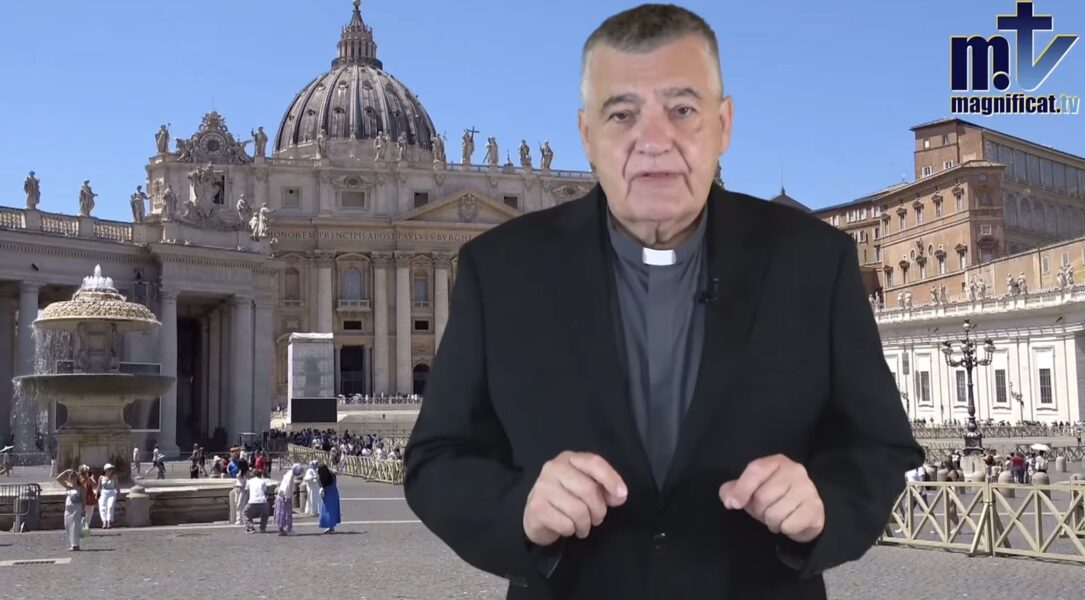
I deeply admire Father Santiago Martín. I watch all his videos, learn from almost all of them, and am convinced that the Church would be a more habitable place if there were more priests like him. Precisely for that reason, I owe him the frankness of saying that his latest video on the Écône consecrations rests entirely on a phrase, and on a reading of that phrase which I believe is mistaken. I will not discuss here whether the state of necessity invoked by the Society of Saint Pius X justifies what it did, nor whether the Roman response was the appropriate one. I will discuss what it means to be imbued with something, because on that verb, and on nothing else, the entire argument of the video hangs.
The facts, first. On July 1, in Écône, the Society consecrated four bishops without a pontifical mandate, despite the public plea that Leo XIV had addressed to them days earlier asking them to reconsider their decision. At the moment in the rite when the apostolic mandate is read, the secretary general read in its place a declaration, which the Society itself has published, whose central phrase states that, from the Second Vatican Council to the present day, the authorities of the Church are “imbued with a spirit contrary to that of the Faith and act against Sacred Tradition,” supported by Saint Paul’s warning to Timothy about those who will not endure sound doctrine. The following day, the Dicastery for the Doctrine of the Faith noted that the six bishops involved had incurred ipso facto excommunication latae sententiae for an act of a schismatic nature, placed the ministers of the Society in schism according to canon 1364, and referred the situation of the laity to the criteria of formal adherence established in 1996.
Father Martín maintains that that phrase was the trigger for the Roman severity and that with it the Lefebvrians, “although not formally,” had just excommunicated the entire Catholic Church. From this he deduces that for Écône all the popes since the Council are heretics, and all the bishops, including Burke, Sarah or Müller, and all priests and deacons—“we are authorities of the church,” he says, including himself: “we are heretics”—and from there, pushing the logic to its limit, Padre Pio, Saint Josemaría, Mother Maravillas or Teresa of Calcutta. The deduction is effective, even moving. It has only one problem: it refutes a reading, not a text. And the reading was constructed by him.
Let us turn to the verb. “Imbue” comes from imbuere: to soak, to impregnate, to imbibe. To be imbued with something is a state, not an act; it is predicated of one who has breathed an air, not of one who has signed a thesis. No one imbues himself: one is imbued as one is soaked, by exposure and not by decision, and for that very reason imbuement admits degrees—one is more or less imbued—and does not require awareness, much less pertinacity. Heresy is exactly the opposite. Canon 751 defines it as the pertinacious denial, after baptism, of a truth that must be believed with divine and Catholic faith: a propositional, personal, formal, obstinate act. Between a climate that saturates and a denial that obstinately persists lies the distance that separates a diagnosis from a sentence. Father Martín crosses it in a single step, and he himself records the leap: that “although not formally” he introduces at the beginning is the confession that the text does not formally do what he is going to spend twenty minutes saying it does.
The Écône phrase also contains two predicates, and fusing them is the video’s second error. “They are imbued” describes a state; “they act against Sacred Tradition” points to acts, and acts are discussed one by one, with dates and documents, as has been done for sixty years. The video fuses both into a third that the text does not contain: “they are heretics.” And there is a detail of the ceremony itself that disarms this fusion from within: that same morning the four candidates swore in Latin “to fight against schismatic heretics.” The word heretic was available in Écône on July 1; it formed part of the liturgical vocabulary of the day. For heretics they used it; for the authorities of the Church they wrote something else. Whoever has the word at hand and chooses not to use it is saying something by that choice.
The subject remains. Who are the authorities of the Church?, Father Martín asks, and answers by broadening the scope: the popes, the bishops, the priests, the deacons, the foundresses, himself. But a text whose function is to justify certain episcopal consecrations that were denied points with “the authorities” to the one who denies them: to Rome, to the authority that grants or refuses mandates. I grant what must be granted: the text read in Écône in 1988 spoke of the authorities of the Roman Church, and in 2026 the adjective has fallen, which gives the broadening a foothold it would not have had then. But between “the authorities of the Church” without an adjective and all the priests and deacons on the planet since 1965, and from there to the foundresses of orders, lies a stretch that is only covered by wanting to cover it. Father Martín covers it entirely and, upon reaching the end, finds himself among the heretics. Écône did not put him there; he put himself there.
“They did not say some, they said all,” the video insists. Strictly speaking, they said neither the one nor the other. “The authorities of the Church are imbued” is a generic plural, the grammatical form of structural accusations: as when one says that banking speculates or that politicians lie, one imputes to a body a dominant spirit without taking a census of each individual. One may discuss whether the structural accusation is just; what cannot be done is to turn it into a distributive judgment on every soul that has occupied an ecclesiastical office since 1965 and then be scandalized by the judgment one has oneself fabricated. Father Martín himself demonstrates that the dispute is one of quantifier and not of concept when, minutes later, he states without blinking: “it is true, unfortunately, that some authorities of the church are imbued with liberalism, with modernism.” The predicate seems true to him; only the scope seems excessive. Very well: then the discussion is not whether the phrase excommunicates the Church, but how much of the Church it covers. That is not excommunicating the Church; it is discussing a percentage.
Because the phrase, in its weak version, is true, and it is true with credentials that no Catholic can reject. When Saint Pius X published Pascendi he did not place the modernists outside the Church, but in its very bosom, among the priests, and warned that for that reason they were more dangerous. When Paul VI spoke of the smoke of Satan he did not smell it in the street: he smelled it inside. When Cardinal Ratzinger denounced the dictatorship of relativism on the eve of his election he was not describing a phenomenon foreign to the temple. If diagnosing that a contrary spirit has penetrated the authorities of the Church were equivalent to declaring it heretical, the first excommunicator of the Church would have been Pius X in 1907. And let us say it completely: we are all imbued, some more than others, with modernism, with emotivism, with a certain moral relativism. I first, and the reader who believes himself immune, second. There is no traditionalist trench that filters the air of the century: it seeps into nostalgia just as into novelty. The question was never whether the water entered the ship—the very Father Martín recalls in the video that the water is not lost only through one part—but how much there is and in which holds.
And the fact is that Father Martín subscribes to the weak version with more energy than almost anyone. For years, he says, he has been repeating that tolerance of evil is a cancer for the Church. In this same video he laments that cardinals from Munich or Brussels continue to bless what the Pope has asked them not to bless and that “nothing happens here”; he acknowledges “an atmosphere of tolerance toward those who are imbued.” A man who says all that does not reject the diagnosis of imbuement: he shares it, he preaches it and he documents it with more precision than Écône. What he combats is something else: the universal, distributive and formal reading that he himself erected upon the phrase, the one in which he too turns out to be a heretic. Against that reading he is entirely right. Only that reading is not in the text; it is in the video.
“At last they have come out into the open,” he also says: what they murmured “in a low voice in their most intimate circles” would now be public. The newspaper archive says otherwise. The 2026 declaration is an almost literal re-reading of the one read in Écône on June 30, 1988, at the same point in the rite, with the same function of supplying the mandate and with the same citation from the Second Letter to Timothy. That one stated that the authorities of the Roman Church were “animated by the spirit of modernism” and acted against Holy Tradition. For thirty-eight years that accusation has been in print, and on Wednesday its updated version was read before thousands of faithful—16,500 according to the organizers—and with a broadcast translated into six languages. Nothing has been uncovered: it has been reissued. The only real novelty is in the wording, and it is not the one the video analyzes: where 1988 named a concrete and condemned error, modernism, 2026 writes a spirit contrary to that of the Faith, a formula at once vaguer and more serious; and where 1988 specified “Roman,” 2026 does not. If anything deserves to be examined as a hardening, it is that mutation. That video has yet to be made.
The causal thesis remains: everything would have been different, Father Martín maintains, without “this declaration of heresy.” But if there was no declaration of heresy—and there was not: there was a declaration of imbuement, which is a different thing, as has been seen—the explanation is left without a cause. The decree of the 2nd, according to its own text, does not punish a phrase: it notes an act of a schismatic nature, the episcopal consecration without a pontifical mandate and against the will of the Pope. And since we are speaking of the weight of words: it is also not accurate that Rome has excommunicated “all the associated laity,” as the video claims; the Note refers the situation of the faithful to the criteria of formal adherence of 1996, which require attention to the intention of each person and judgment case by case. Whoever asks for precision in reading Écône must also apply it when reading Rome.
In the end I suspect that Father Martín and I believe the same thing: that the spirit of the age is inside, some more than others; that tolerance of evil is a cancer; that recognizing the disease is not excommunicating the sick person. Our disagreement is lexicographical, and lawsuits against the dictionary are always lost. To be imbued is not to be a heretic: it is to be soaked, and from that rain no one has been spared, neither in Rome, nor in Écône, nor at Magnificat TV, nor in this editorial office. Words weigh what they weigh, not what they hurt.