


By Fr. Raymond J. de Souza
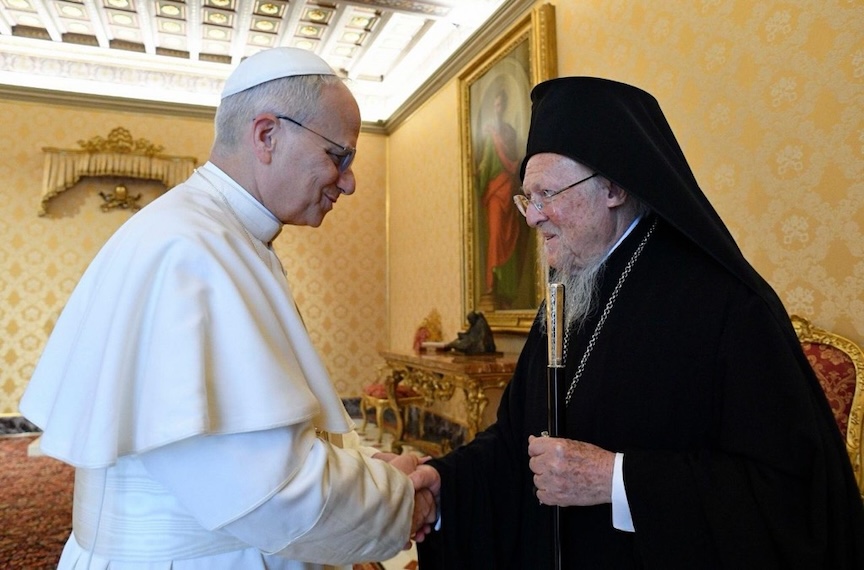
The cardinals attending the extraordinary consistory in Rome will depart today, just as the usual delegation from the Patriarchate of Constantinople arrives for the solemn feast of Peter and Paul.
It is an annual fraternal custom. A delegation from Rome visits Constantinople for the feast of St. Andrew on November 30. Last year, Pope Leo XIV personally led the delegation in the context of the 1700th anniversary of the Council of Nicaea. On June 29, the Successor of Andrew sends representatives to the Successor of Peter.
The Year of Our Lord 2026 included a unique moment in the warm relations between Rome and Constantinople under Patriarch Bartholomew, who is already the longest-serving patriarch of Constantinople in history. His thirty-fifth anniversary falls this October.
The visits of Andrew to Peter are now routine. But three months ago something unique occurred. Bartholomew occupied Benedict’s seat.
The Institut de France is itself a unique entity, conceived as a kind of repository and custodian of French culture. It houses five prestigious academies for scholars, scientists, writers and artists, analogous to the Royal Societies of the countries of the British Commonwealth or to the pontifical academies in Rome. Yet it is more central to France’s intellectual culture than those counterparts.
One of the academies is that of Moral and Political Sciences, which includes foreign associate members.
When invited to join, a new member is assigned a specific “seat,” which he occupies for life. After admission, the new academic is invited to deliver a speech that, by custom, includes a eulogy of the previous holder of that seat. This year, Patriarch Bartholomew was admitted to the seat formerly occupied by Cardinal Joseph Ratzinger since 1992 and which he retained until his death on the last day of 2022.
“It reveals not only the continuity of an academic tradition, but also the spiritual bond between Rome and Constantinople, between Old and New Rome,” Bartholomew noted.
The seat that passed from Benedict to Bartholomew is noble; Ratzinger’s predecessor was the great Russian scientist, dissident and witness to conscience, Andrei Sakharov.
There is more than a little sadness in that sequence today. The seat occupied by the bishop of First Rome and now of Second Rome was held by a Russian before them. Today, the bishop of Third Rome—the Patriarch Kirill of Moscow—is no longer in communion with Bartholomew. By blessing Vladimir Putin’s war against Ukraine, in which Orthodox Christians kill one another within the same flock that Kirill presides over, the Patriarch of Moscow has become an anti-witness to the Gospel. There is a long way down from Sakharov, the conscience of Russia, to Kirill, the corrupter of the Russian conscience.
In his 1992 speech in praise of Sakharov, Ratzinger noted that after 1968 the Soviet regime excluded the physicist from work related to state secrets. Marginalized in that way, “from that moment his mind focused on the question of human rights, on the moral renewal of the country and of humanity, and more generally on universal human values and the demands of conscience.”
“He, who so loved his country, had to become the accuser of a regime that pushed people into apathy, weariness, indifference, that made them fall prey to external and internal misery.” Ratzinger continued:
It could be said, of course, that with the fall of the communist system Sakharov’s mission has been fulfilled; that it was an important chapter of history that now belongs to the past. I believe that reasoning in this way would be a grave and dangerous mistake. First of all, it is clear that the general orientation of Sakharov’s thought concerns human dignity and human rights. Obedience to conscience, even at the cost of suffering, is a message that loses none of its relevance, even when the political context in which this message had acquired its special relevance no longer exists.
Today in Russia, officials both of the Church and of the State face a struggle of conscience under the leadership of Putin and Kirill.
Consider that Kirill would not even be welcome in France, let alone at the Institut de France. The European Union attempted to sanction Kirill, but the restrictions were vetoed by Putin’s ally, Viktor Orbán of Hungary. With Orbán’s recent defeat, Hungary has withdrawn its veto and the restrictions were proposed again this month in Brussels.
It may be of interest to readers that when Canada banned Kirill and other Russian leaders from entering in July 2022, Russia responded by banning 28 Canadians from entering Russia. This writer headed the list.
Bartholomew’s task was to eulogize Ratzinger, which he did at length with genuine admiration and evident affection. He summarized Ratzinger/Benedict’s long career as a search for truth, without which “freedom becomes arbitrary.”
That search for truth led Ratzinger to look toward the shared riches of Christian history.
“He arrived at an intuition already prepared by the great figures of the ‘New Theology’ and of Orthodox thought,” Bartholomew said. “A return to the Fathers was not a flight into the past, but a rediscovery of the living sources of the faith, attested, on the Catholic side, by Henri de Lubac and Yves Congar, and on the Orthodox side, by the Russian theologians in exile, Georges Florovsky and Vladimir Lossky, who found refuge in the West and opposed—both with their words and with their lives—the totalitarian system of Soviet communism and its interference in the life of the Church.”
Bartholomew presented himself as the steward bringing forth treasures new and old, speaking about the challenges of artificial intelligence with words that Pope Leo XIV would echo shortly afterward in Magnifica humanitas. “In today’s world, where technology and artificial intelligence increasingly shape our lives, there is a risk of reducing truth to calculation or functionality,” Bartholomew said. “The truth of the human person transcends any algorithm: it is relation, revelation and meaning. Reason without truth loses its direction, and freedom without truth ultimately destroys itself.”
Bartholomew in Benedict’s seat is fitting, just as his words are in harmony with the current occupant of the Chair of Peter.
About the author
Fr. Raymond J. de Souza is a Canadian priest, Catholic commentator and senior fellow of Cardus.