


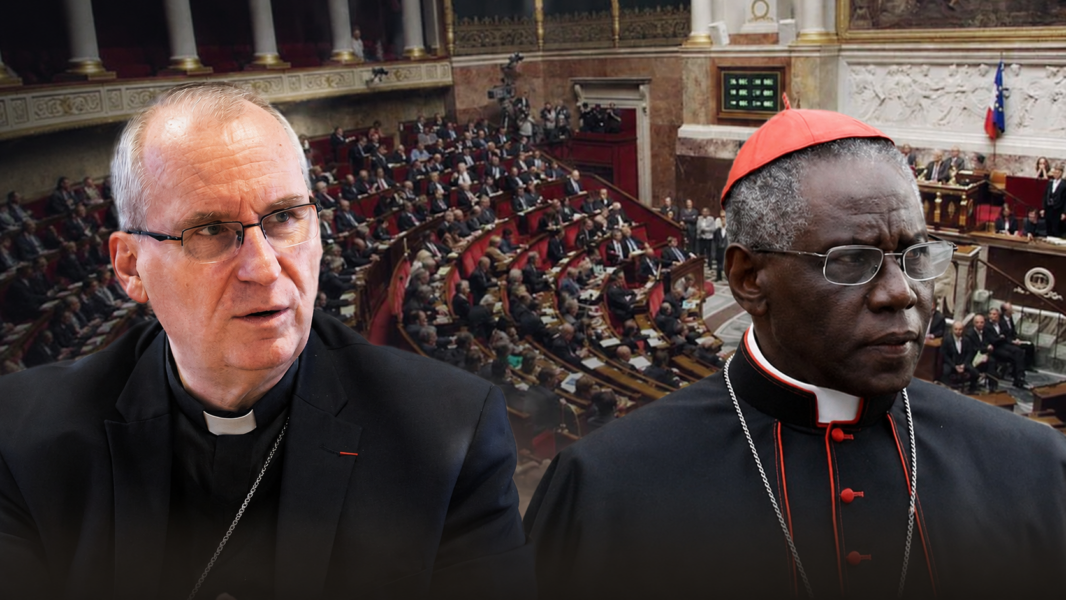
The French Episcopal Conference has intensified its opposition to the bill that seeks to legalize euthanasia and assisted suicide in France with an appeal directed at deputies to reject a text which, in the Church’s view, will profoundly transform the conception of human life and the protection of the most vulnerable.
The vice-president of the French Episcopal Conference and archbishop of Tours, Monsignor Vincent Jordy, has warned that the legalization of euthanasia and assisted suicide does not constitute merely a legislative reform, but “an anthropological change” that will alter the way life, suffering, dependence and death are understood.
“It is a new outlook on life and the end of life that is gradually being prepared to spread throughout the country,” the prelate states, who has urged parliamentarians to act “with conscience and responsibility” before a decision which, he maintains, will have consequences far beyond the specific cases contemplated by the law.
Read also: French bishops call for a novena for life as the euthanasia bill returns to Parliament
A call to legislate with conscience
Monsignor Jordy recalled the famous dictum of François Rabelais—“Science without conscience is but the ruin of the soul”—to warn that an issue of this magnitude cannot be resolved solely through parliamentary majorities or ideological criteria.
The archbishop alerted to the effects that the future legislation could have on healthcare professionals, families, the elderly, people with disabilities and, in general, the most vulnerable sectors of society.
“This law will necessarily influence the way we look at life, at the feeling of being useful or useless within society,” he stated. In his view, the text will also provoke legal and social consequences that will ultimately affect the entire social body.
As an example of this evolution, he recalled the experience of other countries where euthanasia was introduced with significant initial limitations that were later expanded. He specifically cited the case of the Netherlands, where—he pointed out—“a teenager was subjected to euthanasia a few weeks ago,” as evidence that initial safeguards can disappear over time.
“The consensus Macron called for does not exist”
The vice-president of the French episcopate also addressed a message to President Emmanuel Macron, who at the beginning of the legislative process had expressed his desire to reach a broad national consensus.
“Today we know that this consensus does not exist,” Jordy stated. In his opinion, the narrow majority in the National Assembly, the divisions in the Senate and various public-opinion studies show that French society is far from supporting legislation of this kind by a majority when it understands its real implications.
The prelate also took the opportunity to respond to those who believe the Church should not intervene in this debate out of respect for the principle of laïcité.
He recalled that French laïcité guarantees freedom of conscience, religious freedom and the neutrality of the State, but does not require the silence of religious confessions. “Neutrality does not affect society; it affects the State,” he stressed, defending the right of Christians to participate in public debate like any other citizen.
Cardinal Sarah: “A democracy does not decide by itself what is good”
Monsignor Jordy’s warnings find solid support in the reflections of Cardinal Robert Sarah, who in his book 2050, written together with journalist Nicolas Diat, addresses precisely the moral limits of democracy and the responsibility of the legislator on issues such as euthanasia.
For the Guinean cardinal, democratic legitimacy does not automatically make a law just.
“Just because a law has been voted on in a democratic parliament does not mean it is good in itself,” Sarah affirms. Democracy—he explains—constitutes a legitimate form of government, but it does not create good and evil nor can it replace the principles inscribed in natural law.
The cardinal warns against the risk of a “democratic tyranny” that “recognizes no limit to its power and prevents all discussion.” In that scenario, he maintains, political power ends up becoming the sole source of law, detaching itself from any objective reference to the dignity of the human person.
Drawing on the classical philosophical tradition, Sarah cites Cicero to recall that there exists “a true law, in accordance with right reason and nature,” prior to any positive legislation and which no parliament can abolish.
Natural law as the foundation of legislation
The cardinal links this reflection to the words recently pronounced by Leo XIV during the Jubilee of Rulers, when he reminded political leaders that “natural law, universally valid beyond other debatable opinions, constitutes the compass for legislating and acting.”
Without that reference, Sarah warns, “democracy runs the risk of sinking into the swamps of destructive relativism,” becoming what Saint John Paul II defined as a “democracy without values,” susceptible to drifting into forms of totalitarianism, open or covert.
The cardinal concludes that laws “must always respect and promote the human person” and maintains that “a law that does not respect the right to life, from conception to natural death, whatever the condition of the person—healthy or sick, embryonic, elderly or terminal—is not a law in accordance with God’s design.”
A few hours before a vote that could mark a turning point in French legislation, the interventions of Monsignor Jordy and Cardinal Sarah converge in the same warning: the discussion on euthanasia does not affect only the regulation of the end of life, but the very conception of human dignity and the ethical limits that must guide every democracy.