


By Robert Royal
Like many Americans, I have been brushing up on my knowledge of the American Revolution in anticipation of this year’s Fourth of July. And, at the same time, I find myself comparing the Founders’ notions of human dignity with the way the term is frequently used these days, even within the Church.
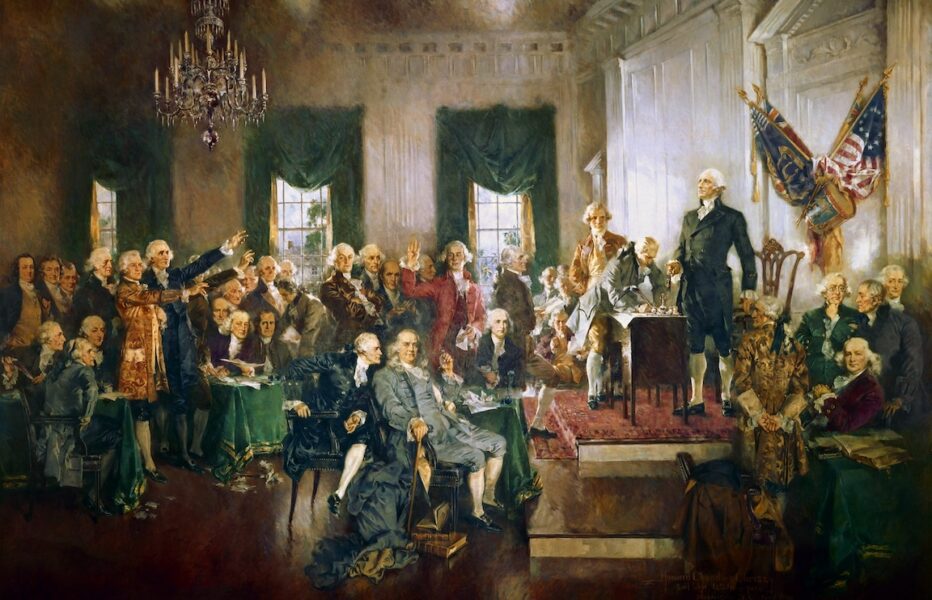
Like most premodern thinkers, the Founders believed that there is something divine in each of us («All men have been endowed by their Creator…»). As the pagan Stoic Seneca—widely read both by the Founders and by nearly all Christian thinkers until modern times—put it: Homo res sacra homini («Man is a sacred thing to man»).
But they were also aware of the other side of the coin: Homo homini lupus («Man is a wolf to man»). It would probably be an exaggeration to say that the Church and the State have forgotten the latter, but it is clear that both have lately been devoting far more praise to «human dignity» than in the past.
In a way, this is understandable: we talk so much about human dignity because there are too many things in our world that deny it. Materialism denies it. So do relativism, skepticism, scientism, communism, consumerism, postmodernism, and most modern psychologies. And all this long before we get to old threats like economic exploitation and political tyranny, and new threats like the «technological paradigm» and its demonic offspring, AI.
Still, replacing one extreme with another is rarely sensible. Both our classical and biblical traditions, rightly understood, looked elsewhere. We talk a great deal, even in the Church, about exclusion and marginalization as if they were the primordial sins against «human dignity.» Yet our civilization once saw the cultivation of virtue and the building of institutions to restrain vices as crucial ways of honoring what is properly human.
Gordon Wood, the recently deceased and justly celebrated historian of early America, argues in his book The Creation of the American Republic, 1776-1787, that the Founders of the United States regarded licentiousness as a threat to liberty second only to slavery.
We have all read John Adams’s remark: «Our Constitution was made only for a moral and religious people. It is wholly inadequate to the government of any other.» And there is also Benjamin Franklin’s equally biting reply to Elizabeth Willing Powel’s question: «Well, Doctor, what have we got, a republic or a monarchy?» «A republic, if you can keep it.» Such sentiments were widespread at the birth of the United States.
In this, Americans followed millennia of human thought that emphasized that virtuous habits—our efforts to conform ourselves to the Good and the Truth within us—are what make us truly free, and what help lead to ordered liberty in society.
Several modern voices with force—especially Josef Pieper, Romano Guardini, Fulton Sheen, Alasdair MacIntyre, Peter Kreeft, and even Jordan Peterson—have risen to recover ancient wisdom, but so far with little effect. What used to be considered one of the main tasks of human life—developing virtues (under God’s grace) in order to live a good life both individually and with others—has almost disappeared from our horizons.
What has replaced that «paradigm» is a bit harder to pin down, but it is something akin to Jean-Jacques Rousseau’s claim: «Man is born free, but everywhere he is in chains.» This absurd proposal suggests that every baby, if only preserved from the distorting influences of parents, church, school, community, etc., would become a virtuous and free human being.
There is a tiny grain of truth in this because all human beings, including babies (as St. Augustine crudely noted in the Confessions), are damaged by Original Sin and pass it on to others. As Freud notoriously showed in secular terms, families can harm us. But Freud had not yet seen what the absence of nurturing families and other natural societies would do to us. That is an experiment in which we are engaged at this very moment, with terrible results.
The Founders spoke much about virtue even before the Revolution, while recognizing the need for social structures to ensure proper freedom. Wood notes that many colonists feared the tyranny of England because they believed that the English people, along with the monarchy, had been corrupted by wealth and power, and that, therefore, it was necessary to restore the English constitution:
Yet all knew that reducing the constitution to its first principles—»restoring it to its pristine perfection»—was impossible if the people themselves had become corrupted and sunk into vice. Until society itself had become infected, until there was «a general depravity of manners, a total alienation of virtue, a people cannot be completely [sic] enslaved.»
We hear much about the death of democracy today. But it is worth noting that the Founders feared pure democracy. They saw what—from antiquity onward—could happen when public life was dominated by the unstable will of mere majorities. For this reason, they designed republican constitutional structures that would allow popular participation, but channel it through different powers—executive, legislative, and judicial—that would check one another.
As formulated in The Federalist No. 51:
If men were angels, no government would be necessary. If angels were to govern men, neither external nor internal controls on government would be necessary. In framing a government which is to be administered by men over men, the great difficulty lies in this: you must first enable the government to control the governed; and in the next place oblige it to control itself. A dependence on the people is, no doubt, the primary control on the government; but experience has taught mankind the necessity of auxiliary precautions.
Government cannot create a virtuous people. That work must be done by families, the Church, schools, and communities. But how well are these institutions fulfilling that task today?
Pope Leo XIV has observed: «If you want to change the world, start by letting God change you.» Very true, but many people today have their own ideas of what God wants, rather than what God has told us He wants.
The Church, with its deeply rooted traditions of the cardinal and theological virtues, the seven capital sins, and the gifts of the Holy Spirit, has a great deal to offer our beloved and ailing American nation on this, its 250th anniversary.
You may also enjoy: Hadley Arkes: Reason, Revelation, and the American Regime George J. Marlin: The American Creed © 2026 The Catholic Thing. All rights reserved. For reprint rights, write to: info@frinstitute.org The Catholic Thing is a forum for intelligent Catholic opinion. The views expressed by the authors are their own.
About the Author
Robert Royal is the editor-in-chief of The Catholic Thing and president of the Faith & Reason Institute in Washington, D.C. His most recent books are The Martyrs of the New Millennium: The Global Persecution of Christians in the Twenty-First Century, Columbus and the Crisis of the West and A Deeper Vision: The Catholic Intellectual Tradition in the Twentieth Century.