


By Stephen P. White
As you surely know—especially since it has been mentioned repeatedly in these pages—the bishops of the United States, in preparation for the celebration of the 250th anniversary of the Declaration of Independence, have consecrated the entire nation to the Sacred Heart of Jesus.
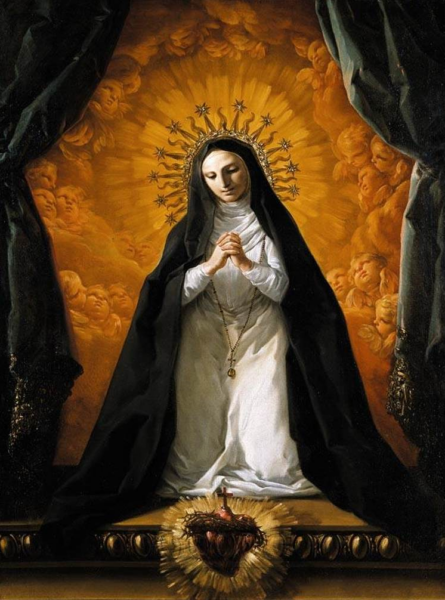
You also surely know, faithful readers of The Catholic Thing, that the image of the Sacred Heart was revealed by Jesus himself to a seventeenth-century French nun named Margaret Mary Alacoque. If you did not know it before, you probably learned it just yesterday thanks to Monsignor Charles Fink’s wonderful reflection on how sacred images, including the Sacred Heart, can captivate the imagination and thus move us toward greater devotion.
What you may not know, but should, is this: the major relics of Saint Margaret Mary Alacoque, the Apostle of the Sacred Heart, will arrive in the capital of our nation just in time for the Fourth of July. They will be available for public veneration at the Saint John Paul II National Shrine in Washington, D.C., from June 29 to July 4.
I mention this for several reasons.
First, I mention it because I work at the Shrine and would very much like everyone who can to come and venerate these relics. But I also mention it because, as Monsignor Fink observed yesterday regarding sacred images, I believe that Catholic veneration of relics offers a path to deeper devotion. Venerating the holy bodies of the saints is a powerful antidote to the gnosticism of our disembodied age.
Relics are a powerful reminder that we are all, so to speak, in the same story.
Any ancient artifact can, on a natural level, remind us that we are all swept along by the same current of time: you, me, George Washington, Cleopatra, and Nebuchadnezzar. We might as well include mastodons and dinosaurs while we are at it. But the relics of the saints are more than mementos, more than fossils or museum pieces, however fascinating those objects may be.
Relics remind us both of the fact of our mortality and of the precious examples of holiness and devotion. And they remind us of the promise of the resurrection.
Relics remind us that the action of grace is not sporadic or scarce, but permeates the whole of human experience across time and space. Relics remind us that we are united in the same great drama that has been unfolding, under the providence of God, throughout all of history. In this way, the sacred relics of the saints make present to us those who share our same mortal destiny and immortal destiny.
Above all, relics are sacramentals, which means they are not mere reminders of something interesting or moving; they produce spiritual effects in imitation of the sacraments themselves.
Yes, there is something slightly strange, a bit macabre, and even, I dare say, gothic about our Catholic relics (as a recent visit to the Capuchin “church of bones” in Rome reminded me). It is also the sort of thing that those of us who claim to believe in the reality of the Incarnation ought to do. And it is precisely the sort of thing that we, who profess to “look forward to the resurrection of the dead,” ought to do!
The saints, of course, are not abstractions or disembodied ideas. They are neither angels nor mere memories. The saints were flesh, blood, and bone, just as God himself was in Jesus Christ. They were real people who lived and died in concrete times and places. Moreover, the saints, the saints of God, are very much alive in Christ because, as our Lord himself insisted: “He is not the God of the dead, but of the living.”
That is why the veneration of relics is such a good thing. The bodies of the saints are the bodies of those who are united in Christ, who have died in Christ, and who will rise in Christ. The saints, in their earthly lives, carried the love of God into the world through their bodies. And they continue to be instruments of God’s grace now that those saints have been raised to eternal life.
As Jesus told Saint Margaret Mary Alacoque, His work is carried out through His servants, His love is spread through us:
My Divine Heart is so inflamed with love for men, and for you in particular, that, no longer being able to contain within itself the flames of its burning charity, it needs to spread them through you and manifest itself to them in order to enrich them with the precious graces of sanctification and salvation necessary to draw them out of the abyss of perdition.
Each of us is called to be a conduit of God’s grace and love, to spread them through us. That is what it means to be a disciple. That is what it means to be a Christian. And, lived faithfully to the end, that is what it means to become a saint.
One might even say that we should all aspire to become relics: to live this life so conformed to our Lord that, once we pass into the next life, our mortal remains may continue to be occasions for the outpouring of God’s blessings and grace.
If you can, visit the relics of Saint Margaret Mary Alacoque. Venerate them. And pray, through her intercession, for this great nation of ours.
The relics of Saint Margaret Mary Alacoque (traveling under the custody of the Knights of Columbus) are currently available for veneration (June 24–27) at the Blessed Michael McGivney Pilgrimage Center in New Haven, Connecticut. After their visit to the Saint John Paul II National Shrine in Washington (June 29–July 4), the relics will travel to the Basilica of the National Shrine of the Assumption of the Blessed Virgin Mary in Baltimore (July 5–6) before returning to New Haven, where they will again be available for veneration until July 18.
About the Author
Stephen P. White is executive director of the Saint John Paul II National Shrine and a fellow in Catholic Studies at the Ethics and Public Policy Center.