


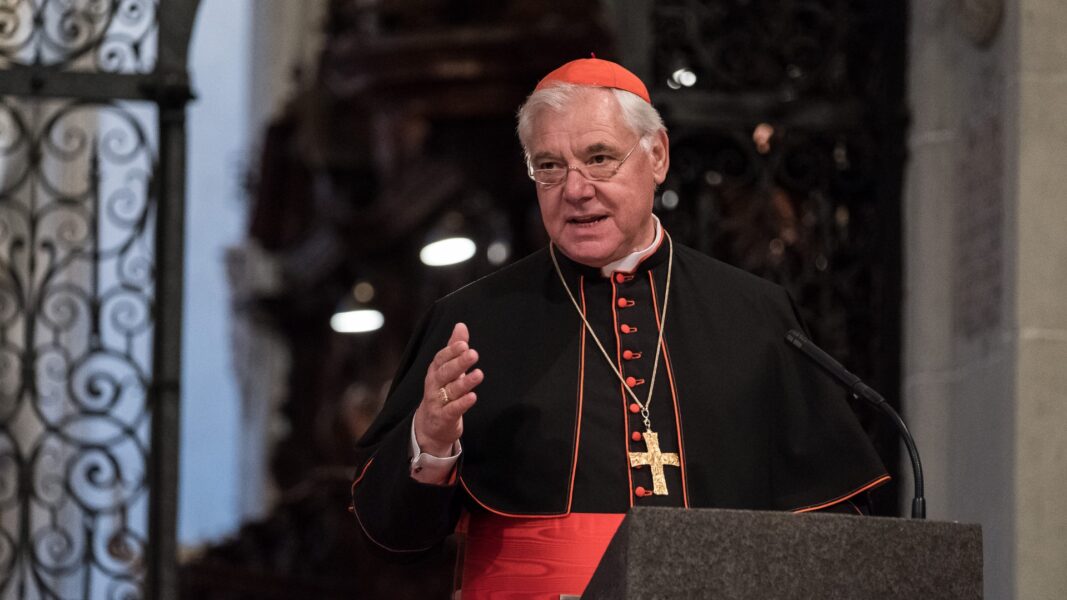
The Vatican journalist Diane Montagna has published the full text of the intervention delivered by Cardinal Gerhard Ludwig Müller during the extraordinary consistory held in the Vatican on June 26 and 27. Until now, only some of the main points of his intervention had been made public, especially his call to respond clearly to the challenge posed by the Priestly Fraternity of Saint Pius X (FSSPX) and his proposal to create a commission inspired by the former Ecclesia Dei. The complete document now allows us to understand the full scope of the reflections that the emeritus prefect of the Dicastery for the Doctrine of the Faith addressed to Pope Leo XIV and the College of Cardinals.
We provide below the full text:
INTERVENTION AT THE EXTRAORDINARY CONSISTORY OF CARDINALS
Cardinal Gerhard Müller
Rome, June 26, 2026
1. I thank the Holy Father for having reaffirmed the fundamental role of the College of Cardinals for the universal Church. From Irenaeus of Lyons to the First Vatican Council, the primacy of the Pope was not understood as if it belonged to an isolated individual, but as the primacy of the Church of Rome, whose Bishop is at the same time the visible head of the entire Catholic Church. This served to prevent isolating him from the Church. As Bishop of Rome, he is always the head of the college of the suburbicarian bishops, as well as of the Roman presbyters and deacons. There is, certainly, a broad external collegiality of the Pope with the bishops of the other Churches; but there is also an internal collegiality, inasmuch as every bishop is always in communion with his own presbyterate, as Saint Ignatius of Antioch affirms. A part of the Roman clergy was institutionalized in the College of Cardinals, not for the pastoral care of the diocese of Rome, but as an instrument that the Pope uses for the governance of the universal Church.
From this perspective, it is also fitting to reflect on the way in which a consistory unfolds. In all representations and photographs of the councils, discussion in plenary session appears. Consequently, the free exchange of opinions, preceded by carefully prepared interventions, should precede the work in groups and be granted a greater space than is currently allowed. In any case, the new method deserves further reflection, taking into account the nature of an ecclesial assembly of cardinals and bishops with the Pope, as well as that of the bishop with his presbyterate and with the councils of the laity.
2. The Priestly Fraternity of Saint Pius X has sent an open letter to all the cardinals. It is our duty, by virtue of our office, both individually and as a college, to reject the scandalous accusation that the Church of Rome has departed from the Catholic faith. In the face of the schismatic act of an episcopal consecration carried out without the prior grant of communio with the Pope, there can be no ambiguity. In pastoral and liturgical matters, one may proceed with pastoral sensitivity. I propose the creation of a commission, following the model of the former Ecclesia Dei, to allow those who have embraced this schismatic position to return to full communion with the Pope. But the boundary of schism is definitively crossed when the ministry of the Bishop of Rome is violated, the visible principle and permanent foundation of the unity of the Church in revealed truth. During the Council of Trent, the eminent Polish cardinal Stanislaus Hosius said to the Protestants of his time—and his words apply equally to the Lefebvrists of our time—:
Catholicus non est, qui a Romana ecclesia in fidei doctrina discordat.
He is not Catholic who disagrees with the Church of Rome in the doctrine of the faith.