


By Msgr. Charles Fink
It is a common observation that most people think more easily in images than in abstract concepts, and that stories move and transform us in ways that logical arguments often do not. God, who of course knows this, has revealed Himself to us, as C.S. Lewis said, by writing Himself into our story—being, so to speak, at once the author of the whole and a character in the play—and, over the centuries, bequeathing to us a series of vivid images that, as the saying goes, are worth more than a thousand words.
Three of these images are closely related, even though great spans of time separate the Divine Artist’s production of each. The first and oldest is the Crucifix, which depicts the death of Christ on the Cross. How strange that it adorns our churches, our homes, even our own persons, being as it is the symbol of such tragic human folly and brutality, and a reminder of what we are all capable of in our worst moments.
And yet, it is also a reminder of God’s willingness, out of incomprehensible love, to absorb all the worst we can inflict upon Him, rather than using His infinite power to give us what we deserve. What we have here, then, is a symbol of inexpressible love and mercy on God’s part and of boundless sin on ours. Can we learn more about God and human nature by contemplating the Crucifix than by reading dozens of books on theology and psychology?
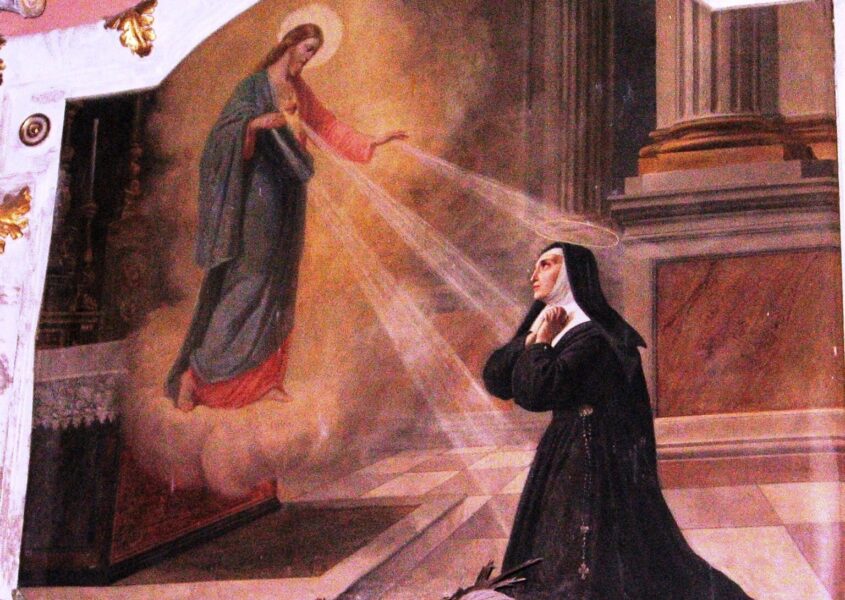
But God is also aware of our unfathomable capacity to take even the best gifts for granted and to trivialize even the most sacred and profound things, not to mention the variety of human temperaments that make one image transformative for some and less so for others. Many centuries after Christ was crucified, and with crucifixes already everywhere, Jesus appeared to a simple Visitation nun in seventeenth-century France.
What He revealed to St. Margaret Mary Alacoque was the image of His Sacred Heart, encircled with thorns, surmounted by a cross, bearing a wound—the result of the centurion’s lance—and all ablaze with flames of love. He answered the rigorism and melancholy of Jansenist heresy with an image. It told the same story as the Crucifix, and still does, but with a different emphasis, directing our attention even more clearly to Christ’s sacrifice as an act of love, taking pity on humanity’s waywardness and insensitivity.
Our bishops have just consecrated the United States to the Sacred Heart of Jesus in preparation for the 250th anniversary of our founding. If this leads to nothing more than a renewal among our Catholic people of devotion to the sacrificial Heart of Jesus and to living the Two Great Commandments with greater fidelity, the Church and the nation would surely be much the better for it.
I wonder whether even our Protestant brothers and sisters might benefit from adopting this visual reminder of our Lord’s love. In some circles they already seem less hostile than in the past toward Catholic sacramentals; for example, in the distribution of ashes at the beginning of Lent. Why not the Sacred Heart? What harm could it do?
Between the two great wars of the twentieth century, God painted a third revealing image of His love and mercy. In 1931, the recipient of the revelation was an enclosed nun named Faustina Kowalska, later canonized by Pope John Paul II, the first saint of the third millennium. Indeed, John Paul II was, more than anyone else, responsible for making St. Faustina’s Diary widely known and for the devotion to Divine Mercy becoming one of the most popular Catholic devotions in the contemporary world.
It consists of five elements: the second Sunday of Easter as Divine Mercy Sunday, the Divine Mercy Novena, the Hour of Mercy (3 p.m., the hour when Jesus died on the Cross), the Divine Mercy Chaplet, and the Divine Mercy Image. The last is the complement of the images mentioned earlier and the gentlest and most subtle in communicating the message of God’s love and care for us, as well as a reminder of our desperate need for His mercy.
In the Divine Mercy Image there are no bloody wounds, and the brutality that inflicted them on the Lord is only implied in a full-length painting of Jesus pointing to His heart. Two rays of light radiate—one red and one white—representing the blood and water that flowed when the Roman soldier pierced Christ’s heart as He hung upon the Cross; they also represent the sacraments of baptism (the water) and the Eucharist (the blood), as well as the love and mercy of God falling upon us in a heavenly shower.
Flooded as we are by a discouraging 24/7 news cycle, an ocean of internet pornography, and an endless barrage of advertising that lures us toward bottomless pits of consumption, how healthy it is to be washed and refreshed in the rain of Divine Mercy by an image painted by God Himself for His beloved children.
The Crucifixion took place 2000 years ago. The risen Christ has ensured that it remains with us in three vivid images: the most literal, the Crucifix itself; the second, the image of His wounded Sacred Heart; the third, a portrait of Himself pouring forth from that Heart what He will not keep for Himself: His infinite compassion and goodness, His unfathomable mercy, and His love.
One or another of these images may hold greater appeal for you depending on all sorts of factors. Each says more than a thousand words, and every word is an expression of the Word who was in the beginning, who was with God, who was God, who became flesh and dwelt among us: a living image of God, who is love.
May one or more of these images adorn and shape our hearts and our homes. What better hope for our 250-year-old nation and for our much older, though not wiser, world?
About the author
Msgr. Charles Fink has been a priest for 50 years in the Diocese of Rockville Centre. He is a former pastor and seminary spiritual director, and lives retired from administrative duties at Notre Dame Parish in New Hyde Park, New York.