


Originally published by The Catholic Herald on June 22, 2026, under the title “Why some working-class Americans feel unheard by the bishops,” written by Patrick Neve. Translated into English.
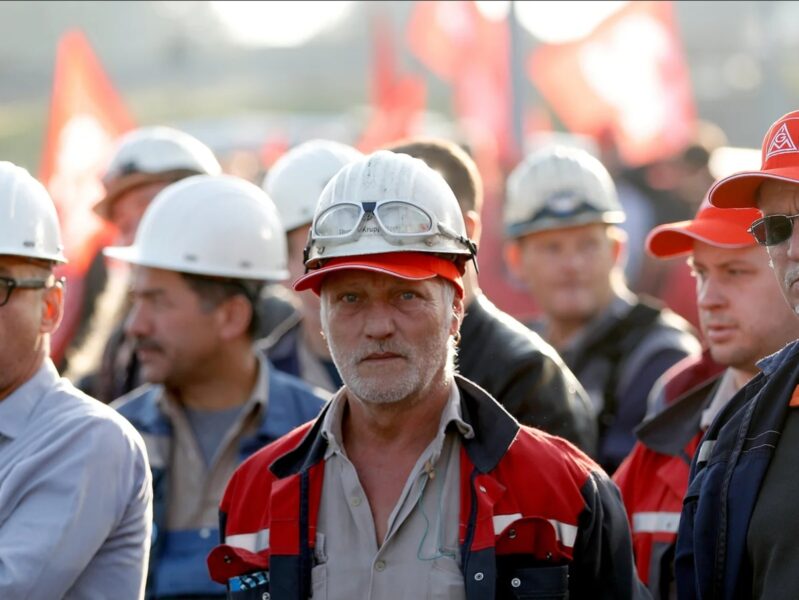
At this moment, the bishops have a problem. They are unable to speak to native working-class Americans. They are viewed with suspicion by the poor whom the Church is supposed to serve.
From the coal mines of Appalachia to the oil fields of Texas, these people look at the Church with distrust because it does not seem to act in their interests or understand their plight. Fortunately, Vice President JD Vance is in a unique position to build a bridge between the clergy and this group of people they have failed to reach. Unfortunately, the Church hierarchy seems unwilling to listen to him. That needs to change. I see three reasons why the bishops have lost this trust.
First, the bishops rarely offer concrete guidance on the immigration issue. They make vague appeals to love one’s neighbor, and sometimes to a nation’s right to maintain its borders, but this rarely reaches the point of giving prudential advice on how the United States can solve the immigration problem it faces. Without guidance there is no action, so this lack of direction has tacitly allowed the program of mass illegal immigration to continue.
Second, the Church has an economic interest in the continued importation of illegal immigrants through Catholic Charities. I am not alleging duplicity or corruption. I am simply saying that when these charitable organizations receive a large part of their budget from the federal government in order to house illegal immigrants, they have a financial interest in that program continuing. It is a financial bias, and it was an imprudent decision for the Church to put itself in that position.
Third, the bishops have stated that their goal is to listen to the marginalized. However, there are broad sectors of the native American people who are marginalized and poor, yet feel they are not being heard by the bishops of the United States. Every time they express concern about the thousands of migrants changing the fabric of their communities, or about their inability to find work because wages are too low, or about their inability to find housing because prices are too high—and they receive no housing subsidies from the government or from Catholic Charities—they feel slighted.
The Church responds by watching its tone and admonishing them to love the foreigner. They are not being heard, despite the Church’s stated goal of listening to the marginalized.
JD Vance is uniquely positioned to build that bridge between the ignored and the bishops. If the bishops are willing to speak with him and listen to what he has to say, they will find that his position is singular because, unlike many politicians, he grew up with direct experience of these marginalized communities.
Moreover, his conversion to Catholicism places him in a unique position to understand specifically Catholic social doctrine. He cites Rerum novarum in his recent book, Communion, and makes clear that he reflects deeply on what it means to be a Catholic statesman in the United States.
There are two main reasons why the bishops might be reluctant to listen to Vance. The first is that they do not want to appear political, to which I would respond: too late. The bishops already appear biased toward the Democratic Party. The highest-ranking cardinals in the American Church frequently associate with Democratic politicians and allow themselves to be photographed with them at public events. Many powerful prelates in the Catholic media wrote glowing endorsements of President Biden and his Catholicism.
The second is that many left-leaning Catholics, including bishops, fundamentally do not trust that JD Vance’s conversion is legitimate. They suspect it was some kind of cynical maneuver to achieve political advancement at a time when the Church enjoys popularity. Vance’s recent memoir, Communion, dispels any suspicion of cynicism. Vance converted to Catholicism in 2018, during one of the worst sexual abuse scandals in the American Catholic Church—possibly greater than the 2002 scandal. In 2018 it was revealed that one of the highest-ranking cardinals in the American Church, Cardinal Theodore McCarrick, had frequently abused seminarians. At the same time, the infamous Pennsylvania Grand Jury Report was published, bringing to light sexual abuses committed over previous decades.
In the midst of this barrage of scandals, Vance remained convinced that Jesus Christ had founded the Catholic Church, and he converted anyway. The fact that Catholicism became somewhat fashionable a few years later is astonishing and providential, but it has no bearing on his conversion. Any fear about Vance’s duplicity or the illegitimacy of his conversion is unfairly prejudiced.
Vance represents an opportunity for the American Church to reach a population it has avoided. If the bishops want to maintain their commitment to synodality, I recommend that they work with him.
Unlike many of my conservative American compatriots, I choose to believe that the bishops say what they think. I trust that they want to reach out to “the peripheries” and are committed to hearing the cry of the poor. Given that commitment, I ask the bishops to consider the plight of poor Americans, the often-defamed “basket of deplorables” who voted for Trump and who so often offend the sensibilities of our country’s coastal elite.
These people deserve to be heard, despite being rough around the edges. If they know that the Church is willing to listen to them, perhaps they will be willing to listen to us in turn. Perhaps they will be willing to hear how the bishops correct the vices they see in them.
The social doctrine of our Church tells us that we must have a preferential option for the poor. We must listen to them and give voice to their concerns, because too often they are denied a voice in the public square. They have found a voice in the vice president, and we would fail in our duty as a Church if we did not listen to them as well.
Original article: Patrick Neve, “Why some working-class Americans feel unheard by the bishops”, The Catholic Herald, June 22, 2026.