


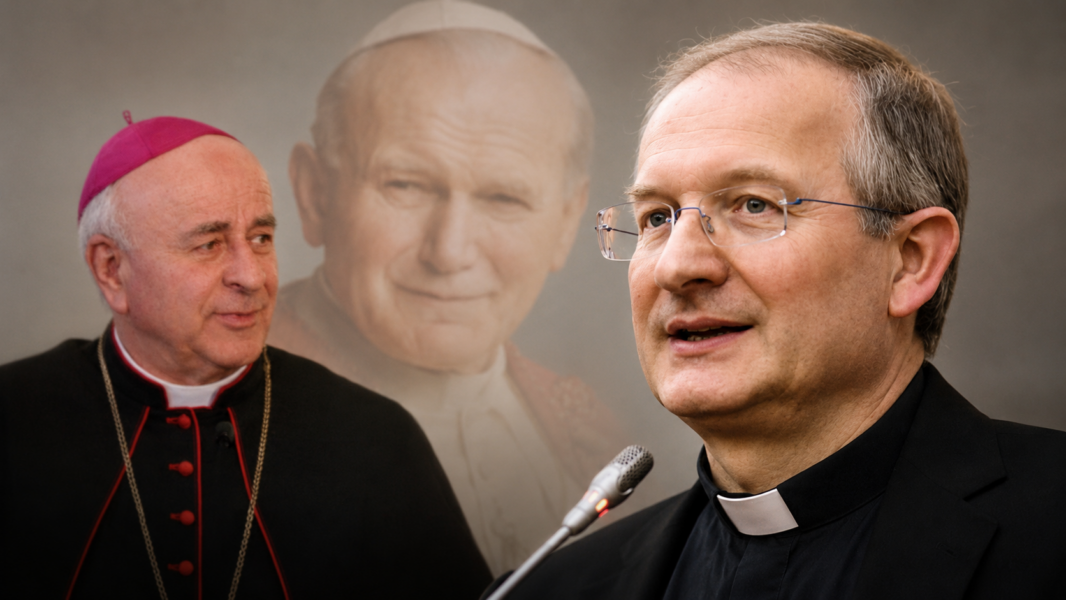
The statements recently made by Monsignor Vincenzo Paglia regarding the disappearance of the Pontifical John Paul II Institute for Studies on Marriage and Family continue to generate reactions. After the Italian prelate claimed his role in the reform of the institution and defended the need for a profound doctrinal transformation of Catholic morality, one of the main figures affected by that decision has responded sharply.
It is Monsignor Livio Melina, president of the Institute from 2006 to 2016 and one of the most prominent figures in moral theology linked to the legacy of Saint John Paul II. In an extensive analysis published in The World Catholic Report, Melina maintains that the suppression of the Institute was not due to academic or theological reasons, but to an “ideological operation” aimed at replacing the vision of Catholic morality.
The controversy comes weeks after Paglia stated in an interview that Pope Francis desired an update of the encyclical Humanae vitae and defended the reforms introduced both in the John Paul II Institute and in the Pontifical Academy for Life.
“It was not a desk theology”
Melina begins by questioning the portrait Paglia has painted of the former Institute. According to the Italian archbishop, the institution founded by Saint John Paul II would have remained anchored in a rigid understanding of natural law, built on abstract principles and detached from people’s concrete experience.
For the one who led the Institute for a decade, that description does not correspond to reality.
Melina recalls that Saint John Paul II himself promoted the creation of the center because he considered the traditional models with which moral theology was addressing the challenges posed by the sexual revolution and the controversies that arose after the publication of Humanae vitae to be insufficient.
Then-Cardinal Karol Wojtyła was convinced that the Church needed more than a legal defense of moral norms. It was necessary to develop an authentic anthropology of love and a theology of the body capable of explaining the beauty and rationality of Christian teaching on marriage and the family.
According to Melina, that was precisely the mission the Institute assumed for more than three decades.
“What emerged was precisely a theology of love,” the Italian theologian states in summarizing the work carried out during those years.
That is why he considers the accusation that the Institute practiced a “desk theology” disconnected from real life to be unjustified. In his view, exactly the opposite occurred: the goal was to understand the human experience of love in order to illuminate it from faith and accompany people on their journey.
The institution that Paglia decided to dismantle
Far from being a small structure specialized in internal debates of moral theology, the center had developed a broad international academic network. It maintained stable relations with civil universities, collaborated with sociologists and psychologists, promoted meetings with representatives of Judaism, Islam, Buddhism, and Hinduism, and had sections spread across different continents.
Melina also mentions dozens of congresses and research projects dedicated not only to marriage, but also to issues such as education, intergenerational transmission, fatherhood, the social dimension of the family, or evangelization.
If the Institute was truly a structure incapable of dialoguing with the contemporary world, how can one explain the breadth of its academic and pastoral activity?
The institution founded by Saint John Paul II was born precisely to overcome the limitations of certain manualistic approaches to moral theology and to develop an anthropology capable of explaining the human vocation to love, marriage, and the family.
“What emerged was precisely a theology of love,” Melina affirms, maintaining that the academic work carried out over more than three decades was aimed at illuminating concrete human experience and accompanying families, not at formulating abstract principles detached from reality.
That is why he considers the accusations made by Paglia to be “ideological and superficial,” because, in his view, they do not correspond to the actual content of the research, publications, and academic programs developed by the Institute during its 36 years of existence.
The true reason for the conflict
However, for Melina the issue is not limited to a discussion about the Institute’s past. What he considers truly relevant is that Paglia has openly acknowledged that the reforms promoted in recent years pursued a doctrinal transformation.
According to him, for a long time the reforms were presented mainly as pastoral adjustments or methodological changes. Now, however, Paglia himself admits that the goal was deeper: While the Catholic tradition has understood natural law as a reality inscribed in human nature itself and accessible to reason, Paglia proposes an interpretation linked to the historical and cultural discernment of human experiences.
In the former president of the Institute’s view, this approach implies shifting the center of gravity from objective truth about the person to the interpretation that each era makes of human experience.
And there, he maintains, the real debate begins.
Two opposing visions of Catholic morality
Melina sees a close connection between this new interpretation of natural law and the role Paglia attributes to conscience.
According to him, the proposal promoted by the Italian archbishop starts from a reinterpretation of natural law based primarily on historical and cultural discernment, as well as an expansion of the role of subjective conscience in determining universal moral norms and intrinsically evil acts—that is, behaviors that cannot be justified by circumstances or intentions.
According to the Italian theologian, this approach entails abandoning central elements of the teaching developed by Saint John Paul II in the encyclical Veritatis splendor. In particular, it questions the idea that negative moral norms can be subordinated to concrete circumstances or to the subjective assessment of each situation.
For Melina, behind this change lies a genuine “paradigm shift” that affects not only the Church’s pastoral action, but also its moral doctrine and two different ways of understanding the relationship between truth, freedom, and conscience.
Precisely for this reason, he considers Paglia’s recent admission that the reforms promoted during the years of Pope Francis’s pontificate had a doctrinal rather than merely pastoral scope to be significant.
The debate on the “possible good”
Another point questioned by Melina is the concept of the “possible good,” used by Paglia as a criterion for addressing certain complex moral situations.
The former president of the Institute warns that an extensive interpretation of this principle could end up lowering the moral demands of the Gospel and transforming doctrine into an unattainable ideal that must constantly adapt to people’s concrete limitations.
Against that perspective, he recalls that the Catholic tradition has always affirmed that God does not command anything impossible and that grace makes it possible to follow a path of conversion even when the goal seems distant.
For this reason, he recalls the teachings of the Council of Trent and, explicitly citing Saint John Paul II, insists that the pastoral response to fragilities cannot consist in reducing the demands of the Gospel, but in accompanying people so that they can fully live their Christian vocation. Thus, he rejects the idea that the Church’s moral doctrine should be understood as an unattainable ideal that later needs to be lowered to fit concrete reality.
A fundamental accusation
If the Institute had developed an intellectual proposal inspired by Saint John Paul II, if it had shown the capacity to dialogue with contemporary culture, and if it had given rise to an extensive international network of research and formation, then the reason for its suppression cannot be found—according to Melina—in any supposed academic insufficiency.
“Paglia’s actions were not motivated by theological reasons but by an ideological critique of the Institute,” he states.
In his view, behind the decision was the will to replace one particular understanding of Catholic morality with another.
A substitution that would not affect only an academic institution, but the very way in which the Church today presents issues such as marriage, sexuality, the family, or the real possibility of living the demands of the Gospel.
A controversy that remains open
While Paglia presents the transformations as a necessary theological update capable of responding to contemporary challenges, Melina maintains that the disappearance of the former John Paul II Institute meant the closure of an academic experience that had sought to show the reasonableness and viability of the Church’s moral teaching in continuity with the magisterium of Saint John Paul II.
Five years after its suppression, the debate no longer revolves solely around an academic institution. What is at stake is the meaning of the reforms promoted in recent years and the direction Catholic moral theology should follow.