


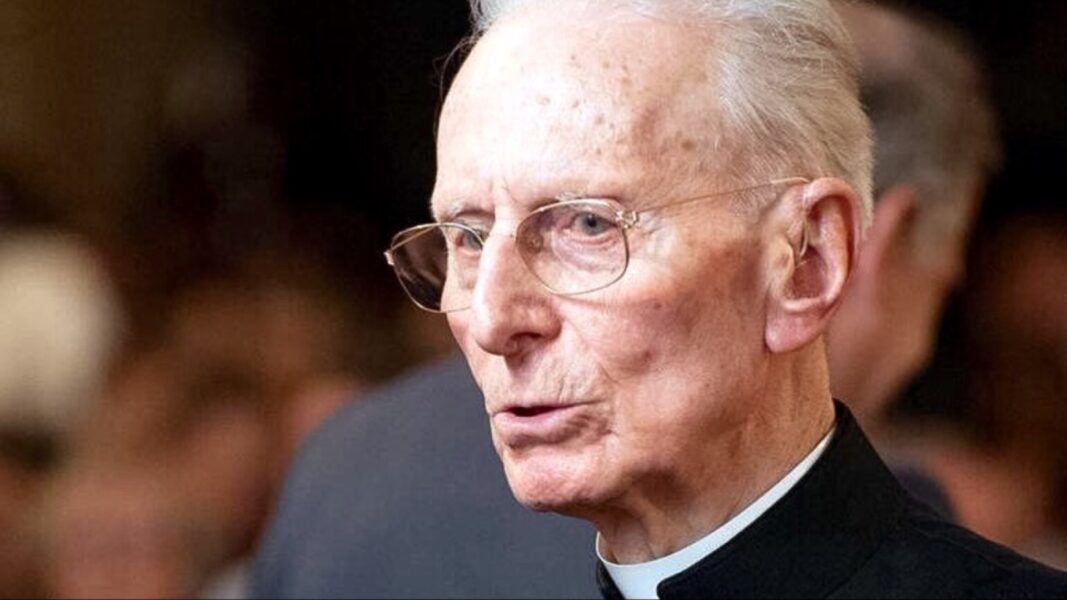
Following the debate reopened by the recent consecrations of the Priestly Fraternity of Saint Pius X and by the question of the adherence due to the Second Vatican Council, it seems opportune to recover this text by Monsignor Brunero Gherardini, originally published in 2011 by Disputationes Theologicae.
The writing was born as a response to the article by Monsignor Fernando Ocáriz published in L’Osservatore Romano on adherence to the conciliar magisterium. Gherardini, one of the most relevant theologians in the discussion on the interpretation of Vatican II, does not deny the magisterial character of the Council, but introduces a decisive distinction: recognizing that Vatican II belongs to the Magisterium does not equate to turning each of its statements into dogma nor to excluding all questioning about its continuity with Tradition.
Church-Tradition-Magisterium
The great celebration of the fiftieth anniversary has begun. The beating of drums is not yet heard, but it can already be perceived in the atmosphere. The fiftieth anniversary of Vatican II will unleash all that is most superlative that can be imagined in terms of praise. Of the sobriety that had been requested, as an attitude and as an occasion for reflection and analysis for a more critical and profound evaluation of the conciliar event, not a trace remains. Already, without restraint, the same things that have been said and repeated for fifty years are being reiterated: Vatican II is the culminating point of Tradition and its very synthesis. International congresses on the greatest and most significant of all ecumenical Councils have already been scheduled; others, of greater or lesser scope, will be organized along the way. And the essayistic production on the subject grows richer day by day. L’Osservatore Romano, obviously, does its part and insists above all on the adherence due to the Magisterium (2/12/2011, p. 6): Vatican II is an act of the Magisterium, therefore… The reason given is that every act of the Magisterium must be received by Pastors who, by virtue of apostolic succession, speak with the charism of truth (DV 8), with the authority of Christ (LG 25), in the light of the Holy Spirit (ibid.).
Apart from the fact of demonstrating the Magisterium of Vatican II through Vatican II itself—what was formerly called petitio principii—it seems evident that such a procedure starts from the premise of the Magisterium as an absolute, an independent subject of everything and everyone, except for apostolic succession and the assistance of the Holy Spirit. Now, if apostolic succession guarantees the legitimacy of sacred ordination, it is difficult to establish who guarantees the intervention of the Holy Spirit in the terms in which it is spoken of.
There is, however, something beyond all discussion: nothing in the world, the receptacle of created things, possesses the attribute of the absolute. Everything is in motion, in a circuit of reciprocal interdependencies, and therefore everything depends, everything has a beginning and will have an end: “Mutantur enim —said the great Augustine— ergo creata sunt.” The Church constitutes no exception, nor does her Tradition or her Magisterium. These are sublime realities, situated at the summit of the scale of all created values, endowed with qualities that cause vertigo, but they remain penultimate realities. The eschaton, the ultimate reality, is only He, God. Language is frequently used that inverts this fact and attributes to these sublime realities a scope and meaning beyond and above their own limits; that is, they are absolutized. The consequence is that they are stripped of their ontological status, turning them into an unreal presupposition which, precisely for that reason, loses even the sublime greatnesses of their condition as penultimate reality.
Immersed in the trinitarian moment of her design, the Church is and acts in time as the sacrament of salvation. The theandrism that makes her a mysterious continuation of Christ is not in question, nor are her constitutive properties (unity, holiness, catholicity, and apostolicity), nor her structure or her service; but all this remains within a reality of this world, capable of sacramentally mediating the divine presence, though always as and insofar as a reality of this world, which by definition shuns the absolute.
So much so that she is identified with her Tradition, from which she obtains continuity with herself, to which she owes her vital breath and from which derives the certainty that her yesterday always becomes today to prepare her tomorrow. Tradition, therefore, provides her with the interior movement that impels her toward the future, safeguarding her present and her past. But neither is Tradition an absolute: it began with the Church and will end with her. Only God remains.
Over Tradition the Church exercises a true control: a discernment that distinguishes the authentic from the inauthentic. She does so through an instrument that does not lack “the charism of truth,” provided it does not yield to the temptation of the absolute. That instrument is the Magisterium, whose holders are the Pope, as successor of the first Pope, the apostle Saint Peter, in the Roman see, and the bishops as successors of the Twelve in the ministry or service to the Church, wherever a local expression of her exists. To recall the distinctions of the Magisterium—solemn, if it is of the ecumenical Council or of the Pope when either defines truths of faith and morals; ordinary, if it is of the Pope in his specific activity, and of the bishops together and in communion with the Pope—proves superfluous; much more important is to specify within what limits “the charism of truth” is guaranteed to the Magisterium.
It must be said above all that the Magisterium is not a super-church that imposes judgments and behaviors on the Church herself; nor a privileged caste above the people of God, a kind of strong power to which it suffices to obey. It is a service, a diakonía. But also a task to be carried out, a munus, specifically the munus docendi, which cannot and must not be superimposed upon the Church, from which and for which it arises and acts. From the subjective point of view, it coincides with the teaching Church, the Pope and the bishops united to the Pope, in the function of the official proposal of the Faith. From the operative point of view, it is the instrument through which that function is carried out.
Too often, however, the instrument is turned into a value in itself and appealed to in order to cut short any discussion, as if it were above the Church and as if it did not have before it the immense mass of Tradition that it must receive, interpret, and retransmit in all its integrity and fidelity. And it is precisely here that those limits become manifest which preserve it from the danger of elephantiasis and the absolutist temptation.
There is no need to dwell on the first of those limits, apostolic succession. It should not be difficult for anyone to demonstrate, case by case, its legitimacy and, therefore, the consequent succession in the possession of the charism proper to the Apostles. On the other hand, it is fitting to say a few words about the second, that is, about the assistance of the Holy Spirit. The expeditious procedure in vogue today is more or less the following: Christ promised the Apostles, and therefore their successors, that is, the teaching Church, the sending of the Holy Spirit and His assistance for the exercise of the munus docendi in the truth; consequently, error is ruled out beforehand. Yes, Christ made such a promise, but He also indicated the conditions for its fulfillment. However, precisely in the way of appealing to the promise a grave adulteration is perceived: either the words of Christ are not cited, or if they are cited they are not given the meaning they have. Let us see what it is about.
The promise is found above all in two texts of the fourth evangelist: Jn 14,16.26 and 16,13-14. Already in the first resounds with extreme clarity one of the limits mentioned: Jesus, in effect, does not limit Himself to promising “the Spirit of the truth”—note this italic, due to the specifying article thV, which from top to bottom continues to be translated as “of,” as if truth were an optional attribute of the Holy Spirit, when in reality He personifies it—but also announces its function: it will bring to remembrance all that He, Jesus, had taught before. It is, therefore, a conserving assistance of revealed truth, not an integration of it with other truths distinct or different from those revealed, or presumed to be such.
The second of the Johannine texts, confirming the first, descends to additional precisions: the Holy Spirit, in effect, “will guide you to all truth,” even to that which now Jesus keeps silent because it is beyond the capacity of His own (16,12). In doing so, the Spirit “will not speak on His own, but will say all that He hears […] He will take what is Mine and declare it to you.” Therefore, there will be no subsequent revelations. The only Revelation closes with those to whom Jesus is now speaking. His words present a univocal meaning, referring to the teaching imparted by Him and only to that teaching. A language neither cryptic nor ciphered, but clear as the sun. An objection could be raised about the perspective of apparent novelty in relation to what Jesus now keeps silent and what will be announced by the Holy Spirit; but the delimitation of His assistance to an action of guiding toward the possession of all the truth revealed by Christ excludes substantial novelties. If novelties should arise, they would be new meanings, not new truths; hence the very apt eodem sensu eademque sententia of Saint Vincent of Lérins. In short, the claim to link to the assistance of the Holy Spirit any movement of leaves, I mean any novelty and especially those that adjust the Church to the dimensions of the dominant culture and the so-called dignity of the human person, not only constitutes a structural inversion of the Church herself, but also a great cross drawn over the two texts indicated above.
That is not all. The limit of magisterial intervention also resides in its own technical formulation. For it to be truly magisterial, in a defining or non-defining sense, it is necessary that the intervention resort to an already consecrated formula, from which without any doubt results the will to speak as “Pastor and Doctor of all Christians in matters of Faith and Morals, by virtue of his Apostolic Authority,” if the one speaking is the Pope; or that it result with equal certainty, for example in the case of an ecumenical Council, through the usual formulas of dogmatic affirmation, the will of the conciliar Fathers to bind the Christian Faith with divine Revelation and its uninterrupted transmission. In the absence of such presuppositions, only in a broad sense may one speak of Magisterium: not every word of the Pope, written or spoken, is necessarily Magisterium; and the same may be said of the ecumenical Councils, not a few of which did not treat dogmatic questions or not exclusively. Sometimes they even inserted dogma into a context of internal disputes and personal quarrels or of factions, to the point of making absurd any magisterial claim within that context. An ecumenical Council of indisputable dogmatic-christological importance such as Chalcedon still causes a clearly negative impression, since it spent most of its time in a shameful struggle of personalisms, precedences, depositions, and rehabilitations; Chalcedon is not dogma in that. Likewise, the word of the Pope is not when he privately declares that “Paul did not understand the Church as an institution, as an organization, but as a living organism, in which all act for one another and with one another, united from Christ”; exactly the opposite is true, and it is known that the first institutional form, precisely to favor that living organism, was structured by Paul in a pyramidal manner: the apostle at the summit, then the episcopoi-presbuteroi, the hegoumenoi, the proistamenoi, the nouthetountes, the diakonoi; they are distinctions of tasks and offices not yet exactly defined, but already distinctions of an institutionalized organism. Also in this case, let it be clear, the attitude of the Christian is that of respect and, at least in principle, also that of adherence. But if for the conscience of the individual believer adherence to a case such as the one set forth is not possible, that does not imply rebellion against the Pope nor denial of his Magisterium: it means only that that is not Magisterium.
The discourse now returns, to conclude, to Vatican II, in order to say, if possible, a definitive word on its belonging or not to Tradition and on its magisterial quality. On the latter there is no question, and those laudatores who for fifty years now never tire of upholding the magisterial identity of Vatican II lose and make others lose time: no one denies it. However, given its uncritical exuberances, a problem of quality arises: what kind of Magisterium is it? The article of L’Osservatore Romano to which I referred at the beginning speaks of doctrinal Magisterium: and who has ever denied it? Even a purely pastoral affirmation can be doctrinal, in the sense of belonging to a certain doctrine. But whoever should say doctrinal in a dogmatic sense would be mistaken: no dogma figures in the assets of Vatican II, which, if it also possesses a dogmatic value, possesses it in a reflected way where it is linked to dogmas previously defined. In short, as has been said and repeated to anyone who has ears to hear, its is a solemn and supreme Magisterium.
More problematic is its continuity with Tradition, not because it has not declared such continuity, but because, especially in those key points where it was necessary that such continuity be evident, the declaration remained without demonstration.
December 7, 2011