


By Brad Miner
A recent, brief exhibition at the Morgan Library & Museum in New York City highlighted the life and work of Wolfgang Amadeus Mozart. J.P. Morgan, the famous financier, built his library on Madison Avenue in the nineteenth century as a place to house, preserve, and make available to scholars his growing collection of rare books and manuscripts, including handwritten copies of Mozart’s musical scores.
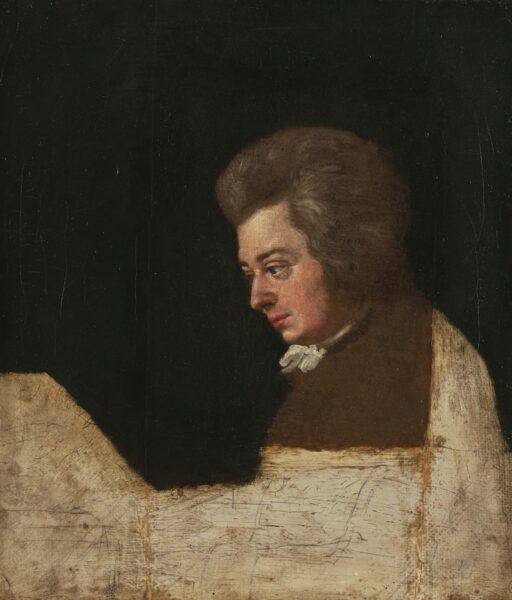
“Wolfgang Amadeus Mozart: Treasures from the Mozarteum Foundation Salzburg” included some of those scores and, thanks to the Mozarteum, several of the great man’s musical instruments, numerous portraits of Mozart, his family, and his patrons, as well as many letters and other documents from throughout the all-too-brief life of W.A. Mozart (1756-1791).
And once again, this made me reflect on the Catholic Mozart’s affiliation or flirtation with Freemasonry. I’ll speak more about that departure from the One True Faith later, but first: Mozart the Catholic.
Let’s begin with the fact that he wrote five dozen Catholic liturgical compositions, the most famous of which is the last one he wrote: his unfinished Requiem Mass, nearly an hour in length. In my opinion, however, his most beautiful work is the four-minute Eucharistic hymn, Ave verum corpus (“Hail, true body”), an SATB four-part piece, meaning the music is arranged for four distinct vocal ranges: Soprano, Contralto, Tenor, and Bass. It is lovely with orchestra and a large choir or as an a cappella quartet. Here is Leonard Bernstein conducting the Ave verum corpus (and, as he often did, drawing almost more attention to himself than to the music):
In childhood, the Mozart family—the father Wolfgang (Leopold), the mother (Anna Maria), the sister (Maria Anna), and Wolfgang—were devout Mass-goers. (Five other Mozart children died in infancy.) Wolfgang never really ceased to be a faithful Christian.
So why—at age 28—did the genius from a devoutly Catholic family decide to join the Masonic lodge Zur Wohltätigkeit (“Beneficence”) in Vienna? Well, why does Masonic imagery persist on United States currency? For the second question, the answer may be as simple as: Ben Franklin, who was a Mason and a freethinker, and (as Mr. Jefferson might say—and did say about his Declaration) Masonic ideas were “in the air” 250 years ago.
In Vienna, as in Philadelphia, liberty, fraternity, equality, and scientific inquiry were seemingly irresistible Enlightenment ideals, and there is no doubt that their foundation was largely secular, often even anti-Catholic. But it is also true that, for statesmen and artists, religious faith was more in their bones than simply in the air.
Mozart’s lodge was a social club with rituals and mysteries that parodied Roman Catholic rites. The Church had been the ground on which Western culture was based. Some scholars speculate that Masonic temples, secular in nature, were intended to be refuges from the conflicts between Catholics and Protestants that had been roiling Britain and Europe since the sixteenth century (largely settled by the Treaty of Westphalia in 1648, but still lingering in regional conflicts through the religious affiliations of the combatants). The Lodge became a place where Protestants, Catholics, and men of no faith could gather in peace.
Of course, Mozart and his friends would also have attended Mass on Sunday. But composing, like writing, is a solitary profession, and Mozart may have found the lodge more relaxed and agreeable than the church.
Pope Clement XII had forbidden Catholics from becoming Freemasons in the 1738 bull, In Eminenti apostolatus, and the penalty for being a Mason was excommunication. None of the documents in the Morgan exhibition (nor any known to exist elsewhere) suggest that Mozart read the bull and decided to ignore it.
A peculiar historical fact is that Zur Wohltätigkeit was a kind of Catholic-reformist lodge based on the teachings of the liberal Italian priest and theologian Ludovico Antonio Muratori (1672-1750). Muratori was solidly Catholic in most respects, but he eschewed popular piety and was particularly committed to the Catholic ideal of charity (another translation of Wohltätigkeit). Yet in his book De Ingeniorum Moderatione, he also called papal authority into question.
And in Zur Wohltätigkeit the influence of Johann Nikolaus von Hontheim (1701-1790), coadjutor bishop of Trier (Germany), who wrote under the pseudonym Justinus Febronius, was also at work. His nationalist Catholic views were termed Febronianism. Von Hontheim wanted to diminish the power of the papacy and the Holy See. Call it “reform Catholicism” or the “Catholic Enlightenment,” but these ideas—anticlerical (especially anti-Vatican) and nationalist movements—were an integral part of Freemasonry in several Catholic countries.
Interesting, isn’t it, that we see this sort of thing sprouting in Germany today? The Aufklärungskatholizismus (Enlightenment Catholicism) of Muratori, as his German-speaking confreres called it (as only they can), would eventually be condemned. But at the time, Muratori’s emphasis on patristics was a welcome advance, even as his insistence that temporal rulers and local bishops should be empowered to reform the Church without waiting for Rome’s approval was unacceptable. Pius VI condemned this approach in Auctorem fidei (1794), which in turn was a precursor to the nineteenth- and twentieth-century reaffirmations of Catholic orthodoxy and papal primacy.
Pius VI also issued a warning against Febronianism in Super soliditate petrae (1786), and yet the controversy over the fluidity of doctrine and the questioning of papal authority continued to simmer until the First Vatican Council responded to the question of papal authority in the Pastor aeternus of 1870, and Pius X shut down the entire liberal project in Pascendi Dominici gregis (1907).
Still, the celebration of individuality, nationalism, and modernity simply refuses to die. Some people reject wisdom because it did not occur to them. Sacred Tradition and the Deposit of Faith teach us that the Holy Spirit continually guides the Church. But the careless evocations of the Spirit in the various synods on synodality proved sacrilegious. Divine revelation, Scripture, and the lived tradition of the Church must guide us, and not what amounts to focus groups. We do not need a show of hands to vote on the Ten Commandments.
So Mozart certainly had his romance with the Enlightenment but, Lord have mercy, he ended up where he belonged. Here is the Kyrie of his Requiem (Mr. Bernstein with the baton again):
About the Author
Brad Miner, husband and father, is senior editor of The Catholic Thing and a senior fellow of the Faith & Reason Institute. He was literary editor of National Review and had a long career in the book-publishing industry. His most recent book is Sons of St. Patrick, written with George J. Marlin. His best-selling The Compleat Gentleman is now available in a third revised edition and also in an Audible audio edition (read by Bob Souer). Mr. Miner has served on the board of Aid to the Church In Need USA and also on the recruitment board of the Selective Service System in Westchester County, New York.