


By Matthew D. Walz
What is the “heart”? The Catechism is helpful on this point. In a section on the unity of man, the Church teaches that man is “both corporeal and spiritual” and that “the whole human person… has been willed by God.” (CCC 362) Then, after developing these statements, the section concludes:
The Church’s spiritual tradition also emphasizes the heart, in the biblical sense of the depths of one’s being, where the person decides for or against God. (CCC 368)
The heart, then, designates what is profoundly singular in each human being, a principle that underlies both body and soul. At the deepest level of every human being’s existence lies a heart from which springs the decisive direction of his life in relation to God.
Unfortunately, the final part of the cited translation could be more precise. The typical Latin edition of the Catechism states that the heart is ubi persona se decidit aut non decidit pro Deo, “where the person decides or does not decide for God.” Deciding or not deciding for God differs importantly from deciding for or against God. The more precise translation indicates that, ultimately, no person is truly capable of deciding against God, because to do so would imply existing in some way outside the order created by God, which is simply not to exist at all. Therefore, the Latin text says that a person is capable of not deciding for God, that is, capable of failing or falling short in deciding for God. Theologically speaking, much depends on this distinction concerning the nature of evil, sin, and damnation—important topics, but for another day.
This more precise translation reveals a significant truth that Augustine articulated long ago while struggling arduously against the Pelagians. The Pelagians thought that human beings control their own destiny, or at least control their first movements toward God and salvation. Pelagianism expresses a kind of default human approach to the hidden God, rooted in a craving for control. All too often we consider ourselves free to carve out our salvation on our own terms. Few among us can claim, then, not to be a “practical Pelagian.”
To such Pelagian self-aggrandizement, Augustine, following the example of St. Paul, responds: “Our sufficiency comes from God, in whose power are our heart and our thoughts.” (De dono perseverantiae, 20)
Our heart exists within the potestas of God, His creative power that freely liberates each human being from the abyss of nothingness into the gratuity of existence. Our heart remains within the generative and generous power of God, prior to any awareness we have of that heart or any choice that derives from it.
We can achieve, and sometimes do achieve, awareness of our hearts, and we have been given permission to direct our lives in one direction or another. After all, we were created in the image of God. But always preceding such awareness and freedom is the imperceptible and infinitely dynamic Power that continually gives us existence, which He, with the same continuity, draws toward Himself. Is not this marvelous existential exchange between God and man the supreme instance of a “Heart speaking to heart”?
That is why the Catechism also teaches:
The heart is our hidden center, beyond the grasp of our reason and of others; only the Spirit of God can fathom it and know it. It is the place of decision, in the depths of our psychic trends. It is the place of truth, where we choose life or death. It is the place of encounter, since it is in the heart that we live our relations with others, with ourselves, and with God, in the image of God. (CCC 2563)
To consider the heart is to row out to sea, to enter into the metaphysical depth of our creaturely condition. Yet the heart is also something so easily recognizable, so accessible, so close to our inner and lived experience. Some of us even wear our heart on our sleeve! Indeed, is there any anthropological metaphor more potent than the heart, which the Scriptures reveal to us so persuasively? Such is the pedagogical brilliance of the biblical anthropology of the heart.
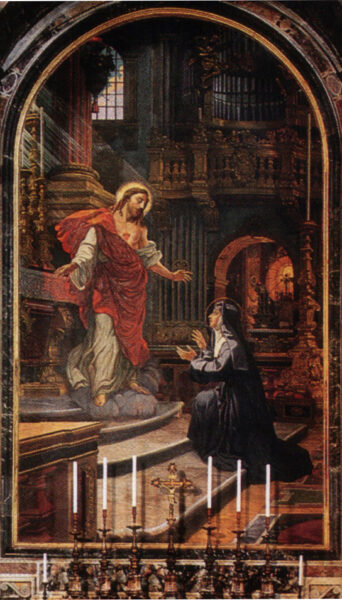
Such is also the liturgical brilliance of celebrating the Heart of Jesus. All that is true about the human heart is true about His Heart, because the God-man has a human heart. Indeed, is there any religious symbol more potent than that of the Sacred Heart?
When it comes to the Heart of Jesus, however, we discover an essential difference: its sacredness. By calling His Heart “sacred,” we grasp not only that it is wholly set apart for the service of God (as all sacred realities are), but also that it exists precisely as God. The Heart of Jesus beats with the actuality of Uncreated Existence. It is Divine, subsisting with the very existence of the Son of God. For this reason it behooves us to adore His Heart and to surrender our hearts entirely to His.
Once again, the Catechism proves most helpful:
Jesus knew and loved us each and all during his life, his agony, and his passion, and gave himself up for each one of us: “The Son of God… loved me and gave himself for me.” He has loved us all with a human heart. For this reason, the Sacred Heart of Jesus, pierced by our sins and for our salvation, “is quite rightly considered the chief sign and symbol of that… love with which the divine Redeemer continually loves the Eternal Father and all human beings without exception.” (CCC 478)
In the Sacred Heart we find both a human heart entirely “decided” for God and a Divine Heart wholly given over to us. Fittingly, then, we ask Him today and every day: “Jesus, meek and humble of heart, make our heart like unto Thine.”
About the author
Matthew Walz will begin serving as President of Thomas More College at the start of the next academic year, after nearly two decades of teaching and administrative work at the University of Dallas and Holy Trinity Seminary. Accordingly, his investiture will take place in September. He and his beautiful wife, Teresa, have been blessed with eight children.