


The Christendom was a period of maximum flourishing in which the European continent, thanks to the Church, reached the zenith of civilization. Christendom was, according to Leo XIII, the time when “the Gospel governed the States”.
In this sense, then, Christendom does not have to be something belonging exclusively to the past, but can occur again. That is why Dom Gérard Calvet, founder of the Benedictine abbey of Le Barroux, spoke of “the Christendom of tomorrow”.
Christendom is the Christian civilization in which there is no separation between Church and State. There is distinction, because each one attends to its own affairs: the Church to the supernatural and the State to the affairs of the material world; according to Christian criteria, of course. That is what Pius XI spoke about in his encyclical Quas Primas, published in 1925, which teaches that Christ has the right to reign in society and that the laws of society must submit to Him, because both divine and natural laws come from God. Through this encyclical the pope instituted the feast of Christ the King.
In that same year of 1925, a young José María Escrivá was ordained a priest. And only three years later, in 1928, this young priest (born in 1902) founded Opus Dei. For more than ten years, according to his own words, he had been turning over in his mind the way in which the world had to be converted. He thought that Opus Dei should be like leaven in the dough, so that everyone could attain holiness in ordinary life through work. The “dough”, it is understood, was it not already Christian? That is why, from the 1930s onward, his language was ambiguous, since his idea of a non-Christian society clashed head-on with the doctrine of Christ the King, and for that reason he was accused before ecclesiastical courts on various occasions of being liberal and even a heretic.
His disciple Álvaro del Portillo, who participated in the Second Vatican Council as an expert and secretary of the Commission on the Discipline of the Clergy, said to him: “on how many occasions, during the approval of the Council documents, it would have been only just to speak with the founder of Opus Dei and repeat to him: ‘congratulations’, because what he has in his soul, what he has tirelessly taught since 1928, has been solemnly proclaimed by the Magisterium of the Church”. Saint Josemaría himself affirmed: “We must be content, now that this Council has ended: thirty years ago I was accused of heresy for preaching things of our spirit that the Council has now solemnly recognized in the dogmatic constitution De Ecclesia. It is clear that we have moved forward”.
In fact, that is the aspect that most surprises when one approaches the history of Opus Dei: how “ahead of their time” they were, since the other realities that happily assumed the separation of Church and State, religious freedom and other liberal postulates appeared in the Church after the Second Vatican Council: the Charismatic Renewal, Regnum Christi / Legionaries of Christ, the Neocatechumenal Way and others.
It seemed to me that this extensive preliminary explanation was necessary in order to get to the heart of the matter, because it clearly shows the difference between a traditional Catholic, who is simply a Catholic, and a conservative Catholic like Saint Josemaría Escrivá and his work and other conservative institutes, which is liberal and modernist. Because, apart from the outdated progressives in the Roman Curia and the episcopate, the “Church that is on the move”, which seems alive – as we have already said on other occasions – is this neo-conservative Church.
And this produces great unease. I do not at all agree with those who say “better Hakuna or Emaús than nothing”. I believe that nothing is better than Hakuna or Emaús; because, although it is true that these focal points of first proclamation are necessary, after them the Church should come to the rescue of these converts and form them in the true Catholic faith, doctrine, liturgy and morals, because, when people remain in these liberal and neo-conservative movements (which are truly legion in the present-day Church) they run the risk of ending up sliding toward a sentimentalist, anthropocentric and worldly religion that is not the Catholic one.
Many years ago, when I returned to the Church, one of the things that most caught my attention was the superiority of Christian thought over any kind of philosophical system and the perfect coherence with which it explained everything. The depth, breadth and height of Catholic thought fascinated me and continues to fascinate me. God is the Truth, a Truth that is Love, and that is logical and supra-rational, because it contains mysteries that our mind will never be able to fully understand or explain.
Studying the history of the Church, I was fascinated by the boldness of the medieval mendicant friars. How they set out to proclaim, baptize and teach, as our Lord Jesus Christ commanded. The first Franciscans arrived in Spain with the intention of crossing into North Africa to convert the Moors and die as martyrs if necessary. For his part, Saint Dominic of Guzmán fought without respite against the Albigensian heretics, and it is well known how, before allowing his friars to go out to preach, they received an exquisite formation. From this arose not only the genius of Saint Thomas Aquinas, but also a laywoman in the middle of the fourteenth century, a Dominican tertiary, Saint Catherine of Siena, who was not afraid to rebuke the popes and urge them to put an end to the scandal of the Western Schism.
Those were other times. They were the times of Christendom. The Church was not ashamed of the Truth. She knew she possessed the great responsibility of proclaiming it in order to save souls. She did not yield before pagans or heretics, offering dialogue or updating herself, from the Supreme Pontiff down to the simplest peasant.
When Luther broke Christendom with his heresy, some of the greatest saints the Church has given were born in Spain, such as Saint Teresa of Jesus and Saint John of the Cross, Saint Ignatius of Loyola and Saint Francis Xavier, who evangelized half the world and were a beacon of the West. The Pope has referred to them on some occasion during his recent visit to Spain. That is why it is interesting to hold up the mirror of Christendom to the current Spanish Catholicism that has been so media-focused on the visit of Leo XIV. It is also interesting to confront the current Supreme Pontiff with the image of some of his medieval predecessors.
Regarding this visit to Spain, there is nothing to say about the hundreds of thousands of Catholics who have attended the events organized for the Holy Father: their good will, their faith, their devotion. The ecclesiastical hierarchy and its transmission belt of the prefabricated narrative deserve separate mention, however: the influencers, digital missionaries or digital mercenaries, whom we discussed last week and who have carried out a shameful exercise of papolatry, in general.
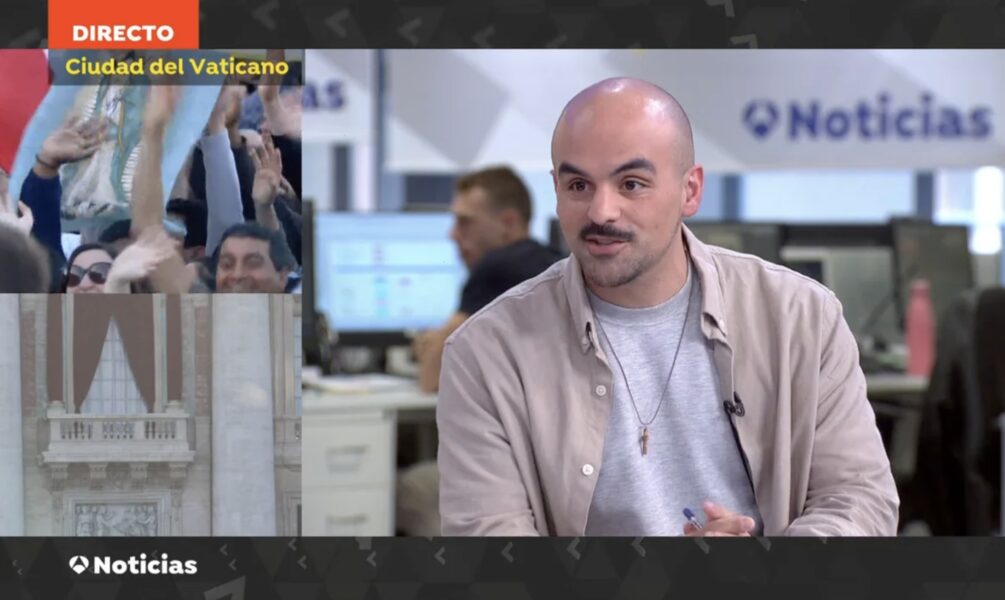
This is not the first time we have dealt with the phenomenon of Catholic influencers turned into “digital missionaries” in an official way and, finally, into digital mercenaries. It is a subject that interests me greatly because, more and more, they become simple propaganda for the regime and the officialist narrative of the ecclesiastical hierarchy, at least in the case of Spain and, very specifically, of the Archdiocese of Madrid. And they are all neo-conservatives. During this papal visit, the influencers have replaced the classic journalists specialized in Church matters. They have tirelessly broadcast every detail of the pope’s visit not only on their personal social networks, but also on generalist information media on TV, and some, such as the popular CR30 and a former Carmelite friar turned into a horrendous online theology professor, have even been working for El Debate, the newspaper of the ACdP (capable, on the other hand, of the best and the worst).
But digital missionaries, like good mercenaries (and unlike good journalists), are interested in topics in a blatantly selective way: always in line with what the bishops are interested in promoting and what they prefer to ignore or conceal.
And this question is important when one wonders what the selection criteria of these influencers are on the part of, for example, the cardinal of Madrid or the ACdP and its endogamous CEU talks. Is the criterion the number of followers on their social networks? It strikes me as curious, if that is the case, that the cardinal does not, for example, invite Fr. Jorge González Guadalix, who writes the most widely read priest’s blog in Spain, to his meetings with influencers. In terms of number of readers, impact and credibility, I do not think many digital missionaries surpass him.
Perhaps, and I do not wish to think ill, the number of followers is not the only criterion of selection and recruitment, but the degree of “apesedebramiento” also plays a role; the desire many of these influencers have not to work and to live by selectively showing their lives and messages on social networks; to accept paid collaborations with brands and the capacity to be willing to silence the faith and controversial issues in order to secure the chickpeas given by the CEE and the cheap fame of social networks, which allows them to be invited and feted wherever they go. And that, in a very un-Catholic way, feeds the ego and narcissism.
Again, in this regard, the Holy Father’s visit this past week has left various examples. The first, so striking: the complete omission of any reference to the whitewashing of the Islamic invasion in Spain that centered the pope’s first messages. The digital mercenaries only began to have material on Saturday night, when the pope encouraged the formation of families, and especially on Monday, with the pope’s speech in the Congress of Deputies and the defense of life from conception until natural death. It is sad, however, to see how we have settled for the minimum. How a pope saying what a pope is supposed to say seems to us a heroic act.
The matter of the Canary Islands, the Mass with the cayucos and the selective meetings, as the culmination of the initial messages whitewashing the Muslim invasion, would deserve separate mention.
But it does seem worth mentioning, regarding the pope’s visit in particular and the neo-con Church in general, continuing the comparison between the saintly preachers and apologists of other centuries and the current influencers, the low doctrinal level and the emotivist superficiality of this neo-con missionary Catholicism. Can you imagine CR30 or the evangelization company of KM preaching about consubstantiality, about the filioque or about the Theotokos? Or correcting the pro-immigration Spanish bishops on the order of Christian charity? Or defending the Valley of the Fallen against the connivance of those same bishops with the extreme-left government? Can Scholasticism or the Church of the Spanish Golden Age be compared, for example, to the contributions of the Theology of the Body, to the books of Manglano / Hakuna or to the neo-con pornography of Fabrice Hadjadj? In short, can the mendicant friars of the thirteenth and fourteenth centuries be compared to the digital missionaries?
That would mean they were true missionaries, and not mercenaries. It does not matter whether on the digital continent or from square to square. But we are in the times of the aggiornata Church, the Church of dialogue, which does not want to offend the world and has made the Theology of the Body the fundamental theme of its proclamation. Of a worldly, superficial and anthropocentric Church. We cannot expect much more from digital missionaries turned into digital mercenaries: neither that they expose the problems in the Church nor that anyone tears their garments today over the filioque. Lest the chickpeas and the cheap fame for the ego be put at risk.
Note: Articles published as Tribuna express the opinion of their authors and do not necessarily represent the editorial line of Infovaticana, which offers this space as a forum for reflection and dialogue.