


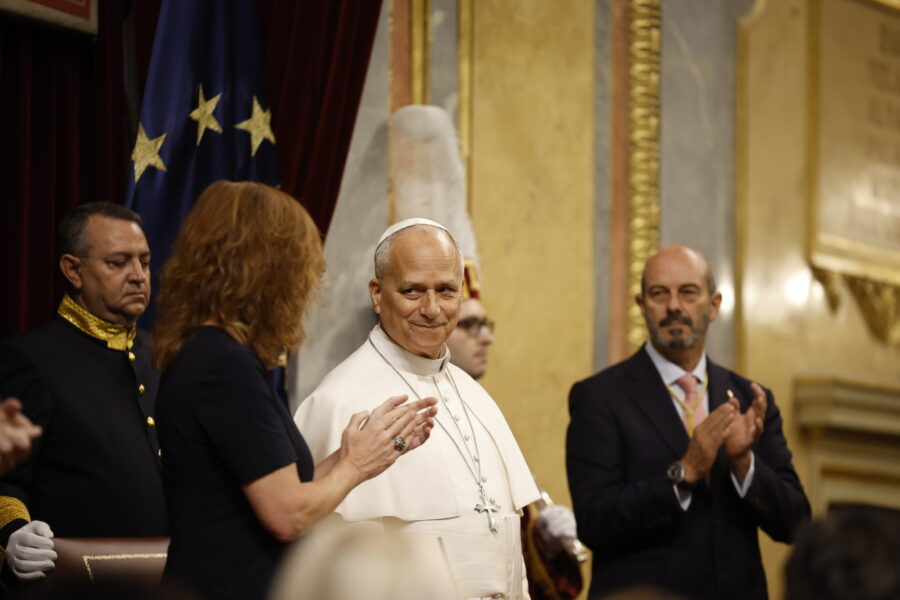
It is fitting to begin with what deserves to be celebrated, because it would be dishonest not to do so. That the first Pope to address the Cortes Generales does so to remind Spanish legislators that the dignity of the person precedes any concession by the State and cannot be left at the mercy of shifting majorities; that he defends the life of the unborn, the elderly, and the sick; that he calls the family the foundation of the community and upholds the primary and inalienable right of parents to educate their children; and that he demands religious freedom and freedom of conscience against those who would relegate faith to silence—this is simply good news. In a chamber that approved the abortion-on-demand law and the euthanasia law, those words are not a mere protocol formality. It must be said clearly before any objection: Leo XIV spoke true and important things, and he said them where it is hardest to say them.
On life, moreover, he was doctrinally clear. He did not hide behind pious vagueness. He affirmed that every human life must be recognized and protected from conception to its natural end, and that its defense is not a partisan issue nor a confessional interest, but a civilizational goal. He explicitly named the child not yet born. Anyone who claims the Pope was not clear on this principle has not read the speech: he was, and without ambiguity.
What can be observed, however, is something else, more subtle. The Pope stated the principle with firmness, but stopped just short of applying it. He did not name abortion. He did not mention the laws in Spain that allow the legal elimination of innocents. He did not confront the deputies before him with the concrete political responsibility of having voted for or supporting those laws. He spoke of the unborn left in the shadows in a general and almost timeless sense, like someone describing a universal truth without pointing to anyone in the room. This is a legitimate choice, and the courtesy of a guest of the State is understandable. But it is worth noting, because it contrasts with what came later.
For in other matters—more debatable, more open to opinion, more subject to prudential judgment—the tone was no less firm; at times it was even more concrete. On European rearmament, an issue currently under intense political debate in Spain and throughout the Union, the Pope did not remain at the level of principle: he took a position and said it is concerning that rearmament is once again presented as an almost inevitable response. On migration, he descended to the operational level and called for safe and legal pathways and a coordinated, solidarity-based, and effective response. Among the causes of uprootedness, he listed, alongside the lack of peace and economic inequalities, the effects of the climate crisis. He invoked international law, the motto of the European Union, and much of the repertoire of multilateral organizations. And all of this with the same pontifical solemnity with which, minutes earlier, he had spoken of life. The principle remained in the realm of principles; prudential application, by contrast, descended into detail.
Here lies the problem. It is not a matter of saying that concern for refugees, the poor, peace, or creation is not Catholic. It is. The Church’s social doctrine speaks of all these things, and with authority. But one thing is the permanent moral principle—the dignity of every human being, the duty of charity, the demand for justice, the reasonable welcome of the foreigner, the pursuit of peace—and quite another are the concrete applications of that principle: technical diagnoses, legal categories, political solutions. Safe and legal pathways are not an article of the Creed, but a perfectly debatable option in migration policy. The advisability or danger of European rearmament is a prudential judgment on the security of the continent, on which opposing and legitimate Catholic opinions are possible. These applications do not bind the faithful in the same way as the defense of the unborn, and presenting them as if they did does not make them truer: it only makes them more confusing.
That a person flees drought, poverty, war, or catastrophe is a real suffering, and before that suffering the Christian response is obligatory. But turning that heterogeneous reality into a solemn moral category, supported by the encyclical itself and the language of international summits, and pronouncing it from the rostrum of Congress with the weight of the pontificate, places it in a rank it does not deserve. It does not have the doctrinal density of life, family, or educational freedom, and it should not sound as if it did.
The problem, at bottom, is not that the Pope speaks about migrants (sic), peace, or climate. The problem is that a papal speech must distinguish precisely between binding Catholic doctrine, permanent moral principles, prudential applications, and debatable opinions. When everything is pronounced with the same gravity, precisely what most needs clarity is weakened: the life of the unborn, the family, freedom, the common good… Equal firmness distributed across the board does not add authority to what is debatable; it subtracts clarity from what is essential.
Because the Pope has authority—and great authority—to teach faith and morals. He does not have it in the same way to elevate his prudential judgments on climate, migration, defense, or international policy into a kind of unquestionable practical doctrine. These are things of a different order, which require different kinds of obedience from the listener. And when they are all enunciated with identical solemnity, the boundary between the Magisterium, social doctrine, prudential judgment, and the personal opinion of the speaker becomes blurred. The faithful listener is not moved by rebellion, but by love of clarity, when it troubles him to see invested with the symbolic weight of the pontificate that which does not belong to the deposit of faith nor possesses its moral certainty.
And this confusion, it is worth warning, does not strengthen the Church: it weakens it. Clothing a prudential opinion with the authority of the Successor of Peter does not add truth to it; it subtracts clarity from that authority. And an authority less clear loses force precisely where it should resound most clearly and without trembling: before threatened life, before the disfigured family, before the right of parents to educate, before the conscience that power seeks to administer.
None of this turns the speech into a bad speech. It had high passages and truths spoken with courage where it hurts to say them, and it would be unjust and petty to deny it. What can be demanded is not less doctrine, but more precision. The Church renders its best service to the world when it speaks from what it has received, and not when it adopts, without sufficient critical distance, the political vocabulary of the moment. Its task—the only one that no one else will fulfill for it—is to say clearly what the world does not want to hear: that the unborn has the right to live, that the family is not an administrative construct, that parents are not educational delegates of the State, that conscience does not belong to power, and that faith must not be cornered into silence. That was, in its best part, what Leo XIV said in the Cortes. One wishes he had said it without mixing it with everything else.