


By Michael Pakaluk
Catholics who sometimes worry that the Church is no longer bold enough in its preaching of the Gospel might, at least, find some consolation in its buildings. Sacred buildings stand for a long time and perpetuate the convictions of those bolder people who came before us, unless they are destroyed by fire or, in an interesting case, blocked.
Two examples come to mind. The first is St. Paul’s Church in Cambridge, Massachusetts, which the parish website, in its historical overview, describes as deliberately located in an “aggressive setting next to an expanding secular university.”
The brochure on the construction and design of the church, “St. Paul Church, Cambridge, Mass. – Description, Exterior and Interior,” written by its first pastor, Fr. John J. Ryan, begins with a remark from the then-cardinal of Boston, William Henry O’Connell: “The building you describe, Father Ryan, is a book in stone, and it ought to be put into print.”
The cornerstone of this church of exquisite beauty, designed by Edward T.P. Graham, a Harvard graduate and parishioner, was laid in 1916. Its construction, delayed by the Great War, was completed in 1923.
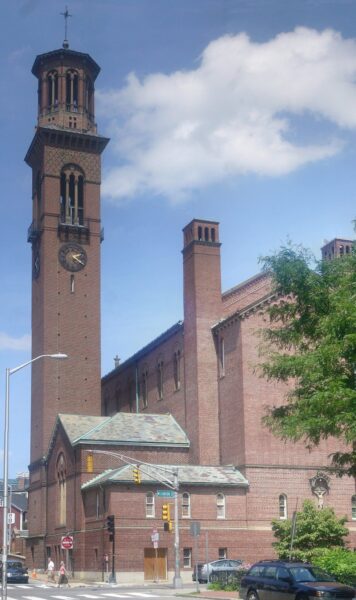
Fr. Ryan’s brochure describes the church as located “at the head of the ‘Gold Coast,’ the term given to the street on which the splendid dormitories of Harvard’s supposedly wealthy students face.” He is referring to Wigglesworth Hall on Massachusetts Avenue.
Regarding this “book in stone,” he comments:
St. Paul’s Church is the formal expression of an unqualified belief in revealed religion and in the Divinity of Christ. Looking at the frieze, this faith is set forth by the Angel of Revelation holding a cross; toward the cross the ancients look for the salvation that will be the gift of the cross; and, counterbalancing, one may see the Christians who likewise regard the cross as the source of salvation and of all spiritual good. The tympanum displays a beautiful bas-relief bust of St. Paul, the interpreter of the old law and of the new law, with his finger placed upon the text and the page held open by the sword grasped in his left hand. The text is carved on the edge of the tympanum and reads: “The church of the living God, the pillar and ground of the truth.” (I Timothy, Chapter III). The quotation from St. Paul, the patron of the church, is the key to the full understanding of all that is within and without this temple of God.
The verse about truth directly confronts Harvard University with its then-new motto of Veritas. I say “new” because, it seems, from shortly after Harvard’s founding until around 1880, its motto was understood to be a religious expression: either In Christi Gloriam (“to the glory of Christ”) or Christo et Ecclesiae (“for Christ and His Church”). But in the nineteenth century “Veritas” was discovered in old records and came to supplant the earlier formulations (although combined forms were also used).
When Fr. Ryan placed “pillar and ground of the truth” over the door of St. Paul’s, Harvard had already for a generation been proclaiming “truth” without Christ and without the Church. The inscription answers: truth needs a pillar, even for a university.
Readers who have visited St. Paul’s will be surprised to learn that, when the church was planned, it was understood to be oriented directly toward the university, bearing witness to Catholic truth in a quite bold manner. Is not the building, rather, tucked away behind a tall apartment building (Longfellow Court)?
In fact, that building went up shortly after construction of the church began and was completed in 1930. I have heard old-time locals refer to those apartments as the “spite block.” If spite was the intention, the architecture itself is like a medieval siege and counter-siege. A concrete block was imposed to cover up that “book in stone.”
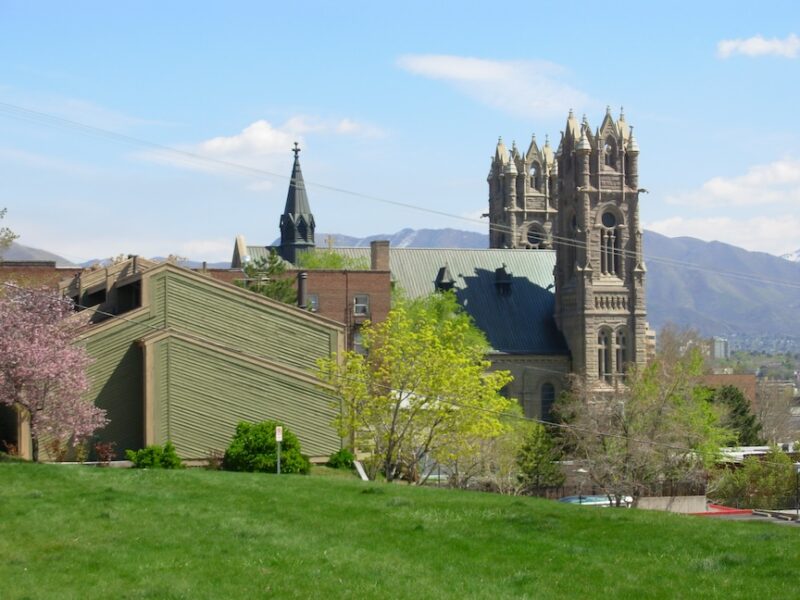
The other great example is the Cathedral of the Madeleine in Salt Lake City, built at about the same time as St. Paul’s (1900–1909) and consecrated by Cardinal James Gibbons of Baltimore. It stands on a hill along South Temple, a mile from the Mormon Temple Square. On the wall of its transept it bears a teaching of St. Paul, addressed to those who hold that the angel Moroni delivered a new Book of Mormon: “But even if we or an angel from heaven should preach to you a gospel contrary to that which we preached to you, let him be accursed!” (Galatians 1:8).
But if this cathedral is a book in stone, it is an illustrated book, teaching the truth through its beauty. Its exterior is Romanesque, built of warm pink Utah sandstone. Its interior is Gothic: vaulted, colorful, and bathed in the light of Munich stained glass. Its original interior, which was plain white, was transformed through successive improvements into something close to a medieval illuminated manuscript in three dimensions: painted murals covering the walls and ceilings; touches of color everywhere; a carved Spanish Gothic reredos; and an altar and baptismal font of Carrara onyx with glass mosaics. Stations of the Cross painted by Utah artist Roger Wilson line the nave.
Anyone may enter the building, marvel at its beauty, draw a comparison with the Temple, and render a judgment.
These generations that came before us did not “build better than they knew” (Emerson’s claim in “The Problem”): they built what they knew, whereas we build worse than we know.
Is it an exaggeration to say that these solid Catholics were also very Roman in the way they built churches? Bernini’s famous colonnade for St. Peter’s was controversial in its time: might Protestants slander Catholics for spending money on pomp rather than giving it to the poor? He was insistent:
Since the Church of St. Peter is, so to speak, the mother of all the others, it must have a portico that expresses precisely the fact that she, with arms maternally opened, receives Catholics to confirm them in their faith, heretics to reunite them with the Church, and infidels to enlighten them in the true faith.
These Catholics built with boldness and beauty because they built with Peter, standing firm upon the Rock and confident in the truth.
About the Author
Michael Pakaluk, a specialist in Aristotle and ordinary member of the Pontifical Academy of St. Thomas Aquinas, is professor of Political Economy at the Busch School of Business at The Catholic University of America. He lives in Hyattsville, Maryland, with his wife Catherine, also a professor at the Busch School, and their children. His collection of essays, The Shock of Holiness (Ignatius Press), is now available. His book on Christian friendship, The Company We Keep, is now available from Scepter Press. He was a contributor to Natural Law: Five Views, published by Zondervan last May, and his most recent book on the Gospels was published by Regnery Gateway in March, Be Good Bankers: The Economic Interpretation of Matthew’s Gospel. You can follow him on Substack at Michael Pakaluk.