


By Daniel B. Gallagher
Ever since I began teaching the Divine Comedy years ago, I’ve been looking for loopholes. Just when I think I’ve found one, it turns out Dante has already covered it with incomparable wisdom.
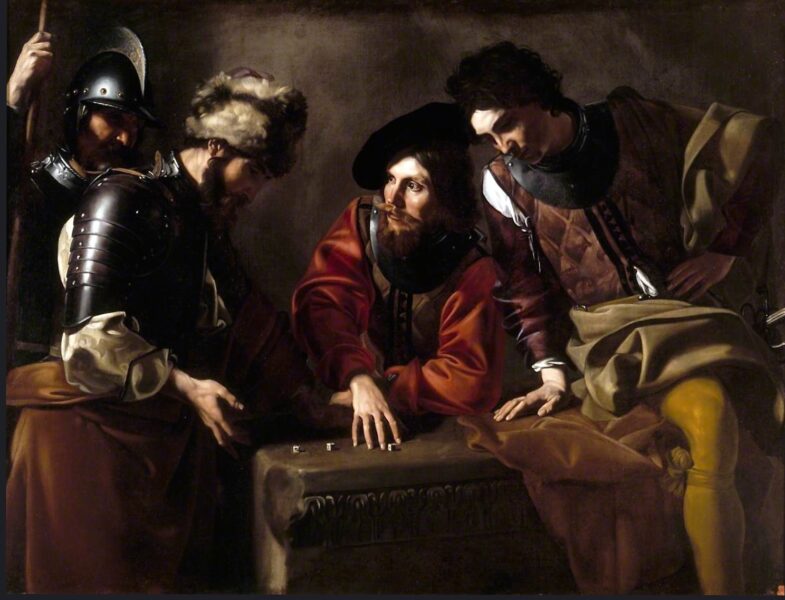
Take gamblers. Why don’t we find them in Hell? Well, it depends on where we look.
There is no specific infernal circle reserved for gamblers. That’s because they’re scattered everywhere. And that, in turn, is because their real sin doesn’t lie in the wager itself, but in what drives it, what fuels it, and what derives from it.
As Dante and Virgil descend into the fourth circle, they glimpse the miserly and the prodigal pushing enormous boulders in opposite directions around a circle of frozen slush. Each time they collide, the miserly shout at the prodigal: “Perché tieni? (Why do you hold on?)”, and the prodigal shout back at the miserly: “Perché burli? (Why do you squander?)” (Canto 7). Gamblers are found in both groups, since they cannot imagine anyone not betting big when so much is at stake, just as they cannot imagine someone putting money anywhere but on the table. They hide money from their families and blow it on slot machines.
More importantly, gamblers inhabit the various bolge (“pouches”) of the eighth circle, reserved for the division of fraud. Of particular interest is the fourth pouch, which contains sorcerers, soothsayers, and anyone who has tried to predict the future. With an ingenious use of contrapasso (the “counter-penalty”), the Florentine poet depicts the soothsayers with their heads twisted 180 degrees and walking backwards “because the power to see ahead had been taken from them” (perché ‘l veder dinanzi era lor tolto). (Canto 20).
The scene is so lamentable that Dante the poet pauses to address the reader directly, saying: “May God grant you, reader, to draw fruit (prender frutto) from what you read.” (Canto 20).
The abundant fruit that can be harvested from Dante’s verses has never been more valuable, in every sense of the word. The Commodity Futures Trading Commission (CFTC) has been busy lately, easing the way for gamblers to bet on anything under the sun, such as which political party will take control of Congress next year and who will win the war in Ukraine.
It is a fact that dollar figures on prediction-market platforms will surpass $240 billion this year, an astonishing increase from $64 billion last year. At that rate, the industry could easily reach the trillion-dollar mark by the end of the decade.
Like Dante and Virgil, until recently I was content to pass the soothsayers in silence, until I understood why Dante the poet interrupts his narrative to remind us how atrocious the sins of the fourth pouch are. He knows that no sphere of human activity is immune to the madness of divination when so much money is at stake, including my nine-year-old son’s little-league baseball team. Apparently, even youth leagues are fair game for big bets.
All of this led me to revisit the official Catholic position that gambling, in itself, is not “contrary to justice.” (CCC 2413). On reflection, that teaching makes perfect sense insofar as it highlights the gravity of other things that cause, accompany, and result from it.
The Catechism stresses that games of chance become sinful “when they deprive the person of what is necessary to provide for his needs and those of others,” or when one becomes enslaved to gambling, or when one cheats and deceives to win. (cf. 2413). Studies show that the latter two situations make the first even more likely.
Who can resist doubling down when an anonymous operator walks away with more than $400,000 after having bet only $34,000 that dictator Nicolás Maduro would be ousted in Venezuela?
More disturbingly, why was no one willing to trace that operator’s identity once it came to light that the bet was placed only hours before U.S. forces effectively captured Maduro? Likewise, two Israelis—both with inside information—pocketed hefty sums after betting that Israel would strike Iran only hours before it actually did.
The threat that prediction markets now pose to national security plunges us into the deepest circle of Dante’s Hell, where treachery and disloyalty are punished.
We are light-years away from grandmothers gathering on Thursdays to play bingo in the church basement to keep the parish school going. We are in an entirely different universe from the friendly office pool during the college basketball tournament to buy a new coffee maker. We live in an age when someone I’ve never met will use artificial intelligence to place a large bet on my nine-year-old son’s regional baseball championship.
As shocking as this is, a cursory reading of the Inferno makes it clear that man, left to his own devices, is just as likely to regress as to progress. Whether you’re day-trading, dabbling in DraftKings, or parking your retirement savings in prediction markets, you’re running the risk of having your head twisted 180 degrees in the next life.
Pointing to Amphiaraus, one of the Seven against Thebes who used the gift of prophecy to foresee that an attack on the mythical citadel would end disastrously for all involved (which it did), Virgil notes how “he made of his back a breast; and because he wished to see too far ahead, he now looks backward and walks in reverse.” (Canto 20).
By banning prediction markets last week, Minnesota became the first state to recognize that betting on absolutely anything under the sun amounts to twisting one’s head 180 degrees and walking backwards. As the anonymous bettor on Nicolás Maduro’s ouster demonstrates, this also opens a shortcut to the lowest circle of Hell, insofar as it can reveal state secrets and effectively amount to treason.
Dante has every base covered in the Comedy. No one rivals him when it comes to warning how an apparently neutral act—one the Catechism rightly characterizes as not in itself “contrary to justice”—can easily capitalize on our concupiscence and land us in the lowest circles of Hell.
About the Author
Daniel B. Gallagher teaches philosophy and literature at Ralston College. He previously served as Latin secretary to Popes Benedict XVI and Francis.