


After the controversy sparked by separatist sectors over the language León XIV will use during the blessing of the Jesus tower at the Sagrada Familia, the priest who will personally welcome the Pope at one of the events during his visit to Barcelona has come out in defense of the use of Spanish and called for an end to a dispute that threatens to overshadow the true pastoral meaning of the trip.
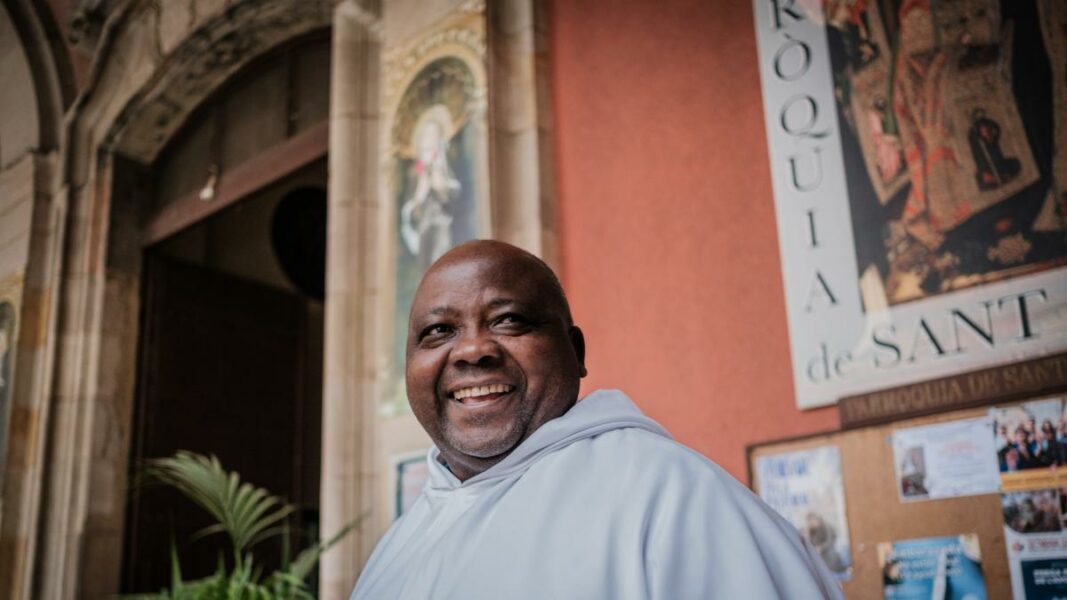
This is Father Faustin John Mlelwa, rector of the parish of San Agustín in Barcelona’s Raval neighborhood, where the Pontiff will meet with social organizations, immigrants, homeless people, and vulnerable groups on June 10.
The priest who will personally welcome the Pope
Mlelwa’s voice is not just another in the debate. The Tanzanian priest leads the parish of San Agustín, one of the places León XIV has expressly chosen to visit during his stay in Barcelona.
The choice is no coincidence. The Pontiff belongs to the Order of Saint Augustine and has included in his schedule a community that visibly embodies the Augustinian charism of fraternity, service, and closeness to those most in need.
The community currently serving the parish consists of four young Augustinian religious from Tanzania and the Philippines: Faustin John Mlelwa, Dennis Pineda Pineda, Michael Go Maambong, and Laurent Joseph Temanya.
Their pastoral work focuses especially on assisting immigrants, vulnerable families, and people experiencing social exclusion. The parish also collaborates with the Mano Amiga Foundation in distributing food and clothing, and maintains a close relationship with the Missionaries of Charity of Mother Teresa, whose sisters daily attend to hundreds of people in need in the neighborhood.
“You can’t learn a language in a day”
In an interview with Catalunya Ràdio, Mlelwa rejected the demands directed at the Holy Father to use Catalan in the blessing of the central tower of the Sagrada Familia.
“One cannot learn a language in a day; besides, we are in Spain, and when someone comes to Spain, we all know that the national language is Spanish,” he stated.
The priest recalled that León XIV has a perfect command of Spanish and that it is logical for him to use a language he knows in order to convey his message clearly.
Mlelwa insisted that it is not reasonable to expect the Pope to learn a new language for a visit of only a few hours and cited his own personal experience. Although he understands Catalan, he admitted that he still does not read it with ease.
“It is not easy to learn a new language in a day; it is impossible,” he stressed.
Omella maintains that “This controversy was unnecessary”
For his part, the Archbishop of Barcelona stated on Thursday that he never understood the origin of the uproar caused by the use of Spanish in the blessing of the Jesus tower and maintained that León XIV had been aware of Catalonia’s linguistic reality from the very beginning.
“I don’t know who started this or with what intention,” Omella said, before explaining that the Pope was fully aware that he was visiting a land where a historic language that has endured for centuries is spoken.
According to the cardinal, León XIV has prepared both his speeches and his homily taking into account the presence of Catalan and will make an effort to include that language in his interventions, without resorting to the artificiality of speaking at length in a language he does not know.
Omella also stressed that this circumstance was known before the controversy erupted. “All this debate was unnecessary; I knew it beforehand,” the archbishop indicated, assuring that the Pontiff had always planned to include references in Catalan during his visit.
The cardinal confirmed that the main formula of the blessing will be in Spanish, but reiterated that there will “certainly” be expressions in Catalan at various moments of the papal interventions.
Even so, he sought to downplay the linguistic issue and recalled what he considers the true meaning of the visit. “The most important thing is that he is coming. The most important thing is the celebration of the Eucharist and the blessing of the cross,” he noted, lamenting that the language debate has ended up occupying more space than the religious event itself.
The Raval, one of the stops in Barcelona
León XIV will arrive at the church at 4:30 p.m. to take part in a meeting focused on poverty, immigration, and social exclusion. More than ninety social and ecclesial organizations from the Raval and other parts of Barcelona are expected to participate.
Among them are Cáritas Barcelona, the Adoratrices—who work with women victims of prostitution and exploitation—and Obinso, dedicated to the social reintegration of former prisoners and people with addiction problems.
The event will not be a liturgical celebration but rather a space for listening and dialogue with those who work daily in the city’s social peripheries.
A parish with nearly seven centuries of history
The history of the Augustinians in Barcelona dates back to the 14th century. Their first convent was founded in 1349, although the construction of the Ciutadella later forced the community to move to the Raval neighborhood, where it remains to this day.
The community suffered greatly during the anticlerical episodes of the 19th century. The convent was burned during the riots of 1835, and the Mendizábal confiscations led to the loss of its properties.
Decades later, the Augustinians gradually returned to Barcelona, and in 2018 they also regained their presence at San Agustín, strengthening a pastoral mission that today also extends to Badalona and the Filipino community of the archdiocese.
Located in one of the city’s most complex and multicultural neighborhoods, the parish has become a symbol of the Church’s social action in Barcelona.