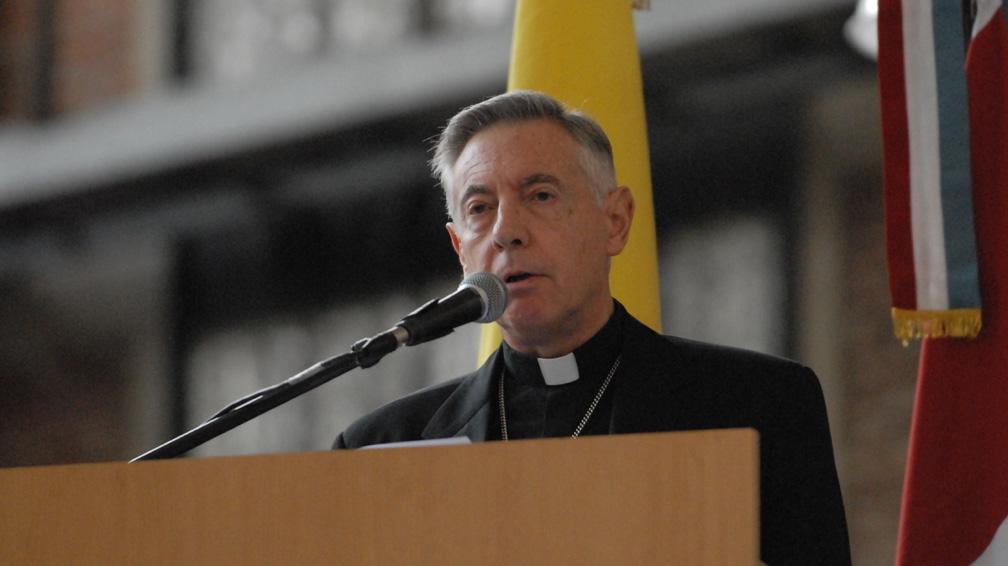
The Archbishop Emeritus of La Plata (Argentina), Mons. Héctor Agüer, has highlighted the growing interest among young people in the traditional Mass and pilgrimages linked to the traditional liturgy, a phenomenon which, in his view, demonstrates that Catholic orthodoxy and tradition are in good health and constitute a hope for the future of the Church.
In an article published by Rorate Caeli, the Argentine prelate notes that in various European countries there is a revitalization of the traditional liturgy, especially among the new generations. As an example, he cites the massive pilgrimage from Paris to Chartres, which this year once again brought together tens of thousands of participants with an average age close to 22.
The phenomenon of traditional pilgrimages
Mons. Agüer considers that the success of initiatives such as the Paris-Chartres pilgrimage reflects a recovery of Catholic tradition in countries where, he claims, it had been stifled for decades by liberalism, progressivism, and atheism.
Alongside the historic French pilgrimage, the archbishop mentions other similar gatherings that have emerged or experienced notable growth in different countries, such as the Rawson-Luján pilgrimage in Argentina, Oviedo-Covadonga in Spain, and Rome-Subiaco in Italy.
In the prelate’s opinion, these events show that there is a growing interest in the more traditional expressions of the Catholic faith, especially among young people.
The traditional Mass and its historical continuity
In his reflection, Mons. Agüer recalls that the traditional Mass has its roots in the early centuries of Christianity and was codified after the Council of Trent, remaining substantially in force for centuries.
The archbishop particularly emphasizes the sacrificial character of the traditional liturgy, centered on the sacramental renewal of Christ’s sacrifice on the Cross and oriented primarily toward the glory and adoration of God.
According to him, this liturgical form accompanied the life of the Church for centuries and was never formally abolished, which is why it has continued to be celebrated to this day alongside the rite promulgated after the Second Vatican Council.
Reflections on the liturgical reform
Regarding the liturgical reform following the Second Vatican Council and the promulgation of the Missal of Paul VI, while he fully recognizes the validity of the reformed liturgy and recalls that it is the Mass he has habitually celebrated since his priestly ordination more than half a century ago, he believes that the reform went far beyond what a prudent updating of the traditional rites would have required.
Mons. Agüer maintains that some of the ambiguities introduced during the reform process have favored liturgical interpretations and practices removed from the authentic spirit of Catholic liturgy.
Read also. Mons. Schneider: the root of the conflict between Rome and the FSSPX lies in the ambiguities of Vatican II
Criticism of liturgical abuses
Finally, the prelate warns about the negative effects of certain practices that are incompatible with the dignity of divine worship.
As an example, he mentions cases of celebrations in which priests introduce elements foreign to the liturgy or turn the Mass into a space for personal creativity.
Read also. An Argentine priest turns Pentecost into a “fruit salad” during Mass
“It is not about creativity, but about fidelity,” states Mons. Agüer, recalling the Church’s teaching that no priest may add, omit, or modify on his own initiative what is established in the liturgical books.
Read also. “Sheikh of Islam”: the striking name of one of the cayucos placed next to the altar of Leo XIV in Tenerife
For the Argentine archbishop, the growth of traditional pilgrimages and the interest that the traditional liturgy arouses among many young people is a sign that many of the faithful are seeking precisely a celebration marked by reverence, continuity with tradition, and fidelity to the norms of the Church.
Below we provide the full text of Mons. Agüer:
The recovery of the Mass
The media and, especially, social networks, indicate that in several European countries, especially among young people, the “Mass of all time” is being lived with fervor, accompanied by numerous processions and pilgrimages. The youthful multitudes that reenacted the traditional Paris–Chartres pilgrimage have drawn attention; with an average age of 22 years. It is a recovery of Catholic tradition; which had been stifled in those countries by liberalism, progressivism, and atheism.
The “Mass of all time” can be called so because it originates from the 7th and 8th centuries, and remained in force for centuries until at least the Council of Trent, which revised and reissued it, so that it has reached our days. Essential to it is its identification with the Sacrifice of the Cross, instituted as the Sacrament of the Sacrifice at Jesus’ Last Supper with His Apostles. This Sacrament is the mystery of the Passion and the Resurrection, consecrated by the Holy Spirit. The Mass is directed to the Glory of the Triune God, to whom it offers the Sacrifice of Jesus. In the Catholic Church it is offered as an oblation of bread and wine, which by the unalterable words of the Consecration become the Body and Blood of Jesus; food of immortality for the faithful.
The Mass identifies Catholicism from the Council of Trent to Vatican II. During the pontificate of Paul VI (Giovanni Battista Montini), who succeeded the brief pontificate of John XXIII, who convoked the Ecumenical Council, a new Mass was invented. Some modification or another could have been introduced to the “Mass of all time”; as was done during its centuries-long validity. But no; Vatican II sought to retouch everything, and from its spirit a new Mass was to spring forth. Always valid, of course; but not without ambiguities that remained at the disposal of the celebrants.
The author of the new Mass was Monsignor Annibale Bugnini; recognized as a Mason according to undeniable documents, though secret according to the nature of Masonry. In it, the priest, standing, faces the people; the biblical readings are multiplied, and over time several Eucharistic Prayers were authorized, which recreate the single Canon of the “Mass of all time.” It would seem that in the Mass of Paul VI and Bugnini, the priest who offers the rite should strive to turn toward God, and ensure that the faithful are not confused.
The ends of the Mass are several, but the latreutic one—the adoration and praise of God—is the principal; without doubt, prayer and communion enrich the people of God. This is the Mass I celebrate, in which I was ordained almost 54 years ago; I do so with the greatest devotion I can. But I recall that in my childhood, as an altar server, I regularly attended the “Mass of all time”; a rite that was never invalidated and which accompanied that of Paul VI until today, which, as I said at the beginning, is being rediscovered with enthusiasm by the youth.
Pilgrimages such as Paris–Chartres; and those of Rawson–Luján (Argentina), Oviedo–Covadonga (Spain), Rome–Subiaco (Italy), and others that are emerging here and there, speak to us of something undeniable: orthodoxy and Tradition are in good health, and are a guarantee of the future. Some bishop who entered Mass on a skateboard, or some priests who dress up as clowns when celebrating, should take note, for example. Such abuses can only provoke a stampede effect. As the Church rightly teaches, “no one, even if a priest, may remove or add anything” to what is established in the liturgical books. It is not about creativity, but about fidelity.
+ Héctor Agüer
Archbishop Emeritus of La Plata.
Buenos Aires, Monday, June 1, 2026.
St. Justin, martyr.