


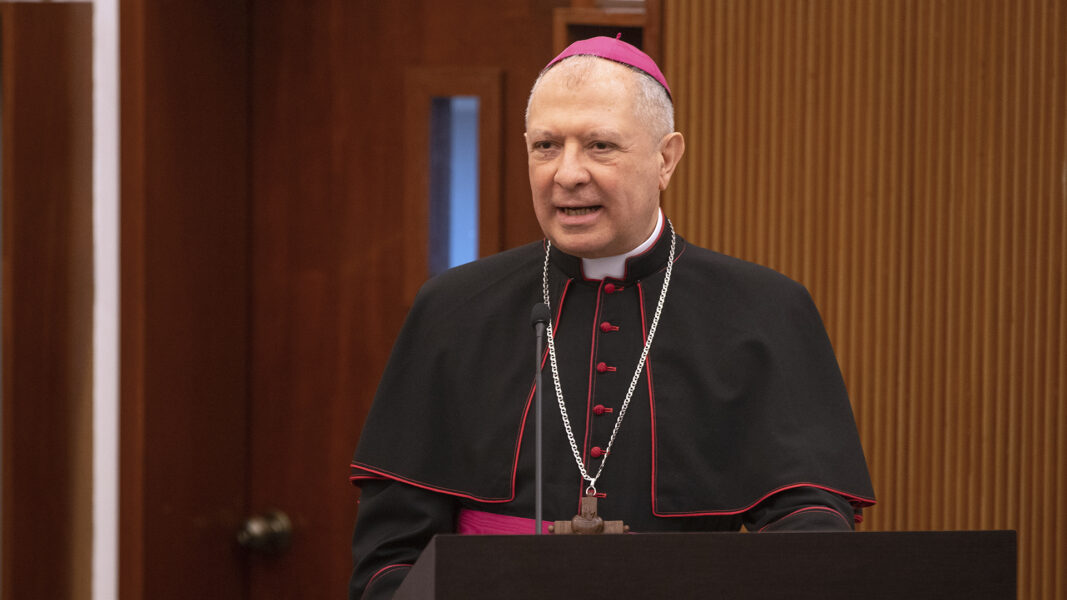
Monsignor Paolo Rocco Gualtieri has an explanation pending. Not a generic explanation, nor an ecclesiastical note wrapped in formulas of diplomatic prudence. A concrete explanation: who authorized that, during the listening channel for victims of the Sodalitium at the Apostolic Nunciature of Peru, the entry and exit of people linked to an extremely delicate process were recorded with cameras, and for what purpose those images were filmed.
The question arises from the complaint published by La Abeja, which states that during several days of the listening channel at the Nunciature, a man with audiovisual equipment observed, filmed, and recorded who entered and exited, in addition to interviewing some people as they left the premises. The outlet identifies that man as Salvador del Solar, a Peruvian actor and filmmaker, and maintains that his presence was repeated later at the reparations Mass in Catacaos, where he is said to have been in the front row filming Jordi Bertomeu and the bishops present.
The Apostolic Nunciature in Lima is not just any public square. It is the diplomatic representation of the Holy See in Peru. The Peruvian Episcopal Conference itself identifies Monsignor Paolo Rocco Gualtieri as Apostolic Nuncio in Peru and titular Archbishop of Sagona. Therefore, what happens under the institutional umbrella of that see cannot be treated as a side incident or as a street scene without anyone responsible.
The official communiqué of the Apostolic Commissioner was unequivocal: between May 4 and 22, 2026, a “First Listening Channel” was enabled at the seat of the Apostolic Nunciature in Peru for people who considered themselves victims not duly compensated for physical, sexual, spiritual, conscience, authority, economic, or other abuses linked to members of the Sodalitium spiritual family. It was not a promotional act. It was not a press conference. It was not a call to feed anyone’s visual archive. It was, at least formally, a device for listening to victims.
Precisely for that reason, the complaint is serious. Anyone who goes to a Nunciature to report harm suffered in contexts of abuse, authority, conscience, or spiritual manipulation has the right to expect confidentiality, sobriety, and institutional protection. They should not have to become an involuntary extra in an audiovisual narrative. They should not have to be filmed entering or leaving. They should not have to discover later that their presence served to give dramatic weight to a self-promotional clerical documentary.
The problem, Monsignor Gualtieri, is no longer only Bertomeu. The problem is the institutional custody of the Nunciature. If the cameras were there with authorization, you must explain who granted it. If they were there without authorization, you must explain why they were not prevented. If the recordings had a pastoral or internal documentary purpose, you must say so. If they were linked to an external production, it must be known who promoted it, who financed it, who keeps the material, and who authorized the use of the image of people who came to a victim-listening process.
Nor is it enough to say that the cameras were outside the building. The Nunciature is not morally absolved because the tripod is placed on the sidewalk or in a nearby square. If the object of the recording was the people summoned by a pontifical procedure, the fact directly affects trust in the see that summoned them. Institutional responsibility is not measured only by the exact point at which the camera was set up, but by the use made of a mission organized by the Holy See.
The Catacaos Mass ended up aggravating the suspicion. The Peruvian Episcopal Conference presented that celebration as a gesture of closeness and symbolic reparation toward the Tallán peasant communities, and Vatican News described it as the culmination of a will for reparation after years of abuses, persecutions, and expropriations. But La Abeja maintains that there were also cameras following every gesture of Bertomeu. The question imposes itself: was the Mass only reparation, or was it also part of a previously calculated audiovisual narrative?
A nuncio cannot take refuge in silence when the see that represents the Pope appears linked to a possible audiovisual instrumentalization of victims. Silence is not prudence when vulnerable people are involved. Silence, in these cases, functions as cover.
The clarification should be public and verifiable. It must state whether Salvador del Solar or any audiovisual team had authorization to film during the listening channel. It must state whether Bertomeu knew that images were being taken. It must state whether the victims were informed. It must state whether there was consent. It must state whether a documentary exists or not. It must state whether the Secretariat of State was aware of this audiovisual dimension of the mission. It must state what measures have been taken to protect the identity, dignity, and privacy of those who came to the Nunciature.
The Church has repeated too many times that it wants to place victims at the center. Placing them at the center does not mean putting them in the frame. It does not mean turning them into atmosphere, scenery, or emotional evidence to magnify a Roman official. It does not mean using their pain as dramatic lighting for a character.
Monsignor Gualtieri must respond. Because if the complaint is false, it is appropriate to refute it with facts. And if it is true, what happened at the Apostolic Nunciature of Peru was not an aesthetic excess or a communicative blunder. It was an institutional profanation of the victims’ trust.