


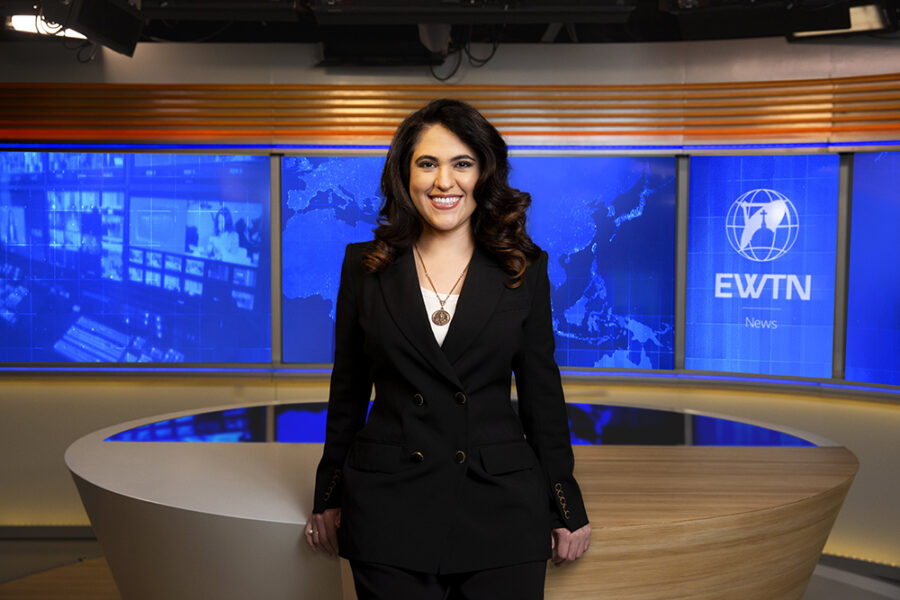
At 39, María Montserrat Alvarado has become one of the most talked-about appointments of the pontificate of Leo XIV. While some progressive media outlets portray her as an “ultraconservative” figure critical of Francis because of her career at the helm of EWTN News, others highlight precisely what explains her rise: solid experience in defending religious freedom, an extensive track record managing international Catholic media, and a reputation built over the years in some of the most influential institutions of American Catholicism.
Mexican by birth, American by adoption and future prefect of the Dicastery for Communication as of next November 1, Alvarado arrives at the Vatican with the challenge of coordinating the entire communications structure of the Holy See to lead one of the most strategic areas of the Roman Curia.
A career built on defending religious freedom
Born in Mexico City, Alvarado studied at Florida International University and George Washington University. For more than a decade she developed her career at the Becket Fund for Religious Liberty, one of the most prestigious U.S. organizations dedicated to defending religious freedom and freedom of conscience.
She speaks Spanish, English and French. Between 2009 and 2023 she held various positions of responsibility at the institution, taking part in initiatives aimed at protecting the rights of believers, religious communities and Catholic institutions against regulations deemed harmful to their convictions.
Her time at Becket gave her experience in the legal, institutional and communications fields, as well as consolidating a reputation as a rigorous professional committed to defending human dignity and fundamental freedoms. That trajectory was summed up by The Wall Street Journal, which described her as “a defender of all religions on the front lines of America’s culture wars.”
The executive who consolidated the growth of EWTN News
In 2023 she was named president and chief operating officer of EWTN News, the news division of Eternal Word Television Network, the communications network founded by Mother Angelica and considered the world’s largest Catholic media group.
From that position she has led a complex international structure that produces content in seven languages through television, radio, print, digital media and social networks.
Her management has been especially valued for her ability to integrate different communication formats and for her commitment to strengthening the Catholic presence in the digital sphere, one of the great challenges currently facing evangelization.
After her appointment was announced, EWTN highlighted precisely her commitment to communication centered on “proclaiming the truth of Jesus Christ and the teachings of His Church with clarity, fidelity and charity.”
A dicastery created by Francis in 2015
Alvarado will replace Paolo Ruffini, who has led the Dicastery for Communication since 2018 and has reached retirement age.
In her first statements after the news broke, the future prefect said she had received the appointment “with deep gratitude, humility and trust in the Lord” and expressed her desire to serve the Holy Father at the beginning of his pontificate.
She also thanked Ruffini for his work and expressed her willingness to continue strengthening the dicastery so that it may keep serving the Church in its mission of communicating Christ to the world.
Can a woman lead this dicastery?
Montserrat Alvarado’s appointment has also raised questions about a canonical issue that has already surfaced in other recent Curia appointments. However, in this case there is no legal or doctrinal problem, because the Dicastery for Communication does not exercise power of governance or jurisdiction; that is, it does not perform functions that involve the exercise of authority proper to ecclesiastical government.
Although canon 129 states that those who have received holy orders are the subjects capable of exercising the power of governance, it expressly adds that “in the exercise of this power, lay faithful may cooperate in accordance with the law.” Therefore, Alvarado’s appointment poses no canonical difficulty and places the focus on what is truly relevant: her preparation, experience and professional background.
An appointment laden with symbolism
The choice of Montserrat Alvarado also carries a symbolic dimension that cannot be overlooked.
The future prefect comes from EWTN, an institution that for years maintained an editorial line frequently critical of some decisions and orientations of the pontificate of Francis; differences that became public on several occasions.
In 2021, Francis himself referred to a “large Catholic television network” that, he said, continually spoke ill of him. Although he did not expressly mention EWTN, no further references were needed to recognize the network founded by Mother Angelica. On that occasion the Pontiff even stated that those attacks were “the work of the devil.”
What bothers some sectors
Labeled ultraconservative and opposed to Pope Francis by the most progressive media, her appointment has generated a reaction that has highlighted the scope of this decision. Some of them have openly acknowledged the difficulty of reconciling an appointment that combines two elements they did not expect to find together: the promotion of a woman to one of the most important positions in the Curia and the arrival in the post of a leader identified with a clearly conservative vision and critical in the defense of religious freedom and doctrinal fidelity.
The discomfort is significant because it reveals that the debate does not really revolve around the presence of women in positions of governance, but rather around the specific profile of the person chosen.
A new stage for Vatican communications
The responsibility Alvarado will assume next November will be enormous. On her shoulders will rest the coordination of the entire communications machinery of the Holy See in an era marked by technological acceleration, social media and the growing fragmentation of the information ecosystem.