


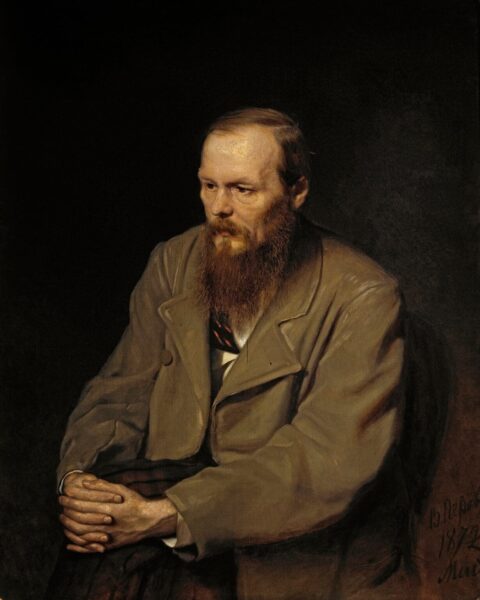
By Joseph R. Wood
A great deal is being written at the moment about AI and the proper Catholic response to it. Therefore, this column will not be about AI.
In Fyodor Dostoevsky’s novel The Brothers Karamazov, Ivan Karamazov has been driven, by his revulsion at evil in the world, to “rebellion” against God, and perhaps to the brink of madness. He has written a poem, “The Grand Inquisitor,” which he relates to his brother, the devout (though perhaps somewhat naïve) Alyosha.
The poem is set “in Spain, in Seville, in the most terrible time of the Inquisition, when fires were lit every day to the glory of God.” Ivan does not admire Western rationalism and science, nor the Roman Church.
After centuries of entreaties by Christians, Christ has appeared in Seville, and is immediately recognized by all. “All” includes the Cardinal Grand Inquisitor, the elderly Jesuit responsible for determining which heretics will be handed over to the civil authorities for immolation. Just after Christ had raised a little girl from the dead on the steps of Seville Cathedral, the Grand Inquisitor orders his arrest and confinement.
Ivan portrays the people of Seville as “so tamed, submissive, and tremblingly obedient to his will” that the Grand Inquisitor can lead the Savior to prison without any protest. He enjoys totalitarian control over the people, who will not oppose him even in the presence of the One they know to be Christ.
The Inquisitor proceeds to interrogate his prisoner, though the interrogation turns out to be a monologue of recrimination directed at the silent Man of Sorrows. “You may well not have come now, or at least not interfere with us for the time being.”
The Inquisitor’s case against Christ centers on the question of human freedom and our capacity to bear it. Christ, the Inquisitor claims, often said that he wanted to make men free. “But in the end we have finished this work in your name. For fifteen hundred years we have been troubled by this freedom, but now it is finished and finished well.” The Inquisitor wants no interruptions in his work, not even from the One in whose name he carries it out.
“These people [in Seville] are more certain than ever that they are completely free, and at the same time they themselves have brought their freedom to us and obediently laid it at our feet.” He and his colleagues “have finally vanquished freedom, and have done so to make people happy.”
Such is the usual bargain proposed by totalitarians: give us your freedom and we will secure your happiness in peace and security.
This happiness is not the Aristotelian and Catholic conception of the human telos as contemplation of the divine, an activity of the soul in accordance with virtue. It is rather a version of the pursuit of pleasure, with material needs met and no difficult choices required. No inconvenience, only pacified tranquility and comfort.
The Inquisitor sees in the three temptations of Christ “three questions [in which] everything was so precisely guessed and foretold, and has proved to be so completely true, that to add anything to them or to take anything from them is impossible.” By answering those questions as he did, Christ chose freedom over obedience to the “dreadful and intelligent spirit, the spirit of self-destruction and non-being.”
But in offering such a possibility of freedom to humanity, Christ erred, the Inquisitor charges. He vastly overestimated the goodness of human beings and our capacity to live with the true freedom he proposed to us. Humans “in their simplicity and innate unruliness cannot even understand [such freedom], which they fear and dread.”
Science, says this Jesuit turned follower of the “dreadful spirit,” will first re-enact the project of the Tower of Babel, which will again fail in its promises to satisfy all human needs. Then, says the Inquisitor, people will turn to him and those like him, who will rule them in what will replace the church of Christ. “No science will give them bread while they remain free, but in the end they will lay their freedom at our feet and say to us: Better that we be enslaved, but that we be fed.”
We cannot have both bread and freedom, because we refuse to share. It is better to renounce freedom, avoid making choices and cultivating virtue through adversity, all for an uncertain and purely free future. It is better to cease being the human created in the image of God, to abandon the hope of deification and union with God as true happiness.
The few who then make up the ruling elite or vanguard will be the only ones to suffer under this final arrangement, because they will know that they are deceiving the masses. “This deception will constitute our suffering.” The masses will submit in exchange for a “quiet, humble happiness, the happiness of weak creatures.”
Those who are thus ruled “will have no secrets from us. We will allow or forbid them to live with their wives and lovers, to have or not to have children—everything depending on their obedience—and they will submit to us gladly and cheerfully. . . . And all will be happy.”
Dostoevsky was writing this in direct opposition to modern science and its political variant, socialism, which promised heaven on earth, a heaven whose only requirement was obedience. These forces responded not only to the weak human inclination to find freedom a burden, but also to the human hope for a universal material and political solution to the problems of the human condition, and to the evil that drove Ivan to despair.
Dostoevsky knew that no such magical solution can allow us to be free without suffering.
St. Augustine also knew that. He distinguishes in The City of God between those who love earthly comforts and would eagerly accept universal technologies or political systems that erase our freedom, and those who turn their love toward the eternal Good, embrace their freedom, and choose the path of suffering toward the full magnificence of their humanity.
It is not a new choice. It simply comes around again and again.
About the Author
Joseph Wood is a Collegiate Assistant Professor in the School of Philosophy at The Catholic University of America. He is a pilgrim philosopher and an accessible hermit.