


By Stephen P. White
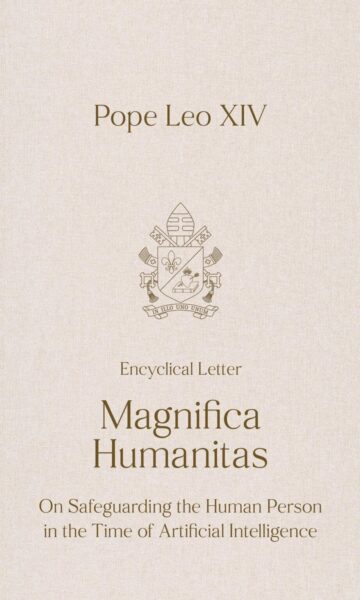
Pope Leo XIV’s first encyclical, Magnifica humanitas, was published earlier this week. It is long for an encyclical and unexpected in some respects. It is worth reading, worth pausing over. What follows is not a summary, much less a “review” of the document, but some reflections prompted by the encyclical.
First, a story: at a conference some time ago, I met a man who works for a large Catholic charitable organization. During our conversation, he made an important point about the work he and his colleagues do every day. Reading this encyclical brought that conversation back to mind.
The goal of their efforts, he said, is not simply to serve the poor; the goal is to find Christ in the poor they serve.
And to illustrate the point, he told this story. The manager of a local branch of their organization, enterprising and well-intentioned, had implemented a new distribution system whereby someone could pull up in their car, receive their allotment of charitable contributions without getting out of the vehicle, and drive away again in a matter of seconds.
And that, my interlocutor insisted, was a huge problem.
It was enterprising, efficient, and utterly impersonal. What was distinctively Christian, or even distinctively human, about “drive-through charity” of that sort? Where was the opportunity to find Christ in the other or to be Christ for him?
It is not very difficult to see how such a critique of efficiency at the expense of interpersonal (that is, human) interaction might apply to artificial intelligence. And Pope Leo does just that in Magnifica humanitas, for example, when he writes:
When efficiency becomes the ultimate measure of value, human beings are tempted to regard themselves as a project to be optimized, rather than as persons called to relationship and communion.
Technology that eliminates human imperfection and fragility—or that leads us to eliminate the broken person altogether—removes a privileged place for encountering Christ himself. In the suffering of Jesus, man’s weakness, his fragility, and even his poverty take on an entirely new dimension. The difference between entering into human fragility and eradicating it has profound implications:
[T]o build for the common good means accepting the limits and weakness of humanity without regarding them as an error to be corrected. Today, the human desire for fullness of life risks being diverted by deceptive goals, such as the prospect of a technology that promises to free us from all weakness, and models of well-being that leave entire populations behind. Too often, we place our hope in unlimited “updates,” in forms of progress that exacerbate inequalities, and in immediate solutions incapable of healing people’s wounds.
It is worth noting that while such warnings are appropriate for the uncritical use of artificial intelligence, they are hardly exclusive to the imminent challenge of AI. Many of the criticisms of AI in this encyclical are of this kind: more generally applicable to modern technology and less specific to the challenges of AI than some readers (including myself) might have expected.
This encyclical declares its theme to be “On Safeguarding the Dignity of the Human Person in the Age of Artificial Intelligence.” And while this encyclical certainly addresses AI, the heart of the document is much more a positive defense of human dignity than a comprehensive or definitive critique of AI.
Which brings us to the next observation about this encyclical: Magnifica humanitas is, in a sense, as much an encyclical on the Social Doctrine of the Church as it is a contribution to that body of teaching.
Pope Leo devotes the first 15,000 words or so to laying out the history, development, and principles of Catholic social doctrine. In doing so, he not only provides a basic handbook on the Church’s social magisterium, but also manages to highlight the deep continuity that stretches from Leo XIII through all subsequent social teaching. That thread of continuity is human dignity, understood in light of the Incarnation.
This thread continues unbroken through the Second Vatican Council, particularly in Gaudium et Spes. And it is this same theme that unites Pope Leo XIV in continuity with his predecessors, most especially with Francis, Benedict XVI, and St. John Paul II.
[T]he guiding principle of Pope Leo’s Encyclical, and of all the Church’s social doctrine, is a correct vision of the human person and of his unique worth, inasmuch as “man… is the only creature on earth which God willed for its own sake.”
John Paul II wrote those words, quoting Gaudium et Spes, in 1991 with reference to Pope Leo XIII’s Rerum Novarum, but they apply equally—indeed, emphatically—to Leo XIV’s Magnifica humanitas.
This truth about man is the Church’s great answer to our modern age, an age in which AI is only one threat, albeit an acute and urgent one, to man’s self-perception.
Leo signals this continuity within social doctrine and papal magisterium, not simply through equitable citations—citing Francis X number of times, John Paul II Y number of times, and so on—but by constructing arguments that show the complementarity and cumulative strength of the various contributions to the tradition.
And that, too, is a significant contribution of this “encyclical on AI.” There is reason to believe that Leo sees his own pontificate as an opportunity for synthesis, an opportunity to weave together many of the scattered and even frayed threads that make up the Church; to hold together pre- and post-conciliar traditions, the pontificates of John Paul II and Francis, the robust Thomism of Leo XIII’s social magisterium and the sociological turn of John XXIII’s Pacem in terris and Paul VI’s Populorum progressio.
Perhaps this is wishful thinking on my part. Perhaps it is too much to deduce from a single encyclical on artificial intelligence. Or perhaps it is exactly what we should expect from an Augustinian Pope who knows that true peace is not the absence of conflict, but the tranquility of order, and who has taken as his motto In Illo Uno unum. In the One, we are one.
About the Author
Stephen P. White is executive director of the Saint John Paul II National Shrine and a fellow in Catholic Studies at the Ethics and Public Policy Center.