


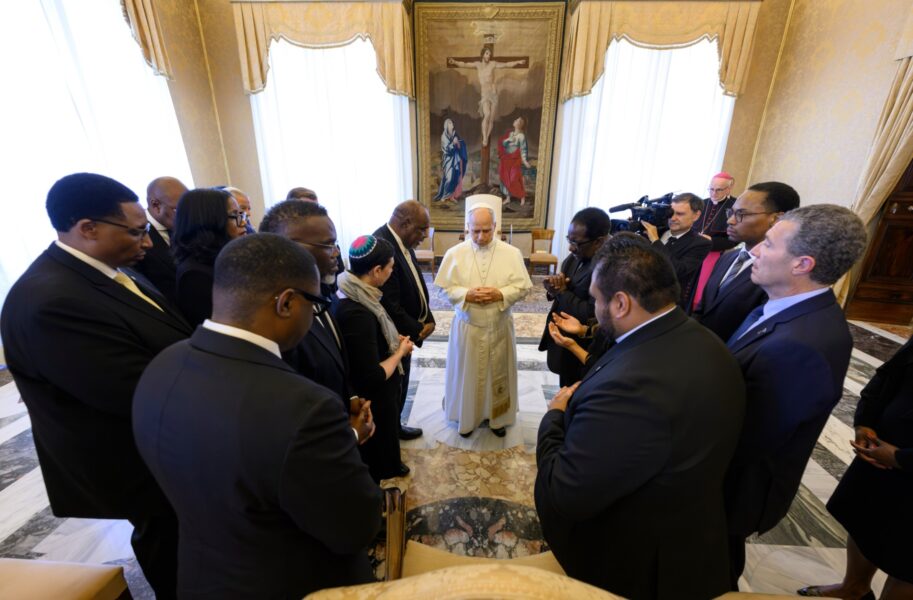
The American Pope held a private audience with Brandon Johnson, the Democratic mayor of Chicago known for his radical defense of abortion and gender ideology. According to Johnson himself, they discussed immigration, reparations for slavery, and the war in Iran, but there was no mention of the moral issues the politician actively promotes.
Leo XIV received Brandon Johnson, mayor of Chicago—the pontiff’s hometown—and a prominent figure on the far-left wing of the Democratic Party, at the Vatican last Thursday, May 28. The meeting included what Johnson himself described on his social media as a “multireligious prayer” with his delegation, made up of members of various Protestant denominations.
The Holy See Press Office has not provided details about the content of the conversation. However, in a subsequent press conference, the mayor enthusiastically outlined the topics discussed: ICE raids in Chicago, the Trump administration’s immigration policies, reparations for slavery, and the armed conflict in Iran.
“The Pope wanted to know how the ICE raids were affecting our city and whether they were still taking place. I told him about my executive orders, to which he was very kind and encouraging.”
Notably, Johnson did not mention that the pontiff had raised any objection to his political record, which includes the active promotion of unrestricted abortion, the free distribution of abortion pills, the persecution of pro-life counselors outside clinics, and the official commemoration of the “National Day of Appreciation for Abortion Providers” in 2024. Nor does it appear that his LGBT agenda was addressed, which includes executive orders on alleged “violence against transgender women”—that is, men with gender dysphoria—and a commitment to reducing police action against those who identify as homosexual or transsexual.
Criticism of Trump, silence on abortion
According to Johnson, Leo XIV expressed his “disagreement with the approach” of Trump on immigration. This stance is consistent with the pontiff’s statements during his first year of his pontificate, in which he has gone so far as to equate support for U.S. immigration policies with support for abortion, an analogy that has caused bewilderment among Catholics who consider the two issues morally incommensurable.
The mayor also claimed to have discussed the encyclical Magnifica Humanitas, in which Leo XIV asked forgiveness for the alleged involvement of the Church in slavery, and the advisability of offering economic reparations to the African American population. According to Johnson, the Pope “took no position” on the latter point.
“In the midst of a brutal, horrific, and ignorant tyrant currently occupying the White House, it is imperative that we walk in the true essence of our faith.”
With these words, Johnson bid farewell to the journalists after the meeting, thanking the pontiff for his welcome and inviting him to celebrate a Mass in Grant Park during a possible visit to Chicago.
Audience for the pro-abortion mayor, silence for the FSSPX
The contrast between the warm reception given to Johnson and the Vatican’s attitude toward the Priestly Fraternity of St. Pius X has not gone unnoticed. While the Pope finds time to meet with a Protestant politician who publicly celebrates abortion providers, the FSSPX—which has more than a thousand priests and hundreds of thousands of faithful worldwide—has yet to receive a response to its request for an audience before the episcopal consecrations scheduled for July 1.
Father Davide Pagliarani, Superior General of the Fraternity, stated in April that “before declaring a society that serves as a reference for hundreds of thousands of faithful to be schismatic, it would be desirable to personally meet those who are to be judged.” According to various sources, the Vatican is preparing the excommunication of the FSSPX bishops following the consecrations.
Historical context: the Church and slavery
Leo XIV’s references to the Church’s responsibility for slavery contrast with the historical record. St. Patrick, himself a former slave, is considered by historians to be the first public figure to condemn the institution. In 1537, Paul III prohibited, under penalty of excommunication, the enslavement of the indigenous peoples of the New World through the bull Sublimis Deus. Gregory XVI denounced the transatlantic slave trade in his 1839 encyclical In Supremo Apostolatus, nearly three decades before its abolition in the United States. These magisterial precedents, systematically omitted in current Vatican discourse, considerably qualify the narrative of a complicit Church that must now ask for forgiveness.