


By Anthony Esolen
Reports from New York indicate that the state Department of Health has issued warnings to the Dominican Sisters of Hawthorne, whose order, for more than a century, has run a hospice for terminally ill patients with incurable cancer. In fact, the town where the hospice is located was renamed Hawthorne in their honor. The state, however, without much reflection, passed a law requiring all nursing homes to accommodate women who insist they are men, men who insist they are women, and any other permutations of sexual expression that that factory of illusions, the human imagination, can invent.
Of course, that is not how they put it. It is how a sensible person would put it. Likewise, a sensible person would affirm other biological facts obvious to anyone with eyes or a clear mind, such as that dogs can only be male or female, regardless of whether they have been neutered, or that the child developing in the mother’s womb is human, individual, alive, a complete organism, and is exactly where it is natural for it to be.
The sisters received no complaints from their residents, so the state’s warnings appear to be motivated by purely gratuitous hostility. Because the sisters are Catholic. They responded as Peter did in the Acts of the Apostles: “We must obey God rather than men.”
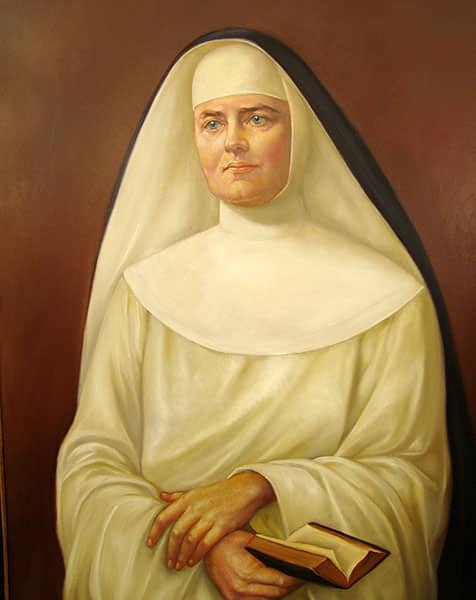
The ironies abound. Their hospice is located in a town called Hawthorne, renamed in honor of their order in the days when New Yorkers were grateful to them for undertaking a work, at no cost to the state, that no one else was eager to do. Their founder, Sister Alphonsa Mary, was none other than Rose Lathrop Hawthorne, the daughter of that titan of American literature, Nathaniel Hawthorne, who certainly was not Catholic, though he harbored no Puritan animosity toward the Church.
Nor did Rose, a convert, dishonor the memory of her mother and father. Far from it. Literary scholars owe her a great debt of gratitude for preserving, editing, and publishing their correspondence. I have read some of the letters they wrote when they lived for a few years in Italy and became close friends with Robert and Elizabeth Browning.
Rose noted that all the great English and American writers and artists of the time, regardless of their faith, traveled to Italy to drink from the wellsprings of Catholic culture.
Hawthorne himself, of half-Puritan sensibility, was keenly aware of his ancestry, even ashamed of it, as he was the great-great-grandson of John Hathorne, the most aggressive of the judges in the Salem witch trials. Those trials brought out the worst in both sexes.
In men like Cotton Mather, who died still believing there had been witchcraft in Salem, the matter was fueled by the ferocity of intellectual warfare; he was fighting against a recrudescent materialism. If demons are real, materialism is false.
The victims of Salem were ground up in the gears of his sharp and relentless mind. I hope God forgave him before he died, but if not, a Dante of our day might find a way to place him beside Lenin, two murderers by abstraction.
The girls fare no better. Indeed, it is impossible to imagine a group of boys gathering to faint, babble, scream, writhe, and throw an entire colony into turmoil with visions of the occult, catching the habit by social imitation, and believing it themselves more than half the time.
“Enthusiasm” is what the shrewd Ronald Knox called it, and his history is replete with devout women:
From the Montanist movement onward, the history of enthusiasm is largely a history of female emancipation, and it is not a reassuring one. Martha Simmonds escorting Nayler into Bristol with cries of Hosanna, Madame Guyon training her director in the path he should follow, the convulsionary priestesses making the motions of saying Mass at Saint-Médard; the staunchest defender of women’s rights can hardly deny that the unfettered exercise of the prophetic ministry by the more devout sex may threaten the ordinary decorum of ecclesiastical order.
To which the feminists of our time would doubtless reply that that ordinary decorum is precisely what they intend to alter, if not destroy altogether.
The brazen and lucid liar is usually male; his lie is strategic and cold. The believer who catches her breath at the lie is usually female; her lie is the work of vanity, or of misdirected piety, and is warm, often with sincere devotion.
Saint Paul must have encountered this. It may well be why he does not permit women to teach at the celebration of the Eucharist, because “the woman was deceived, but the man was not deceived.” The word he uses suggests deception, trickery. It is not the same as a mere statement contrary to reality, as when someone testifies that he saw John steal from the store, when he saw nothing, or when he saw Joe doing it instead. It implies credulity or the willingness to be deceived.
That is why I say there is no possibility, none, that what is happening to the Sisters in Hawthorne could have occurred thirty years ago, and not only because, at that time, if you had said there were more than two sexes, everyone would have known you were not in your right mind.
Folly has taken its seat in the place of wisdom, and we may expect, in various forms, that what happened in Salem will happen among us with all the dizzying force of the mass media—the mechanism of transmission for social contagion—allowing it to increase and multiply. All this will occur while the cold liars, those who hate humanity, continue their project of supplanting the human soul with the algorithms of computers, amassing a power hitherto unimaginable, which, by comparison, makes Stalin seem like a mere schoolyard bully.
Meanwhile, the good Sisters devote themselves to acts of daily charity, sweet, human, and holy, acts that are appreciated neither by the technocrats nor by the readers of the state government’s horoscope.
Nathaniel Hawthorne, you should be living at this hour.
About the Author
Anthony Esolen is a professor, translator, and writer. Among his books are Out of the Ashes: Rebuilding American Culture, Nostalgia: Going Home in a Homeless World, and, most recently, The Hundredfold: Songs for the Lord. He is Distinguished Professor at Thales College. Be sure to visit his new website, Word and Song.