


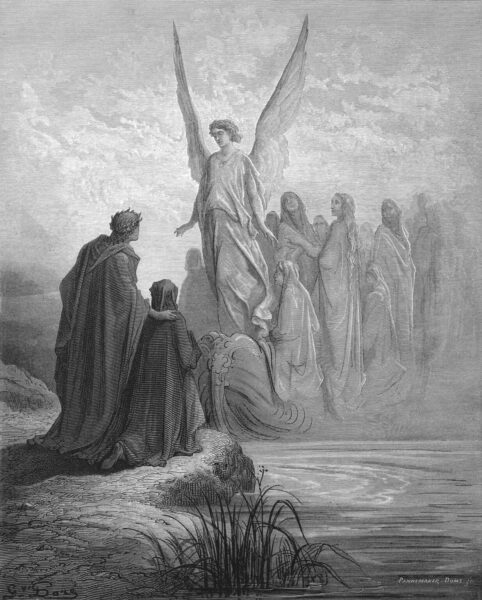
By Randall Smith
Some people have trouble reading Dante’s Commedia. For a “comedy,” it doesn’t seem all that funny. Professors will tell you it’s a “comedy” in the sense that it has a happy ending in Heaven. Some might chuckle at certain punishments Dante imagines for some souls in the Inferno, but others would consider that a lack of sensitivity. Who would be so heartless as to laugh at someone else’s misfortune? It’s so medieval. And yet, I wonder if we are as self-aware as we usually assume.
Suppose you were in Dante’s place and made a journey with your guide through the Inferno. You come upon a dark space lit only by a dim blue glow. As your eyes adjust to the gloom, you realize that the dim blue glow is coming from box-shaped computer monitors, each one sitting on what looks like a combination of a human body and an old telephone switchboard, with cables running in and out of various openings.
“Where are we?” you ask your spiritual guide, Mike Judge, writer and director of the film Office Space. “This is the dark valley where the heartless and useless IT technicians and bureaucrats who have not repented of their crimes against humanity go.” At that moment, you hear voices saying to each poor soul, as they try to plug the right plug into the right hole to “connect” their system: “I’m sorry, sir, but the system is currently unavailable.” Or: “We’re sorry, but you don’t have the right software to connect to that port.” Now, be honest. Tell me if there wouldn’t be a part of you that would have to suppress a little chuckle.
And then suppose you continue on and, in another valley brightly lit with incandescent light, you find a white, intellectual-looking woman with glasses and a business suit sitting in a chair marked “safe space,” while being poked by demons on either side. One says to her: “those pronouns, not these.”
Another shouts: “Minorities are enslaved because of you, and if you don’t apologize, you’re as guilty as a slave owner, and if you do apologize, you’re worse.”
A third pokes her with another sharp stick and says: “You’re a woman, so you’re a disadvantaged minority. But don’t pretend to be a disadvantaged minority because that would be insensitive to the real disadvantaged minorities.”
A fourth pokes her and says: “Children are disgusting. But aren’t you ashamed not to have children?” The woman in the chair seems determined to please every demon that pokes her, saying: “Yes, that’s true. No, absolutely.” Flying over her head are harpies that swoop down and repeatedly scream: “Racist, racist, racist!” She cries: “Not me, them!” But the harpies pay no attention.
When your spiritual guide turns to you as if to tell you about the woman, you simply shake your head and say: “No need. I know who she is.” Now, in this case, you might not laugh, but for the same reason, wouldn’t you say to yourself: “It’s unfortunate, but it makes a certain sense”? When you ask your guide: “Can’t anything be done?” he simply looks off into the distance and says: “We must move on.”
Further down, you find the CEO of the company that laid off thousands of your coworkers (they called it “downsizing”). Although he nearly drove the company into bankruptcy, he walked away with $40 million in a “golden parachute.” He pushes an expensive BMW out of gas up a steep hill toward what looks like a gas station at the top. But when he reaches the top, the car rolls back down the other side and he must start all over again. Now, again, tell me you wouldn’t have a moment of glee. “Oh, dear, I’m sorry. Did a laugh just escape me? That’s so wrong.”
Thus, you end up on Mount Purgatory, where you see many of your old friends, all of whom were basically good people, but each had one or more serious character flaws. The guy whose anger got the better of him from time to time; the woman who was so kind and friendly but who, like Ado Annie in the musical Oklahoma, “was a girl who just couldn’t say no” to all the wrong men; the good manager who couldn’t muster the courage to challenge stupid policies or confront malicious employees.
The usual. Good people, but each of whom needs a little something to root out that last vestige of cancerous growth that kills their joy. And you say to yourself: “Yes, this seems right. I love these people, but they can’t keep destroying themselves like this.”
And then, at the top of Mount Purgatory, you meet that wonderful old secretary, Alice, the one who was always kind and generous, who knew everything and who could really get things done. She is sitting at a desk with that same welcoming smile you remember, and she says to you: “How was the tour?” And you say: “Fine, thank you. I suspect you had something to do with this.” And she replies: “Well, yes, but not me, really. The Boss is the one really in charge. But we talk regularly. As I often told you, He’s a magnificent Boss.”
And this is the moment when you realize that, after all the misery of office politics, the fact that she is here and the others down there are no longer making life hell for themselves and others, makes this a kind of happy ending. There weren’t many laughs on the journey, but things seem to have worked out well.
At that moment, however, Alice turns to you and says: “Did you recognize yourself in any of those people down there?” And although she says it with that cheerful, understanding look she always had, like a loving grandmother, it sends a little shiver down your spine.
About the author
Randall Smith holds the J. Michael Miller Chair in Theology at the University of St. Thomas in Houston. His books include Bonaventure’s Journey of the Soul into God: Context and Commentary, From Here to Eternity: Reflections on Death, Immortality, and the Resurrection of the Body, Aquinas, Bonaventure, and the Scholastic Culture of Medieval Paris: Preaching, Prologues, and Biblical Commentary, Reading the Sermons of Thomas Aquinas: A Beginner’s Guide. His next book, Mapping Bonaventure’s Itinerarium: Context and Commentary, will be published by Emmaus Press this summer. His articles can be found here: http://t4.stthom.edu/users/smith/portfolio/