


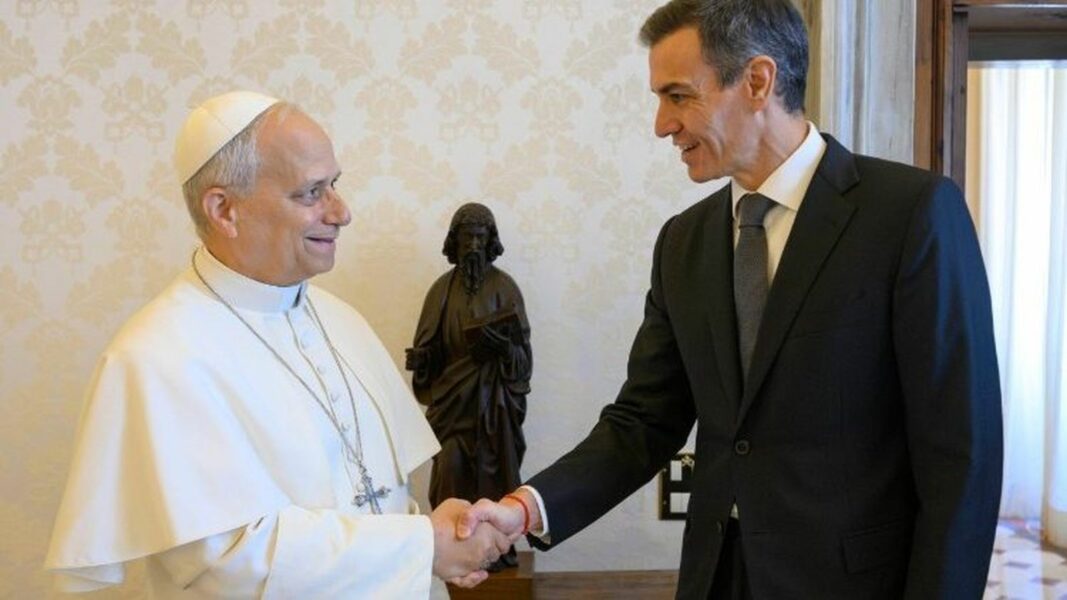
There are embraces born of faith, others of diplomatic courtesy, and still others simply of political necessity. The one the Government of Pedro Sánchez is staging around the visit of Pope Leo XIV to Spain clearly belongs to the latter category. But it would be naïve to pretend that all responsibility rests solely with Moncloa. The reality is that Leo XIV himself appears to be facilitating a political identification that traditional Vatican diplomacy would have handled with far greater caution.
In just a few days we have witnessed a genuine institutional and media operation to turn the Pontiff’s apostolic journey into a major state event carefully managed by political power. More than eighty coordination meetings, the official declaration of the visit as an event of “exceptional public interest,” the largest police deployment of the democratic era, constant public appearances, appropriation of papal phrases, and an institutional mobilization that resembles an international summit more than a spiritual pilgrimage.
None of this would be problematic if it came from a Government whose political record had shown respect, affinity, or even neutrality toward the Catholic Church. But that is precisely where the contradiction lies.
Because the same Executive that today presents itself as an enthusiastic host of the Pope is the one that has pushed some of the most aggressive measures against Catholic symbols, institutions, and principles in recent Spanish history. The same Government that turned the resignification of the Valley of the Fallen into an ideological symbol, that has constantly strained relations with the Church, that has promoted laws openly incompatible with Catholic morality, and that has made militant secularism one of its political hallmarks.
And yet, now everyone wants to be photographed with the Pope.
From cultural confrontation to institutional embrace
The transformation is striking. For years, much of Spain’s political left treated the Church as an uncomfortable, suspect, or outright cultural adversary. Today, by contrast, Leo XIV’s visit is presented as a first-tier institutional asset.
Pedro Sánchez cites the Pope’s encyclical to support his agenda on artificial intelligence and multilateralism. Óscar López interprets the Pontiff’s moral warnings as validation of the Government’s technological policies. Félix Bolaños publicly boasts of having “thrown himself” into making the visit “a success.” In Catalonia, people are already talking about the positive international impact of the trip. Congress is preparing a solemn plenary session—seeking even the participation of Zapatero, who is currently under investigation in the Plus Ultra case—along with regional presidents and the entire institutional liturgy of the State.
All this while sectors of the far left and militant laicism promote manifestos such as “I’m not waiting for you,” denouncing precisely the use of public resources to welcome the Holy Father.
The paradox is revealing: ideological laicism continues to reject the Pope, but political power wants to appropriate him.
The useful Pope
The mechanism is quite transparent. It is not about fully embracing the Church’s message, but about carefully selecting those parts of the papal discourse that can be integrated into the current political narrative.
Migration, artificial intelligence, peace, multilateralism, international dialogue. All of these are cited with enthusiasm. Much less is said about abortion, euthanasia, gender ideology, the demographic crisis, family breakdown, or aggressive secularization.
The diplomatic Pope is embraced, the media Pope, the Pope compatible with the institutional agenda. But the Pope who morally challenges power is systematically silenced.
And yet, what is most troubling is that this appropriation seems to be occurring with increasing ease. The Holy See has always maintained diplomatic relations with governments of all political stripes, but traditionally sought to avoid overly obvious identifications with specific national agendas. There existed a classic Vatican prudence: institutional closeness without political confusion.
With Leo XIV, at least for now, that distance appears far less visible.
The succession of gestures, audiences, statements, and silences is allowing the Spanish Government to construct a narrative of moral and ideological harmony with the Pontiff that would have been much harder to achieve in other recent pontificates. And that has inevitable consequences: it disorients many of the faithful, trivializes deep doctrinal contradictions, and conveys the impression that certain essential issues can be sidelined as long as there is agreement on global matters such as AI, migration, or multilateralism.
The risk of spiritually emptying the visit
Spain is not simply receiving an international figure. It is receiving the successor of Peter. And precisely for that reason, it would be a mistake to turn this visit into a massive political, protocolary, and media operation where everything is carefully neutralized.
The Church does not need political power to embrace it obscenely while ignoring the core of its message. But neither does it help when Rome facilitates an image of political harmony that will inevitably be used by those who have spent years advancing a deeply secularizing cultural project.
The greatest challenge of Leo XIV’s visit will not be the police operation, the logistics, or the ideological protests. The real challenge will be to prevent the Pope from ending up as a politically domesticated symbol: celebrated by all precisely because no one fears what he might say.