


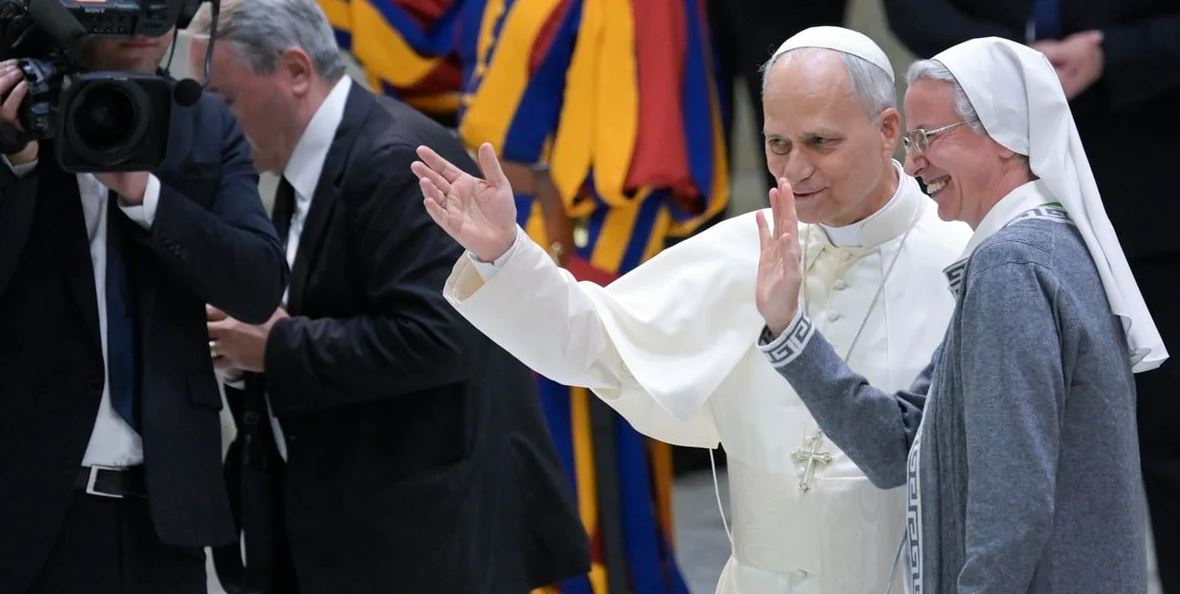
Pope Leo XIV has approved a new provision that allows strengthening the capacity for action of diocesan bishops in crisis situations within autonomous monasteries, especially when the issue affects the superior major of the religious community itself.
The measure was published through a Rescriptum ex Audientia Sanctissimi signed by the Cardinal Secretary of State, Pietro Parolin, and dated March 25, 2026:
The Supreme Pontiff Leo XIV, in the audience granted to the undersigned, Cardinal Secretary of State, on March 25, 2026, taking into account that Pope Francis had already expressed his favorable opinion on the matter, has granted the Dicastery for Institutes of Consecrated Life and Societies of Apostolic Life the faculty to authorize the competent diocesan bishop to issue the decree of dismissal referred to in can. 699 § 2 of the Code of Canon Law, in the event that the professed member to be dismissed is the superior major of the monastery.
The Holy Father has also ordered that this Rescriptum be published in “L’Osservatore Romano” and, therefore, in the official bulletin Acta Apostolicae Sedis, entering into force immediately.
Behind the provision lies a very specific practical and legal problem: how to apply an expulsion procedure when the authority responsible for deciding on it is the same person whose continued presence is being questioned.
What Canon Law establishes
Canon 699 §1 establishes that the expulsion of a religious must be decided collegially by the superior general together with his council—composed of at least four members—after examining evidence, arguments, and defenses. If the expulsion is approved by secret vote, the decree must include the legal and factual reasons justifying the decision.
However, §2 adds a specific provision for autonomous monasteries contemplated in canon 615. In those cases, it falls to the superior major of the monastery to decide on the expulsion with the consent of his council.
The problem arose precisely when the religious affected was the superior major himself. In those circumstances, the procedure could become legally blocked or extremely difficult to carry out due to the absence of a higher internal authority capable of intervening directly.
What autonomous monasteries are
Canon 615 defines an autonomous monastery as a religious community which, apart from its own superior, does not depend on any other external superior major nor is integrated into a religious institute whose authority has true power over it.
Although these monasteries remain under the “peculiar vigilance” of the diocesan bishop, they retain broad autonomy in internal governance. It is precisely this legal structure that made crisis situations related to the highest authority of the community especially delicate.
With the new rescript, Rome does not eliminate that autonomy nor place the monasteries under the direct control of the bishops. The Vatican continues to retain full control of the disciplinary procedure, since it will be the competent dicastery that must expressly authorize any intervention.
The novelty consists in that, once that authorization is granted, the diocesan bishop may directly issue the decree of expulsion when the superior major is the religious affected.
A response to internal crises and governance problems
Although the text has a technical and legal character, the measure is part of a broader context marked by difficulties in governance, abuses of authority, and internal dysfunctions that have affected various religious communities and ecclesial institutes in recent decades.
The rescript appears to reflect a broader orientation of the pontificate of Leo XIV, focused on strengthening institutional responsibility and effective mechanisms of ecclesial oversight without formally altering the traditional legal structure of religious communities.
The document itself also notes that this line of action had already received the favorable opinion of Pope Francis before his death, placing the measure within a certain continuity between both pontificates.