


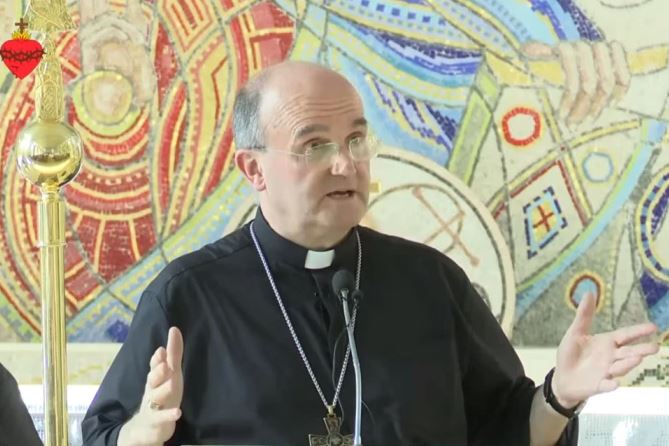
It is advisable to analyze with detachment, stripping it of all indignation, the argument that Bishop Munilla slipped into his radio program on the eve of Pentecost, because its interest does not lie in the temperature of the controversy but in the mechanics of the reasoning, and those mechanics are more instructive than its apparent moderation suggests. The bishop maintains that today, in Spain, no political party is fully identifiable with the Gospel, that all carry serious inconsistencies—“all,” he stresses with that insistence which in rhetoric is never innocent—and that those inconsistencies are distributed equally: some clash with the defense of life, the family, and Christian anthropology; others depart from the Gospel on issues of social justice, migration, or the dignity of the poor; others have embraced warmongering rhetoric; and virtually all subordinate the common good to their strategies of power. The whole is presented as an exercise in even-handedness: the Church, above the trenches, refusing to marry any side, reminding each force of its sins. It is precisely that appearance of even-handedness that needs to be dismantled, because beneath it operates a fallacy, and the fallacy has consequences.
The first move of the argument is a truth. It is indeed true that no party fully coincides with the Gospel, just as it is true that no human work fully coincides with divine perfection. The Church has never canonized a political formation and never will, because the order of grace and the order of historical contingency belong to distinct planes. Whoever affirms this says nothing that a moderately well-formed Catholic could dispute. But the function of that initial truth, within the bishop’s discourse, is not to inform: it is to anesthetize. It serves to make the listener nod, lower their guard, and accept without examination the operation that follows, which is no longer a truth but a leveling. For from the incontestable fact that all parties are imperfect, Munilla moves, without any intermediate step, to the insinuation that all imperfections lie on the same plane of gravity. And it is precisely in that transition, carried out without warning, that everything is at stake.
Catholic moral theology—not a conservative opinion about moral theology, but its explicit doctrinal body—establishes a distinction that the bishop’s argument erases. There are acts that are intrinsically evil, intrinsece malum: acts whose evil does not depend on circumstances, intentions, or consequences, and that no weighing can render licit. Abortion, the deliberate suppression of an innocent, is the paradigmatic example. And there exists, on a radically different plane, the vast territory of contingent questions, those in which doctrine fixes principles but not solutions, where legitimately diverse strategies and opposing Catholic opinions are possible. The doctrinal note of the Congregation for the Doctrine of the Faith on the political commitment of Catholics, signed in 2002 by the future Benedict XVI, formulates it without ambiguity: there are principles that “by their nature and foundational role in social life, are not negotiable,” and with respect to them the Catholic “is not permitted to support them with his own vote”; and there is, by contrast, a terrain marked by “the contingent character of certain choices in social matters,” where “often various strategies are morally possible for realizing or guaranteeing one and the same substantial underlying value.” The very document that distinguishes both orders also warns against the temptation to dissolve that distinction in “a conception of pluralism in the key of moral relativism.”
Now, migration policy belongs unequivocally to the second order, the contingent. How many immigrants to admit, at what pace, under what conditions, with what integration criteria, in what balance between the duty of hospitality and the real capacity of a society to assimilate those who arrive—an equilibrium that the Catechism itself, in number 2241, expressly subjects to the common good of the receiving community—are technical and prudential questions on which two equally faithful Catholics may disagree to the point of opposite extremes without either abandoning orthodoxy. There is no single evangelical answer to the question of how many visas to grant. There are principles, and there is a wide, legitimate margin, recognized by the Magisterium, for applying them in different ways. Abortion, by contrast, admits no margin at all: there is no prudent number of unborn children that may be eliminated, nor any strategy of application that renders their suppression acceptable.
When Munilla places both matters in the same enumeration, with the same syntactic cadence and under the same heading of “serious inconsistencies,” he is committing—consciously or unconsciously, which is secondary—the precise error that the 2002 document condemns: moral relativism disguised as pluralism. He is suggesting that opposing a mass regularization of immigrants is a fault of the same order as defending the right to abortion, that both positions distance the party that holds them from the same “evangelical fullness” to the same degree. And this is not prudence or balance: it is a falsification of the objective hierarchy of moral goods, a falsification that the Church has denounced by name. Leveling the mountain and the grain of sand to conclude that both are, after all, elevations of the terrain does not constitute a superior and dispassionate gaze: it constitutes an error of measurement.
The trap, however, does not end with the abstract leveling, because the leveling is not symmetrical in its effects. And here the analysis must descend from theology to concrete political arithmetic, which is where the operation reveals its true direction. The Spanish party system does not distribute its positions in a homogeneous way. There is one formation—and the bishop, who has attacked it by name on more than one occasion, knows perfectly well which one—that holds restrictive positions on migration while defending, in the realm of non-negotiable values, life and the family. There are other formations that defend or have promoted abortion legislation, euthanasia, and a redefinition of the family, while at the same time maintaining expansive migration policies. When the bishop proclaims that “all” fail equally, the distribution appears to treat both blocs with the same yardstick. But it does not, because the two yardsticks do not measure the same thing: one bloc is reproached for faults in the order of the non-negotiable; the other, for discrepancies in the order of the prudential. And by presenting both reproaches as equivalent, what is actually achieved is to exonerate the first bloc from the specific gravity of its positions and to impose on the second a gravity that its positions do not have. Formal equidistance produces, in its concrete application, a result that is not equidistant at all: it redistributes moral blame to the detriment of those who are right on what is essential and to the benefit of those who are wrong on it.
That this direction is not accidental is confirmed by the contrast with the bishop’s own public trajectory, which does not need to be deduced because it is on record. When the Government approved the extraordinary regularization of immigrants, Munilla described it as a “populist and demagogic” measure and denounced that immigrants were being used “as bargaining chips”; he placed the reproach there, rightly or wrongly, on governmental instrumentalization. When a party voted against regularizing those who already resided and worked in Spain, the bishop charged “openly” against it, judged that expelling those immigrants “would not be acceptable,” and went so far as to ironize, in his own formulation, about those who applaud the children of immigrants when they wear the national team jersey. That is to say: in practice, the bishop has treated the restrictive migration position not as a legitimate prudential option among several—which is what doctrine requires us to recognize—but as a moral fault deserving direct episcopal rebuke. The apparently neutral enumeration in the radio program is not, therefore, a dispassionate reflection on the universal imperfection of politics: it is the theologized version, elevated to the plane of principles, of a political preference that the bishop had already expressed on the plane of facts. Doctrinal abstraction comes to provide magisterial cover for an option that is his own, personal and legitimate as a citizen, but which ceases to be legitimate the moment it is clothed in evangelical necessity and imposed as a criterion of Catholicity.
Here lies the finest inversion of the argument. The 2002 note warns against moral relativism in order to protect non-negotiable values from dissolution in the magma of what is debatable. Munilla employs the same mental structure—the leveling of all positions—but in the opposite direction: not to defend the hierarchy, but to abolish it; not to prevent the non-negotiable from being reduced to opinion, but to raise one of his own prudential opinions to the height of the non-negotiable. The conceptual instrument that the Magisterium forged as a shield for life and the family is thus turned, in his hands, into a weapon against those who make life and the family their banner. It is an operation of notable skill and dubious intellectual honesty, and its formal elegance—that measured, even-handed tone, hovering above the trenches—is precisely what makes it effective, because equidistance always enjoys better press than hierarchy, even though the hierarchy is true and the equidistance, in this case, false.
It is not a matter of demanding that the bishop bless any party; no party deserves it, and in that his initial premise was impeccable. It is a matter of pointing out that the conclusion does not follow from the premise, that between “no party is perfect” and “all imperfections weigh the same” lies a doctrinal abyss that the bishop crosses without license, and that the result of that improper crossing is not the serene impartiality it appears to be, but a taking of sides all the more effective because it disguises itself as its opposite. True ecclesial prudence does not consist in distributing reproach in equal parts so as not to inconvenience anyone. It consists in weighing each thing according to its real weight. And the weight of abortion and the weight of a migration quota do not belong, nor can they belong, on the same pan of the same scale. Whoever equates them does not rise above the conflict: he has simply decided, without saying so, on which side to tilt it.