


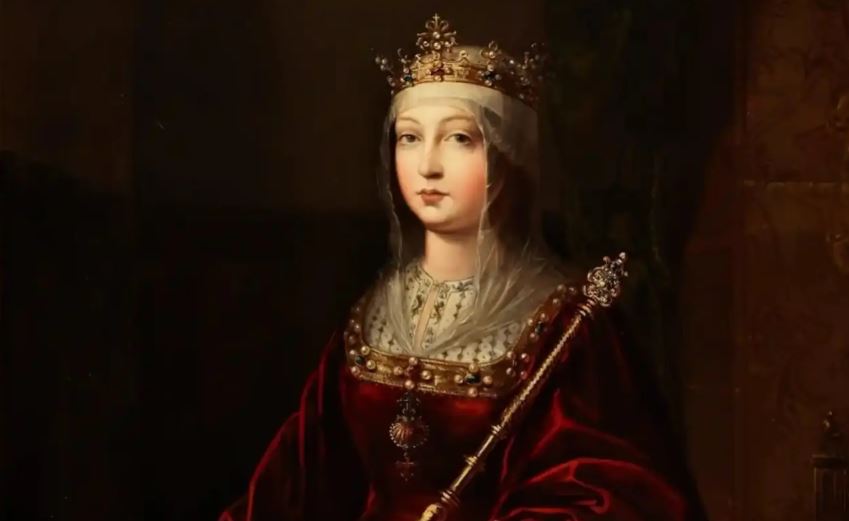
There are historical figures whom time turns into consensus. Isabella the Catholic belongs to the opposite category: the more centuries pass, the more debate she provokes. And perhaps that is why her cause for beatification remains stalled more than thirty years after Rome decided to halt it “for political prudence.”
Not for lack of documents. Not because the Church has dismissed her virtues. Not because the dossier lacks historical or spiritual weight. The problem, as Bishop Luis Argüello publicly acknowledged, remains another: the expulsion of the Jews in 1492.
The year Spain rediscovered its most vilified queen
On April 22, 2026, in the Church of San Nicolás de Bari in Madrigal de las Altas Torres, the Apostolic Nuncio to Spain, Archbishop Piero Pioppo, presided over the solemn Mass for the 575th anniversary of the birth of Isabella the Catholic. The church where the queen was baptized filled with faithful and with institutions that for decades have been asking for the same thing: that the Servant of God finally reach the altars. Pioppo recalled, in his homily, that Isabella was born on Holy Thursday, in the very institution of the Eucharist and the priesthood: a liturgical coincidence that, the nuncio said, runs through her entire life.
It was not an isolated act. It was preceded, in October 2025, by the inauguration at the Catholic University of Ávila of the II Cycle of Conferences Political and Cultural Promotion. People and Institutions in the Time of Isabella the Catholic: eight monthly lectures that now, in May, are coming to a close. It was also preceded, two months earlier, by the International Congress Isabella the Catholic, held in Bogotá, where the Spanish bishops in attendance —Argüello himself among them— were “pleasantly surprised” by the popular recognition of the queen in America. The prints that the beatification commission brought to Colombia sold out within hours.
The devotional map is clear: the most vilified queen in Spanish history is also, at this moment, one of the figures with the greatest popular and episcopal momentum in favor of her elevation to the altars.
And yet, her cause has been stalled since 1993.
The “political prudence” that Rome put in writing
The reason was explained for the first time in public by Bishop Luis Argüello —Archbishop of Valladolid (the diocese leading the process, since Isabella died in Medina del Campo) and president of the Spanish Episcopal Conference— when he opened the UCAV lecture series on October 31, 2025: the Secretariat of State advised pausing the cause “for reasons of political prudence,” he specified, “not closing it.”
Days later, Argüello clarified to the media the nature of that prudence: what was requested was “that a more careful assessment be made of how the process of the expulsion of the Jews had taken place.”
That is, literally, the only substantive argument keeping the cause on hold. Not the Inquisition. Not the conquest. Not the reconquest of Granada. The piece the Secretariat of State placed on the table in 1993 —and that remains on the table in 2026— is the Decree of 1492. Everything else, officially, has been “overcome” or would be surmountable.
What the Positio says, and what Le Monde never read
The Positio of the cause of Isabella the Catholic consists of twenty-eight thick volumes that the Claretian postulator Anastasio Gutiérrez took twelve years to compile (1958–1970), examining more than one hundred thousand documents to select 3,160. It was presented to the Congregation for the Causes of Saints on November 18, 1972.
The Relator ad casum himself, Justo Fernández-Alonso, wrote in his assessment that from the documentation examined “emerges a leading figure of holiness,” and that the classic obstacles —the legitimacy of the succession, the Inquisition, the expulsion of the Jews, the reform of the Church and the religious orders, the tensions with Rome— had been overcome.
Regarding the expulsion in particular, the Positio includes what the Holy See of the time itself put in writing: the Bull Si convenit of Pope Alexander VI, dated December 19, 1496 —signed with the opinion of Cardinals Caraffa of Naples, Costa of Lisbon, and Piccolomini of Siena— which recognized Isabella and Ferdinand for a measure they assumed, according to the Vatican text itself, with “incredible harm” to themselves.
The same bull granted the queen the official title of “Catholic.” The title that Le Monde, in 1991, during the Fifth Centenary, decided to strip from her with no further explanation than the changing times.
The Positio also includes the written congratulations from the University of Paris to the Catholic Monarchs, dated September 29, 1493 —one year after the edict— and the reading that historians such as Marcelino Menéndez Pelayo, Ramón Menéndez Pidal, or Tarsicio de Azcona have made of the decision: for the latter, “a perfectly logical state measure,” considered by the Crown for an entire decade and resolved “as the lesser evil for their kingdoms,” with care “that the operation be carried out now with strict justice.”
And above all, it includes what the Vatican of Alexander VI itself called by name: not “expulsion,” but withdrawal of permission to remain. The distinction is not rhetorical. It is juridical.
The book that brings the 27 volumes within reach of anyone who wants to read them
The general public had never had access to this entire arsenal. For forty-two years, the twenty-eight volumes lay dormant in the Vatican archives. The postulator Anastasio Gutiérrez himself died in 1998, on the feast of the Epiphany, without seeing the queen for whom he had worked thirty-six years raised to the altars.
Journalist José María Zavala —a specialist in investigations based on unpublished archives, author of reference works on Sister Lucia of Fatima, Pius XII, and Padre Pio— gained access to the essential content of the Positio in collaboration with the Beatification Commission based in Valladolid.
On that foundation he built Isabella the Catholic. Why She Is a Saint, originally published by Planeta in 2019, sold out in two editions in a single month and almost immediately turned into a bibliographic item difficult to obtain.
Homo Legens is now reissuing it, in its second edition, with the cause for beatification once again at the center of ecclesial debate.
The book is not a hagiography. It is not an emotional portrait. It is the first documentary reconstruction of the only dossier still on Rome’s table —the twenty-seven volumes of the Positio— organized into four parts: the woman, the queen, the virtuous, and the current favors through the intercession of the Servant of God.
The second part —“The Queen”— is the one that responds, one by one, to the four classic pieces of the Black Legend: the expulsion, the Inquisition, Granada, and America.
The fourth —“Favors and Reputation of Holiness”— gathers the thirty or so contemporary testimonies compiled by Santiago Velo de Antelo from the magazine Isabel, international publication of the Servant of God.
A pastoral window, from June 6 to 12
To this situation is added an immediate circumstance: from June 6 to 12, Leo XIV will make his first apostolic journey to Spain —the first by a pontiff since Benedict XVI fifteen years ago.
He will be hosted by the Spanish Episcopal Conference presided over by Bishop Luis Argüello, the same Archbishop of Valladolid who in October acknowledged the pause “for political prudence” and who, from his archdiocese, heads the commission for the beatification of Isabella.
During that week, Argüello will have direct and prolonged access to the pope and to the Secretariat of State traveling with him —the same dicastery that in 1993 advised the pause.
It is a rare pastoral window to return the dossier, now complete and available, to the table from which it was removed thirty-three years ago.
Popular devotion —Spanish, but above all Latin American, which Argüello himself admitted having witnessed with surprise in Bogotá— is already raising its gaze.
The book exists so that, when the dossier is reopened, it will be in Spanish and read in full.
The paradox of a process
Argüello said it plainly in October: “cultivate devotion” and “deepen knowledge of her life and virtues.” That is what the cause asks in order to move forward. What Zavala’s book provides is precisely the second: the documented virtues, the contextualized facts, the political decisions read with the Vatican source of the time in hand.
There remain, without a doubt, other difficulties on which the Commission continues to work. But the only substantive argument that the presidency of the CEE itself has made public has been answered for seven years. And it has been in print for seven years. Five centuries of devotion, twenty-seven volumes of testimonies, a single objection “for political prudence” —and a book that, read in full, says exactly the opposite.
Isabella the Catholic. Why She Is a Saint, by José María Zavala, is not only a book about a queen. It is a book about how a historical legend is built —and how it is dismantled. And also about something much more current: the difficulty of our time in understanding the past without first turning it into a slogan.