


By John M. Grondelski
Modern philosophy prides itself on claiming responsibility for the “turn to the subject,” that is, toward the human (and, generally, toward a very subjective understanding of the human). Yet the focus on the human can hardly be considered a modern discovery.
St. Irenaeus, bishop and theologian of the second century, is famous for his phrase gloria Dei vivens homo: “the glory of God is man fully alive.” And the bishop of Lyon did not pull that thread out of thin air: the psalmist praises the Creator for making man “a little less than the angels.” (Psalm 8:5) Eastern Christianity has long recognized that God’s work of salvation was, in fact, deification: bringing to fulfillment the image and likeness of God in man. (Genesis 1:27)
The dignity of the human person was so central to the pontificate of Pope St. John Paul II that it became the axis of his inaugural encyclical, “The Redeemer of Man” (Redemptor hominis). That Pope also never tired of citing Gaudium et spes (no. 22), which states that Jesus Christ “fully reveals man to man himself.” Note what the Council says and what it does not say. The Council does not say that Christ “fully reveals God to man” (although that is true). It states that Jesus “fully reveals man to man himself.”
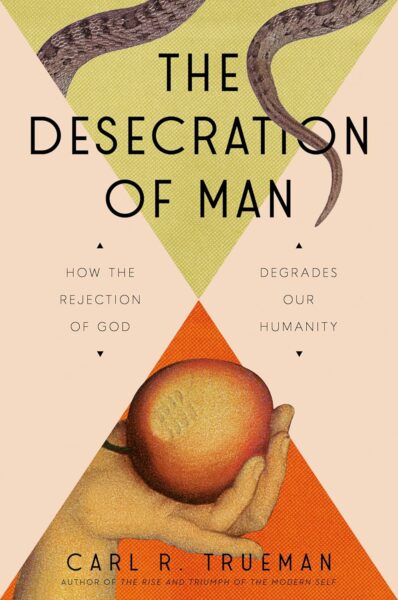
Carl Trueman offers these reflections in his new book, The Desecration of Man: How the Rejection of God Degrades Our Humanity. He argues that, in certain respects, Nietzsche was ahead of his time. Proclaiming the “death of God” to a world still moving by the inertia of religious gases proved ineffective. As with nominalism, culture still concealed the deep abyss entailed by the “death of God,” among whose consequences stands out the destruction of the divine image and likeness in man.
In three chapters, Trueman demonstrates how contemporary man is achieving this in the realm of sex (the sexual revolution and abortion), artificial reproduction (IVF and surrogacy), and death (an enemy that, if it cannot be stopped, can at least be forced to yield to one’s own desires about when and where to die).
Man as the divine image and likeness is the unifying theme in Trueman’s work: if the human person is made in the image of a God who is good, then man’s incursions into sin constitute a disfigurement of that image.
That is not necessarily a new idea either: already in the fifth century, Pope Leo the Great, in his first Christmas sermon, exhorted Christians to “recognize your dignity” (albeit redeemed by grace through the Incarnation). But Trueman persuasively argues that moderns do not merely disfigure their divine image and likeness. Rather, they work actively and almost with pleasure to “desecrate” that image, attempting to destroy the divine imprint in man in order to replace it with an autonomous human god.
This is not merely a moral question about what sins people commit. It is an anthropological question, the same one the psalmist posed: “What is man?”
Trueman’s starting point is important for two reasons.
First, it provides a common starting point that is both ecumenical and interreligious. Jews and Christians can share a mutual perspective that, having a biblical foundation, might mitigate some of the notions of radical human corruption that prevailed among the classical Reformers.
Second, it applies to all men: all human persons are made in the image and likeness of God, whether or not they profess that truth. Man may choose to deny his God; God does not deny his humanity.
On the other hand, the Devil certainly has an interest in denying the truth about the human person. A certain theological tradition holds that his fall is due to the rejection of human creation and the divine Incarnation: how could God create such a hybrid creature, both bodily and spiritual, much less consider assuming such a nature? A creature that even shares in co-creation through sexual reproduction, something no angel can do.
Given these perspectives, should we be surprised that the contemporary assault on human dignity has roots much deeper than “ordinary” sin? Might it not be an infernal fury that questions human existence itself? Is it then so surprising, as Our Lady said at Fatima, that the final battle between God and evil would be fought over marriage and sex?
The reception of Trueman’s book has been positive. As a Catholic theologian, I celebrate it, not because the focus on the divine image in man is a novelty, but because it gives the discussion a broader Judeo-Christian appeal.
What is important and deserves attention is his Nietzschean insight: the contemporary assault on human dignity is qualitatively different because, underlying all the various problems Trueman enumerates, there is a common thread: a cheerful desacralization of the human person.
St. John Paul II centered his pontificate on the human question: if the patristic problem was the One and Triune God, the problem of the Reformers and of us moderns is man.
But as Karol Wojtyła repeatedly emphasized before being elected Pope, in his polemics with Kant, the divine-human relationship is one of direct, not inverse, proportion. One does not become more autonomously “human,” as Kant (and Nietzsche) assume, by rejecting God and his law. On the contrary, to the extent that man follows the God in whose image he was made, to that same extent he realizes his humanity.
That insight is under assault from two directions. The frontal attack comes from a modern culture that wishes to create a man who buries his “god.” But a back-door attack can be found in certain traditionalist Catholic circles, which seem to imagine that the current papal focus on man and human dignity somehow undermines a theocentric Catholicism.
It is true that there are versions of “Catholic modernity” that seem to marginalize God, but that is not the solid theological anthropology, built on tradition and Vatican II, that John Paul and Benedict bequeathed to the Church.
It is rumored in Rome that Pope Leo XIV’s first encyclical will be published on Monday and will address major social issues such as artificial intelligence and global peace. But the broader perspective behind all of them (including whether AI can “replace” man) remains: “What is man that you are mindful of him?” Let us hope that our Pope born in the United States offers fruitful answers to that question.
About the author
John Grondelski (Ph.D., Fordham University) is former associate dean of Seton Hall University’s School of Theology in South Orange, New Jersey. All opinions expressed in this article are exclusively his own.