


By Brad Miner
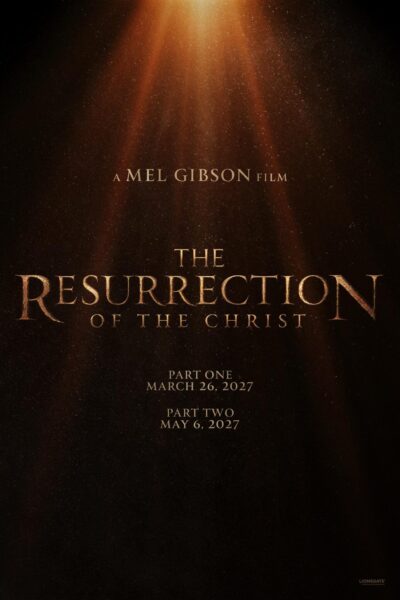
Around this time next year, Mel Gibson will release the two-part sequel to The Passion of the Christ. Better late than never, some will say, though perhaps not Jim Caviezel, who portrayed Jesus so memorably and who, over the two decades since, has spoken enthusiastically about the ever-imminent production of The Resurrection of Christ.
However, Mr. Caviezel is out, having been replaced by Finnish actor Jaakko Ohtonen.
Since certain new technologies began to appear, it was speculated that Mr. Gibson would employ “rejuvenation” through artificial intelligence (as used in the latest Indiana Jones film to make 80-year-old Harrison Ford appear 40). This was intended to make the original cast of The Passion, who by the time of next year’s releases (March 26 and May 7) will be a quarter-century older, look as they did in 2002 during the filming of the movie. But recently it was deemed that digital rejuvenation was too costly and, likely, too distracting to be effective. It is the effect of the “uncanny valley.” [Note: In a promotional email dated May 21, 2026, sent to the Faith & Reason Institute, a publicist for The Resurrection of Christ indicates that the film’s release dates are now May 6, 2027, and May 25, 2028, that is, a full year apart].
Therefore, in addition to Mr. Ohtonen: Maia Morgenstern (Mary, the mother of Jesus in the original) will be replaced by Polish actress Kasia Smutniak; Monica Bellucci (Mary Magdalene) is out in favor of Cuban actress Mariela Garriga; and Italian actor Pier Luigi Pasino will replace Francesco De Vito as Simon Peter. In fact, it appears the entire cast will be new.
And let’s be honest: with a sequel in which the time elapsed between the actual events depicted is three days, a completely new cast was inevitable.
But 23 years between releases? Well, without knowing all the details, I suspect Mr. Gibson was quite exhausted physically, emotionally, and spiritually by The Passion. That, combined with subsequent events, made a quick turnaround impossible.
He and his wife, Robyn, separated and then divorced in 2006 after 26 years of marriage. (She received a $400 million settlement). Mel was granted an annulment… of a certain kind. Rejected by the Roman Catholic Church, the only authority that could canonically approve a declaration of nullity, his father, Hutton Gibson, and a tribunal of members of the traditionalist-sedevacantist church of the Holy Family in California, approved the annulment on the grounds that Mel had felt pressured to marry in 1980 because Robyn was pregnant, which is undoubtedly the most regrettable of excuses.
It is certainly strange that a man would entrust such important ecclesiastical matters to his biological father rather than to the Holy Father. I suspect Mr. Gibson is more American than Catholic, and a very independent American in his decisions.
I recently rewatched The Passion, and it certainly evoked what I consider an unalterably sad flaw in Gibson’s worldview: antisemitism. In 2004, the Anti-Defamation League and the United States Conference of Catholic Bishops issued a joint statement describing the script as “one of the most problematic texts, in terms of its potential antisemitism, that any of us has seen in 25 years,” and adding that the film “would falsify history and fuel the animosity of those who hate Jews.”
This led the 20th Century Fox, which had a right-of-first-refusal agreement with Gibson’s Icon Productions, to decide not to distribute the film. (Given that ambiguity, and not necessarily hypocrisy, is not unknown in Hollywood, Fox later handled the film’s distribution on VHS and DVD).
In any case, with a reported budget of $30 million, The Passion grossed more than five hundred million dollars and, despite some fierce criticism over violence and antisemitism, received the controversial approval of St. John Paul II, who after viewing the film said: “It is as it was,” meaning that the depiction of violence and hatred in the film accurately portrayed conditions in first-century Israel. And John Paul II was no antisemite.

Between The Passion and The Resurrection, Mr. Gibson has acted in 25 films. He directed only three: Apocalypto (2006, a notable Mayan fantasy); Hacksaw Ridge (2016, which I reviewed here); and a film called Flight Risk (2025), a thriller that CinemaScore gave a C on the A to F scale.
The upcoming films of The Resurrection, we hope, will be wonderful, and also free of antisemitic tropes. Mel Gibson does not need any more of that.
Having studied karate and boxing, I only know Joe Rogan through his work as a commentator on mixed martial arts broadcasts. But his podcast, The Joe Rogan Experience, seems to be the place to which all center-right personalities go to talk and promote themselves.
Last year, in a conversation with Mr. Rogan, Gibson described The Resurrection in this way:
It takes a lot because it’s an acid trip. I’ve never read anything like it [presumably referring to Randall Wallace’s script]. […] And I think to really tell the story properly, you really have to start with the fall of the angels, which means you’re in another place, you’re in another realm. You have to go to hell. You have to go to Sheol.
For my part, I look forward to a cinematic representation of the Descent into Hell. Not that there isn’t wide latitude to represent this mysterious aspect of the Apostles’ Creed: “He descended into hell, / on the third day he rose again from the dead.”
The “acid trip” part is a bit worrisome, of course, but we’ll see.
And then there are the comments Mr. Gibson has made about what I’ll call the structural integrity of the film. The Passion was largely a straight line from Gethsemane to Calvary (with flashback scenes of Holy Thursday and some earlier events in the life of Christ), ending with a very brief vision of the Resurrection: the historical fact, not the upcoming film.
But according to reporting by Variety, the bible of the film business, the director has said that the upcoming film:
is not a linear narrative [but rather] you have to juxtapose the central event I’m trying to tell with everything else around it in the future, in the past, and in other realms, and that’s getting a bit sci-fi out there.
Interpret that as you will.
Whether you like Mel Gibson or not, I suspect you’re curious to see what he does next. I am. The Resurrection of Christ may be a triumph or a disaster, but it will almost certainly be worth watching.
About the author
Brad Miner, husband and father, is senior editor of The Catholic Thing and senior fellow at the Faith & Reason Institute. He was literary editor of National Review and had a long career in the book publishing industry. His most recent book is Sons of St. Patrick, written with George J. Marlin. His best-seller The Compleat Gentleman is now available in a third revised edition and also as an audiobook edition on Audible (narrated by Bob Souer). Mr. Miner has served on the board of directors of Aid to the Church In Need USA and also on the recruitment board of the Selective Service System in Westchester County, New York.