


By Brad Miner
First, let us review the corporal works of mercy, which number seven in total:
-
Visit the sick
-
Feed the hungry
-
Give drink to the thirsty
-
Shelter the homeless
-
Clothe the naked
-
Visit the imprisoned
-
Bury the dead
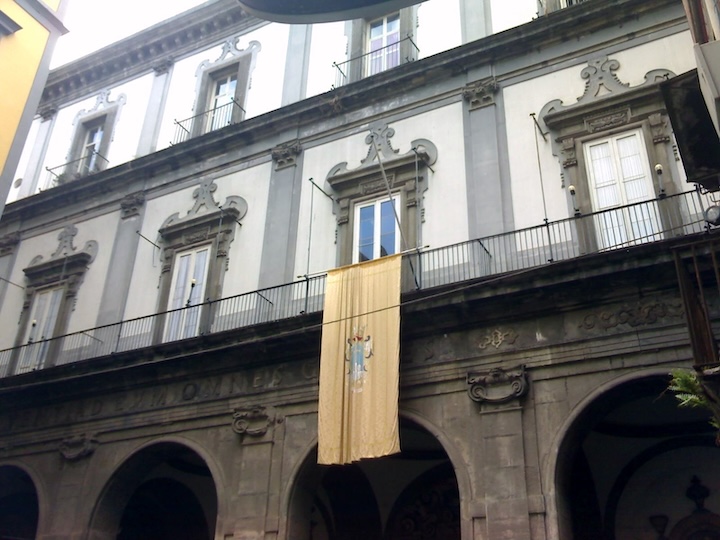
There is a church in Naples, Italy, dedicated to them. And its founding is a beautiful story.
In 1601, seven (how fitting) young Neapolitan noblemen, all in their twenties or thirties, joined together to form the Pio Monte della Misericordia (the Pious Mount of Mercy). And each Friday they gathered at the Hospital of the Incurables (Ospedale degli Incurabili) to care for the sick. They then decided to elevate their commitment by founding the Monte, and a church with it. The charitable institution and the church survive to this day; the hospital disappeared long ago.
But when the construction of the church was finally completed, an altarpiece was needed, so one of the seven young noblemen, Giovan Battista Manso, patron of the arts (and friend to the poets Torquato Tasso and Giovan Marino, and to the scientist Galileo Galilei), learned that a certain young painter, Michelangelo Merisi, had just arrived in Naples.
We know him, of course, by the name of his birthplace, Caravaggio, and he was fleeing justice for having murdered (on May 29, 1606) a young Roman nobleman, Ranuccio Tomassoni (noble only in the sense of the “dignity” of his family). Giovan Manso did not mind that, and was happy to give refuge to Caravaggio, on the condition that he paint an altarpiece for the Pio Monte della Misericordia. Moreover, Caravaggio had been secretly brought to Naples by the Colonna family, and, though I do not wish to evoke vile stereotypes, that group seemed straight out of a Baroque-era version of The Godfather.
Of course, what we today consider “justice” was rather improvised in the seventeenth century.
Caravaggio did not hesitate to accept the commission. Work was his drug. Besides, Manso and the Monte did not spare any expense with the artist. It is estimated that his fee was in the range of $150,000 to $220,000 in 2026 U.S. dollars! That is more than fair pay for the amount of time the painter spent creating it, between September 23, 1606 and January 9, 1607. Three months and a bit more, for the love of God.
The painting is extraordinary. It is also, perhaps, the most difficult to “see.” Caravaggio was the tenebrist par excellence. That term comes from the Italian word tenebroso, meaning dark, shadowy, or mysterious, and the words tenebrist or tenebrism probably were not used in the seventeenth century; they may, in fact, be twentieth-century coinages. But we can be sure that when Giovan Manso—or if not him, another—first saw the finished work, a murmur was heard: “Tenebroso”.
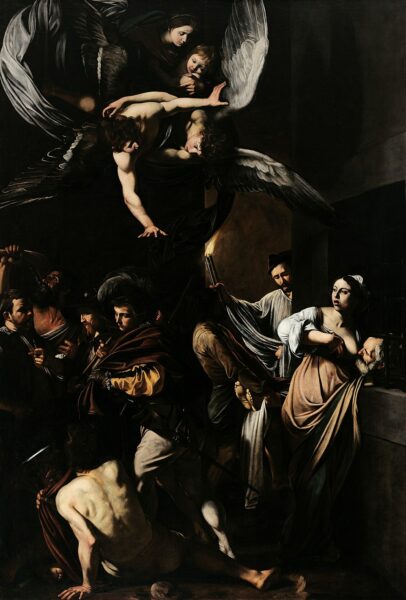
The Seven Works of Mercy by Caravaggio, c. 1607 [Pio Monte della Misericordia, Naples] ***
As an art lover but not an art historian, I can only speculate that the development of technique by Caravaggio (and he was undoubtedly its master) had something to do with his love for the human figure and the drama in humanity, and with his quite unique process (working quickly, painting directly on the canvas without sketches) and (here I speculate) glancing over his shoulder to see if justice was about to kick down the door.
Whatever the reasons, the results were always astonishing, and can be seen from his earliest work to the last: from Boy Peeling Fruit (c. 1592) to The Martyrdom of Saint Ursula (1610). But never was it so astonishing nor so impenetrable as in The Seven Works of Mercy.
Let us divide The Seven Works of Mercy into four parts: upper, middle (right and left), and lower.
In the upper part, we see Mary, the Mother of God, and her tender Son suspended in the air by angels.
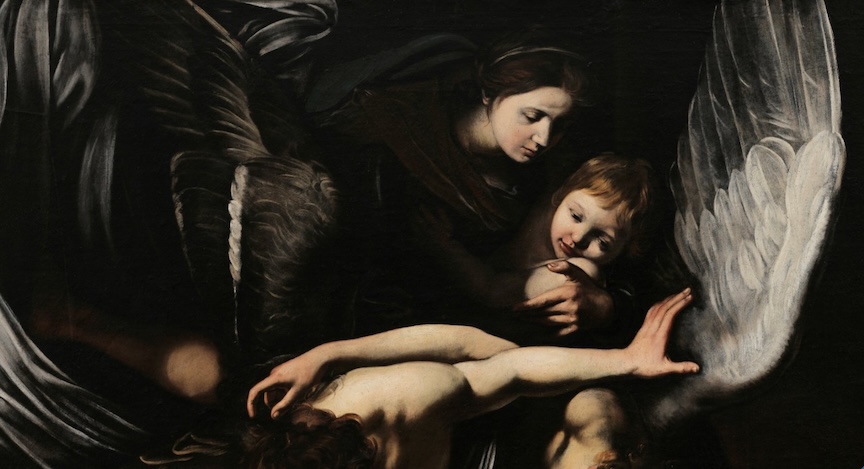
For Caravaggio, there was often a blurring of the sacred and the profane, because—with the exception of Our Lady and her Son, being free of sin—humanity is held in tension between salvation and damnation. Each of us is in need of divine mercy.
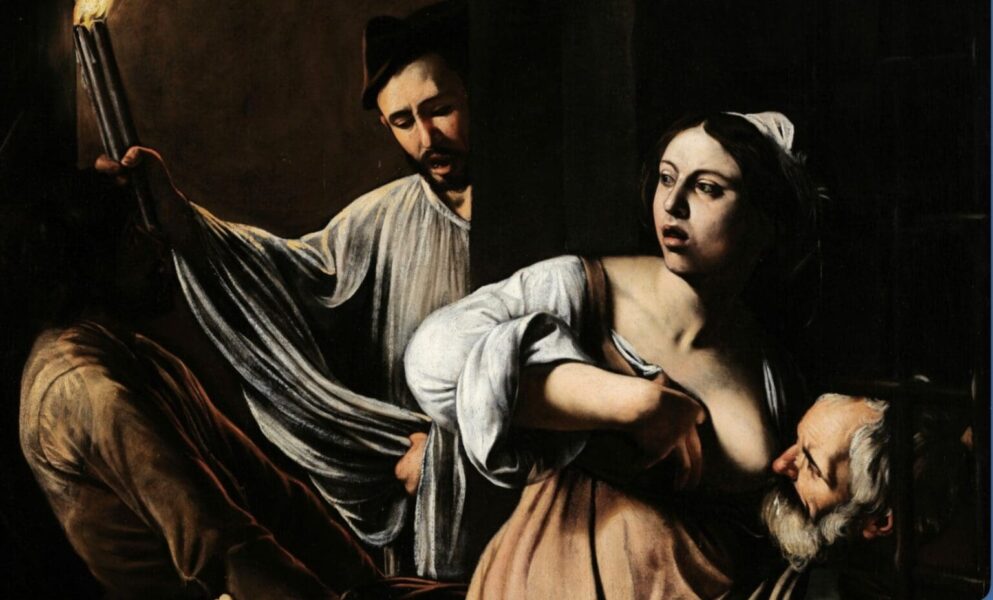
In the center to the right there is a complicated scene, and one that is not possible to show completely. The most obvious are three characters. One is a priest with a torch who, in the darkness of Milan, guides two men who transport a corpse for burial. This is no. 7: Bury the dead. (All we see of the corpse are its feet).
The next shows nos. 2 and 6. And here is Caravaggio in his most creative and impactful facet. He has chosen an ancient Roman story (“Roman Charity”) about Cimon and Pero, written by Valerius Maximus during the time of Christ. Cimon, a man arrested for stealing a loaf of bread and sentenced to death by starvation, receives the visit of his daughter, Pero, who comes daily to the prison and secretly breastfeeds him: feeding the hungry and visiting the imprisoned.
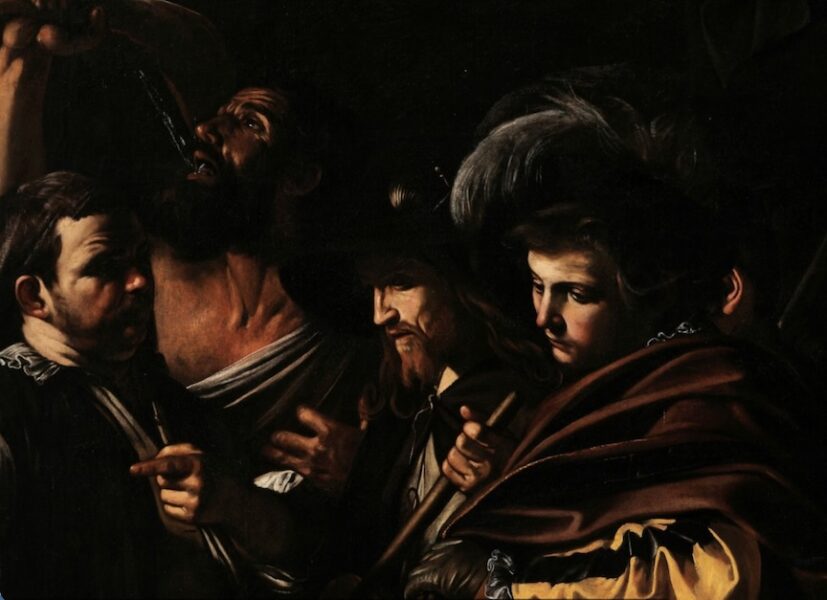
The next (on the link of the main image) is both difficult to see and, again, an astonishing leap of artistic genius: the work of mercy no. 3, giving drink to the thirsty. It is Samson drinking from the jawbone of an ass!
The rest of the image shows a young man (on the right) with a feather hat. That is Saint Martin of Tours, who is in the process of giving his cloak to a sick man, who can be seen in the main image, semi-naked and stretching his hand to receive the burgundy cloak: nos. 5 and 1, clothing the naked at the same time as visiting the sick.
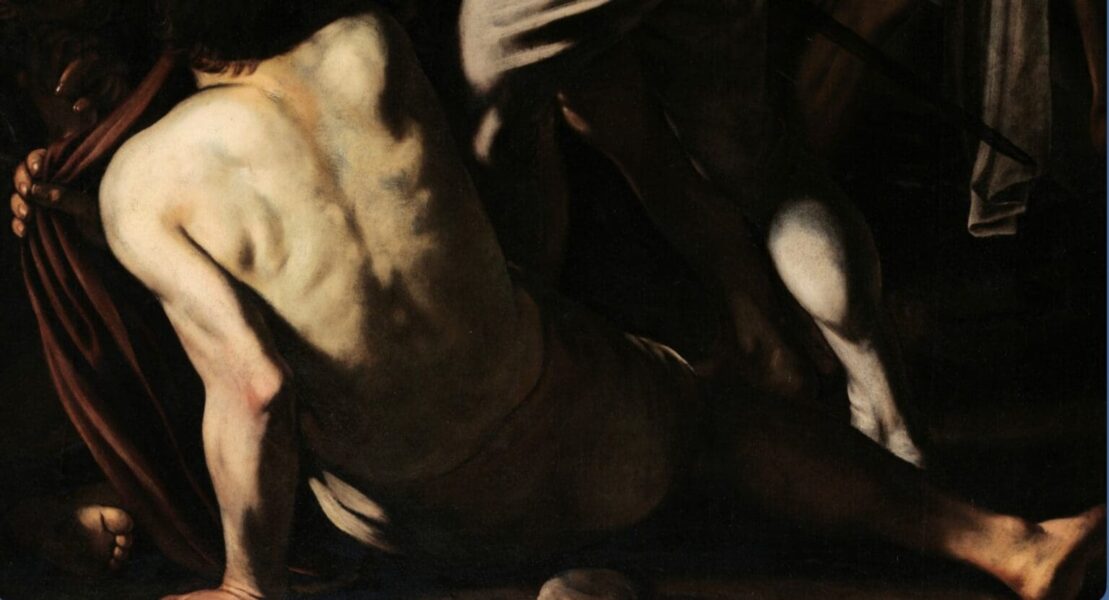
And, at each side of the thirsty Samson, we have an innkeeper and a pilgrim. We know that the man on the right is a pilgrim by the scallop shell attached to his hat. The no. 4: Sheltering the homeless.
After finishing the Seven Works, Caravaggio made a few more paintings in Naples before heading to Malta, where he painted the extraordinary The Beheading of Saint John the Baptist. There he became a Knight of Obedience in July 1608. Unfortunately, shortly after he was involved in a brawl, was imprisoned, escaped and fled to Sicily, where he found work (The Burial of Saint Lucy, The Resurrection of Lazarus and The Adoration of the Shepherds), each work more dark, shadowy and mysterious than ever.
Back in Italy in 1609, his paintings became (as I see it) more hurried and definitely full of pain and death. Was it a premonition?
There were more altercations with justice. He fell ill with fever. Was it caused by Staphylococcus, an infection from a previous wound? And where was he going when he took a boat from Naples towards Porto Ercole (Hercules’ Port), a charming coastal town just over 90 miles from Rome? Was he ready to return to Rome and receive an expected pardon from Pope Paul V?
Non importa. Michelangelo Merisi da Caravaggio died there, on July 18, 1610.
About the author
Brad Miner, husband and father, is senior editor of The Catholic Thing and senior fellow of the Faith & Reason Institute. Was literary editor of National Review and had a long career in the book publishing industry. His most recent book is Sons of St. Patrick, written with George J. Marlin. His best-seller The Compleat Gentleman is now available in a third revised edition and also as an audio edition on Audible (narrated by Bob Souer). Mr. Miner has served as a board member of Aid to the Church In Need USA and also on the recruitment board of the Selective Service in Westchester County, New York.