


By Robert Royal
St. Augustine famously wrote about arriving late to the Beauty that is God: tam antiqua, tam nova (“So ancient, so new”). It is a brilliant and profound way of expressing the truth that the deepest Good is not in the past or the future, but, by its very eternity, transcends time. It is like a moving piece of music that, even the first time it is heard, feels both fresh beyond all expectation and, in that same moment, the evocation of a place one feels to have known and longed for throughout one’s entire past life, the true home of the human heart.
By contrast, what we are immersed in most of the time is a false and politicized version of the old and the new. A limited politics is, of course, a necessary and good thing. But when politics takes on a religious importance, a defining reality for our lives, it becomes a dangerous and partial substitute for the true. The “conservative” then turns into the mere return to some idealized past; the “progressive” becomes the drive toward some future utopia, at any cost (which is usually a very high price in terms of human victims). In comparison with that deeper and truer music of Creation, the substitutes—if they come to possess us—are like the tune of a barrel organ meant to make monkeys dance.
That is not good for either our souls or our public life. And the main task of our existence is always to attend to temporal affairs with our eyes fixed on the eternal. This is what we strive to do, day after day, here at The Catholic Thing.
For that reason, today I must ask you to join us in supporting a work that seeks a broader and more Catholic path. We only turn to you twice a year to ask for your support. And as part of this mid-year fundraising campaign, we have some new/old things to report.
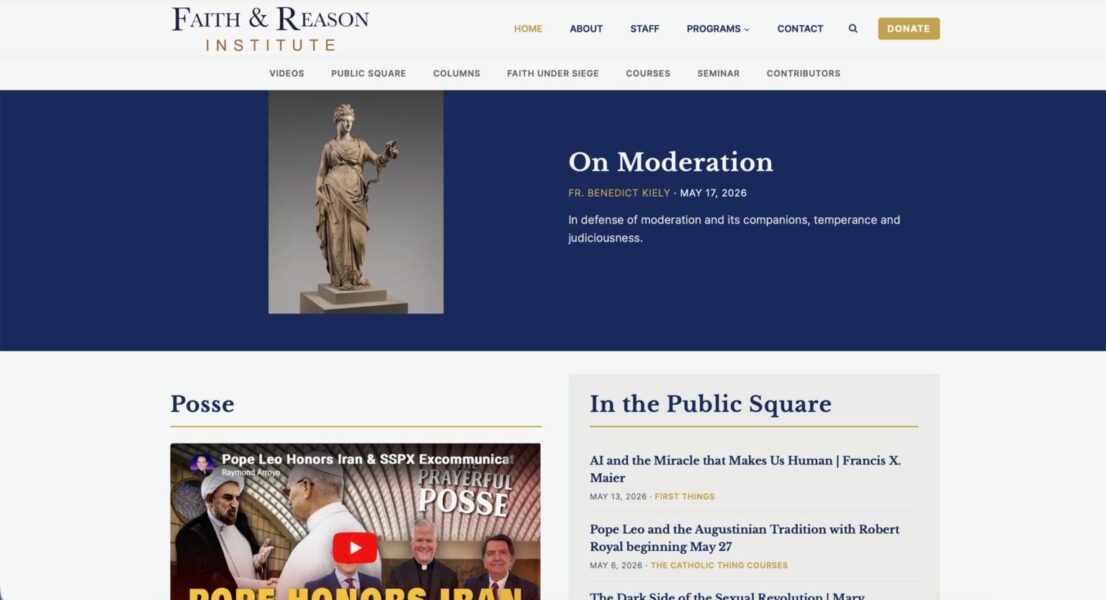
First, today we are relaunching the website of the Faith & Reason Institute (https://frinstitute.org), the parent institution of The Catholic Thing, in a new format that will make it easier to follow our writers, members, and various activities. I believe the staff did a wonderful job and achieved a format that is both attractive and accessible. Please take a look at it.
You will see not only valuable material written by me and others in TCT, but also an archive of the Posses; our video series on martyrs and persecution «Faith under Siege» (“Faith under Siege”); our TCT courses (my new course on the complex relationship of Pope Leo with his Augustinian heritage begins next week); our annual Summer Seminar on the Free Society, which this year features a dialogue between Western and Eastern Catholics on the public space; and several other new initiatives that we will present soon.
We can only offer you all this thanks to the generosity and fidelity of people like you, who care about Catholic truth and are willing to support us in this mission of keeping faith and reason present, together, not only among us but in the world at large. As St. John Paul II wrote at the beginning of his encyclical Fides et ratio:
Faith and reason are like the two wings on which the human spirit rises to the contemplation of the truth; and God has set in the heart of man the desire to know the truth and, ultimately, to know Him so that, by knowing and loving Him, he may also attain the full truth about himself.
There is much at stake in this double approach to knowing God.
I would like to draw your attention to a new initiative in particular that we are launching. Many people today are confused about what the Church teaches and why. And although the columns on this page often address those questions as they arise in the news and public debates, and our courses examine broader themes, we decided that many readers would benefit from a simple but more systematic approach.
And what better way to do it than by reviewing the Catechism of the Catholic Church? And not on its own, but with the guidance of my colleague from the Posse and friend, Fr. Gerald Murray. So, you will soon receive the first installment by email and the opportunity to register for the entire series of short videos—only a few minutes each—in which you will learn the true teaching of the Church from a trustworthy instructor. Stay tuned. You will not want to miss this.
And you will not want to miss our ongoing coverage of events in Rome: the first encyclical of Pope Leo will appear next week (rumors say it is about AI and will be called Magnifica Humanitas —“Magnificent Humanity”—). It will undoubtedly cause a stir, and we will help you reflect on the implications of that text and other events.
We are also planning special coverage with the Posse on the beatification of Archbishop Fulton J. Sheen in September. Speaking of Sheen, he had his own brilliant new/old approach to current issues, both earthly and beyond the grave, in his book Old Errors and New Labels (“Old Errors and New Labels”):
The Church asks its children to think rigorously and cleanly. Then it asks them to do two things with their thoughts… The Church asks its children not only to externalize their thoughts and thereby produce culture, but also to internalize their thoughts and thereby produce spirituality… [B]efore a thought can be passed on to the outside, it must be born inside. But no thought is born without silence and contemplation. It is in the stillness and silence of one’s own intellectual pastures, where man meditates on the purpose of the life and its goal, where real and true character develops. The character is formed by the kind of thoughts a man has when he is alone, and the civilization is formed by the kind of thoughts a man expresses to his neighbor.
As the greatest preacher the United States has ever produced—and an outstanding converter of souls—Sheen is a model for all of us, who know how much the United States and the rest of the world languish without the depth and breadth of the Catholic perspective. In this year, the 250th anniversary of the founding of our dear and troubled nation, he deserves special attention.
Therefore, please examine your own situation and do what you can to support this vital work. Many of us are currently under great financial pressure. But like our ancestors—who, even as immigrants and often poor, built the magnificent American churches, the Catholic school system, universities, hospitals, nursing homes, and charitable institutions, even in the face of anti-Catholic prejudice—we have to do our part, in our time, to keep The Catholic Thing alive and fruitful.
In TCT, we will continue to do everything possible to make this urgent task a reality. Will you? Please join us to support the work of The Catholic Thing.
About the author
Robert Royal is the editor-in-chief of The Catholic Thing and the president of the Faith & Reason Institute in Washington, D.C. His most recent books are The Martyrs of the New Millennium: The Global Persecution of Christians in the Twenty-First Century, Columbus and the Crisis of the West , and A Deeper Vision: The Catholic Intellectual Tradition in the Twentieth Century.