


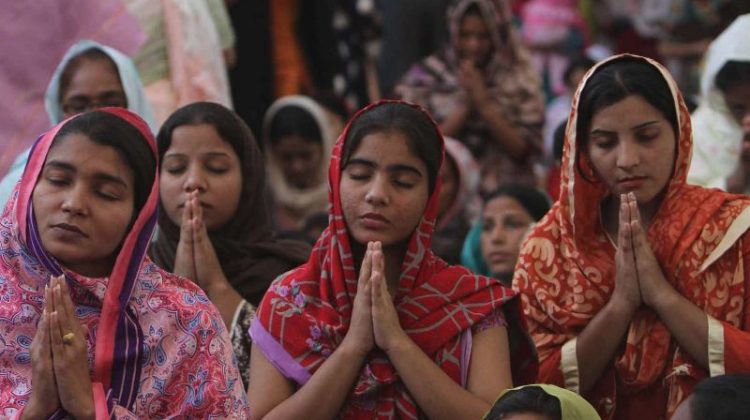
The Catholic Church in Pakistan has denounced the authorities’ passivity after an Islamic court validated the marriage of a 13-year-old Christian girl to the Muslim man accused of kidnapping her and forcing her conversion to Islam. The case, according to Ad Vaticanum, has sparked outrage among the country’s Christian minorities and once again brings to light the silent persecution suffered by numerous young Christian and Hindu women under the cover of certain interpretations of Sharia.
The minor, Maria Shahbaz, disappeared in July 2025 in Lahore when she left her home to go to a nearby store. According to her family, the teenager was kidnapped, forced to convert to Islam, and married to Shaheryar Ahmad, a 30-year-old Muslim man.
Far from protecting the minor, Pakistan’s Federal Shariat Court ruled on March 25 that the marriage was valid under Islamic law and recognized the alleged kidnapper as the girl’s legal guardian. The ruling also rejected the appeal filed by Maria’s father, Shehbaz Masih.
The bishops denounce maneuvers to “make people forget” the case
Following the scandal generated by the ruling, the Pakistani government announced during Easter the creation of a committee tasked with reviewing the judicial decision and presenting recommendations to the Ministry of Justice. However, the Pakistan Catholic Bishops’ Conference has received the measure with open distrust.
The president of the Pakistani bishops, Monsignor Samson Shukardin, bishop of Hyderabad, warned that this type of initiative is often used to cool public indignation until the case fades from media attention.
“These matters usually cool down when the committees finally present their reports. The process is deliberately delayed so that people forget it,” the bishop declared in statements reported by EWTN News.
Shukardin also denounced that many minors accept conversions under pressure and fear, and recalled that the problem directly affects the religious freedom of Christian minorities.
“We hope for an authentic response from the government. Many Muslim clerics support us, but they have avoided joining the protests publicly,” he lamented.
A practice increasingly frequent against Christian minorities
The family presented official documentation issued by the National Database and Registration Authority of Pakistan confirming that Maria was only 13 years old when she was forced to marry, an age clearly below the legal minimum of 18 years established in Punjab province.
However, in numerous similar cases, Pakistani courts end up prioritizing religious arguments over civil guarantees and child protection.
Data from the Center for Social Justice reflect the severity of the problem. Between 2021 and 2025, at least 515 cases of kidnappings and forced conversions of women and girls from religious minorities were recorded.
69% of the victims were Hindu and 31% Christian. The majority of them were minors.
Christian organizations have been denouncing for years that many families live in terror at the possibility that their daughters will be kidnapped and forced into Islamic marriages that subsequently receive legal coverage in the courts.
They call for legal reforms to stop child marriages
Anthony Naveed, vice president of the Sindh Assembly, called on April 6 for the Ministry of Justice to implement urgent reforms to close the “serious legal loopholes” evidenced by the case.
The political leader also demanded that the federal government adopt measures similar to those in Baluchistan, where child marriages are explicitly considered invalid.
Meanwhile, the Pakistani bishops fear that Maria Shahbaz’s case will end up archived among political promises and bureaucratic committees, while hundreds of Christian girls continue to be exposed to an everyday persecution that rarely finds effective protection in the country’s institutions.