


By Michael Pakaluk
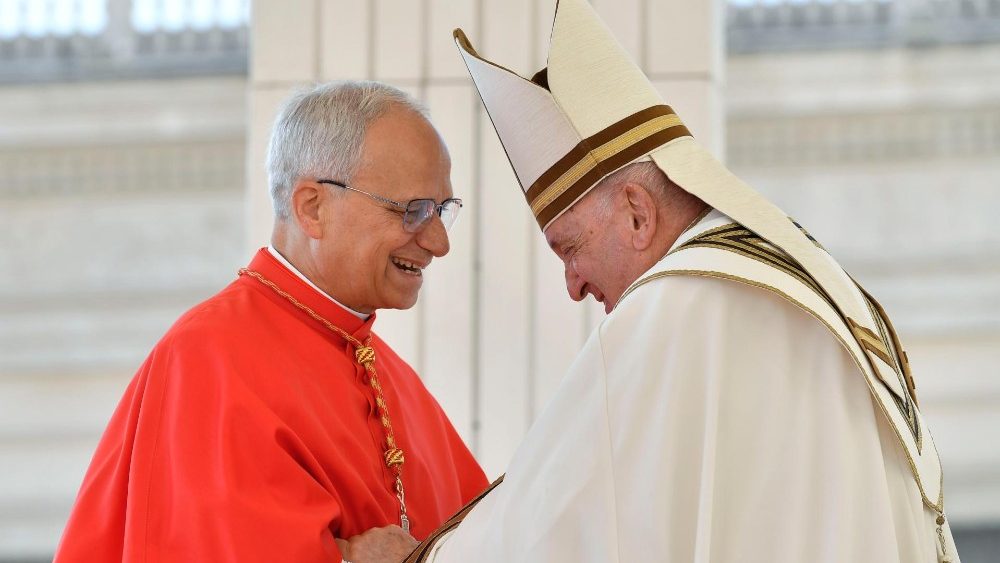
If I were created a cardinal and dispensed from the canonical requirement to be ordained a deacon or priest—my vocation is that of a layman—this is how I would advise the Holy Father on the first anniversary of his pontificate.
“Holy Father, the first thing you must do is correct Francis, because only the Pope can adequately correct a Pope. There is no need to judge his motives. But he often caused confusion and distress, and his attempts to unify often seemed rather to divide.
“In at least one matter, you must correct him clearly, deliberately, and consciously. I advise you to restore the treatment of the death penalty in the Catechism to how it was before. Francis’s insertion of ‘inadmissible’ was autocratic and unhelpful. He intended, with this change, to correct his immediate predecessors, Benedict and John Paul II, who were fully satisfied with the text as it was. Correct him, then, in union with these other Pontiffs, and restore the Catechism to its state of pure truth.
“With this single change, you would then indicate that you are aware of the problem and give the faithful the confidence that, going forward, you will handle similar matters with firmness and prudence.
“You would also cast doubt on the premise that a change, especially one that appears relaxing, is a true ‘development.’ Sometimes, a change can simply be an error that will need to be reversed. This single act would deflate the pretensions of those who wish to use Newman to change the Church’s teaching. It would eliminate much of the toxic confusion caused by chapter 8 of Amoris laetitia and by Fiducia supplicans.
“We know that casuistic moral theologians, who maliciously want to change the Church’s teaching, especially on sexual matters, always begin in the classroom with the death penalty, domestic slavery, and usury, as cases in which the Church supposedly changed its teaching. Francis emboldened these wolves in sheep’s clothing. As guardian of the Deposit of Faith, you have the serious responsibility to protect the sheep from them.
“I advise at the same time that you reverse Traditionis custodes and reaffirm Summorum pontificum, with the judgment, which only you can issue with authority, that Benedict’s wisdom in this matter is greater than Francis’s. After all, was not Benedict the great master of the beauty of the liturgy in our time? His wise ‘accommodation’ brought peace; Francis’s actions have sown division and provoked anger.
“This single act of deliberate correction, in my view, is the first priority. But also in other matters, Francis’s departures from John Paul II and Benedict can be considered unhelpful, such as his degradation of the role of the (former) Congregation for the Doctrine of the Faith; his destruction of the JPII Institute on the Family; and his weakening of the Catholic character of the pontifical academies. Francis’s actions here were harmful to the Church; someone who can reverse them should do so. But prudence and practical limitations can certainly suggest a slower but steady turnaround.
“Other definitive changes I would advise include: embracing Courage and marginalizing Fr. Martin; recovering a chief auditor to achieve the necessary transparency in Vatican finances; and reforming the marriage tribunals so as to end the common abuse of nullities as ‘Catholic divorces.’
“In this last aspect, the painstaking work of reform accomplished by John Paul II over three decades seems to have been effectively undone by Francis.
“These are defined evils ‘in his own house’ that must be addressed. They are not without importance.
“But I know that by choosing the name ‘Leo,’ you expressed the firm desire—with a magnanimous, even leonine heart—to accomplish great things in your pontificate. What legacy of teaching can you pass on for the enduring benefit of the Church?
“I advise against focusing on AI, because its nature and consequences are not yet clear; and because it would be a distraction from more important matters.
“If you are willing to listen to me, here is my threefold advice on this matter.
“First, like the previous Pope Leo, inspire the Church to strive for Christian wisdom. Yes, love for St. Thomas Aquinas must be rekindled once again in the Universal Church. And yet, why not elevate St. Augustine to an equal level, writing a heartfelt encyclical similar to Aeterni patris, but showing St. Augustine as an equally great teacher? Undoubtedly, St. Augustine speaks directly to the youth of our time.
“Second, do not fail to take advantage of the upcoming year, the 250th anniversary of the founding of the United States, as an occasion to celebrate how much the Church has given to this country, and how much American Catholics have contributed to the Church and can contribute in the future. Take as a guide the maxim of Cardinal James Gibbons: ‘Catholics are the best Americans, and Americans are the best Catholics,’ with their spirit of initiative and their love for freedom and subsidiarity. Indeed, Leo XIII shared a similar conviction, which is one of the reasons he founded my university. It would be a great loss for the Church to waste this opportunity.
“Third, lead the Church to see that what has been called ‘the social question’ has changed. We have already moved beyond the mere industrial era and are fully in what economists call ‘The Great Enrichment,’ an explosion of productivity through the free market that lifted most of the world out of misery. Our ‘social question’ is rather: how to inspire young people to marry and have many children, and what policies will support young families in giving their children a religious education, and in allowing the mother to stay at home if she so desires?
“Be the Pope, then, who clarifies that the Church’s teachings on sex, marriage, family, and education count crucially as ‘Catholic social doctrine.’
“Holy Father, I give you my advice now, and my loyalty and prayers always.”
About the author
Michael Pakaluk, a scholar of Aristotle and Ordinarius of the Pontifical Academy of St. Thomas Aquinas, is Professor of Political Economy at the Busch School of Business at the Catholic University of America. He lives in Hyattsville, Maryland, with his wife Catherine, also a professor at the Busch School, and their children. His collection of essays, The Shock of Holiness (Ignatius Press), is now available. His book on Christian friendship, The Company We Keep, is available from Scepter Press. He contributed to Natural Law: Five Views (Zondervan, last May), and his most recent book on the Gospels appeared in March with Regnery Gateway, Be Good Bankers: The Economic Interpretation of Matthew’s Gospel. You can follow him on Substack at Michael Pakaluk.