


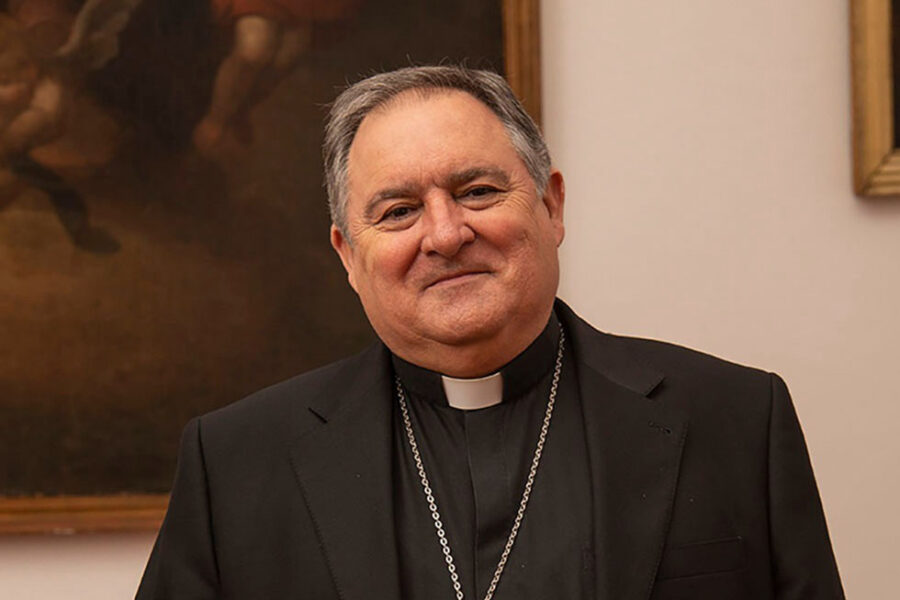
The Bishop of the Canary Islands, José Mazuelos, has called for immigration to stop being used as a political weapon and has urged the recovery of “the spirit of the Transition” ahead of the upcoming visit of Leo XIV to Spain. However, his words come after the constant support from broad sectors of the Spanish Church toward the mass regularization promoted by Pedro Sánchez’s Government.
In an interview granted to The Objective, Mazuelos insisted that immigration “cannot be used to win votes” and described the political polarization around this issue as a “ticking time bomb.” The problem is that much of that polarization has not arisen solely from political parties, but also from an institutional Church that, on numerous occasions, has actively intervened in the public debate defending welcoming and regularization policies promoted by political power.
“Not politicizing” after years of ecclesial positioning
The Canary Islands bishop argued that the migratory phenomenon must be addressed from the common good and not from ideological interests. “Enough is enough,” he stated, criticizing the use of immigration to “win votes and fuel an ideology.”
However, it is now difficult to separate immigration and politics when much of the Spanish ecclesiastical hierarchy has been actively participating in the migration debate for years. The pressure from various Catholic organizations in favor of extraordinary regularizations, humanitarian corridors, and expansive welcoming policies has been constant.
Mazuelos himself acknowledged that the Church had been demanding the regularization of immigrants in Spain for more than a year and a half, precisely one of the most controversial measures recently promoted by the Executive.
A regularization that divides even within Catholicism
Although the bishop defended the need to integrate many immigrants who already work in Spain laborally, especially in elderly care, he also criticized the methods chosen by the Government to push through the regularization.
“It was more because of the elections in Aragón than the Pope’s visit, because it suited them,” he stated, suggesting that the Executive once again used immigration for partisan purposes.
But the debate goes beyond the methods. Ecclesial support for mass regularizations has generated growing criticism among many Catholics who believe that the Church has adopted the dominant ideological framework on immigration without sufficient nuances, ignoring issues of integration, security, pressure on public services, and the pull effect.
The risk of mass regularizations, institutional messages, and certain symbolic gestures ends up incentivizing new waves of irregular migration toward Spain, fueling the growing “romanticization” of migration routes, especially in places like the Canary Islands, sometimes presented from an emotional approach that sidelines the reality of mafias, exploitation, and deaths surrounding these journeys.
Mazuelos tried to distance himself from that accusation by assuring that the Church “is not in favor of irregular immigration,” but rather of immigration “as humane as possible.” Even so, the message clashes with the increasingly widespread perception that much of the ecclesial structures have acted as moral legitimators of polarizing migration policies.
Leo XIV and the risk of political instrumentalization
The upcoming visit of Leo XIV to the Canary Islands adds even more sensitivity to the debate. Mazuelos insisted that the trip should not be interpreted politically and assured that the Pope “is not coming to scold anyone.”
However, the very design of the trip makes it difficult to separate pastoral care and politics. The Canary Islands have become one of the symbols of the European migration crisis, and the fact that the Pontiff visits the archipelago will inevitably be read in a political key, both within and outside Spain.
Read also: The Holy See confirms the historic intervention of Leo XIV before the Spanish Cortes
The bishop also expressed his desire for Leo XIV to bring “the spirit of the Transition” to Congress and help reduce political tension. “There is a large majority of Spaniards who miss that spirit,” he stated.
The underlying issue will be whether that call for unity manages to stay on the sidelines of the ideological battle or ends up reinforcing discourses already very present within certain ecclesial and political sectors.
Read also: Cobo promoted the upcoming speech by Leo XIV in the Spanish Cortes
The migration crisis in the Canary Islands remains unresolved
Beyond the political debate, Mazuelos once again denounced the situation of unaccompanied migrant minors and criticized that many are left abandoned upon turning 18.
“When they turn 18, they are sent to the street,” he lamented, warning that many end up trapped in environments of prostitution, delinquency, or exploitation.
On this point, the bishop highlighted the work of Cáritas and the Canary Islands Church, which have been assuming welfare functions for years where public administrations do not reach.
The problem, however, remains structural. While the migratory flow continues to grow and political solutions remain blocked, the sense of improvisation increases both in the Canary Islands and in the rest of the country.
And in that context, the ecclesial discourse on immigration is increasingly perceived with greater skepticism, because it is no longer clearly distinguished between pastoral accompaniment and political positioning.