


By Robert Royal
Someone recently asked me what it feels like to be a Catholic writer these days. That left me thoughtful. Because the situation of a Catholic writer today is very similar to that of any Catholic: we are all perplexed by so many things that now seem to have surpassed human and rational thought and action. Except that it’s worse for the writer, because he has to put words to try to give some kind of sense not only to the deep mysteries and moral controversies, but to how they relate to our current chaos. The best he can do when faced with a blank sheet of paper—or, more often now, an empty screen—is to implore Divine Mercy to send him a few decent sentences that can spread a ray of hope amid the darkness and noise.
Our era is marked by what the philosopher Paul Ricoeur called a “hermeneutics of suspicion” above all, both in the Church and in the world. Which is not entirely off track, as long as it does not become the only lens through which we see the world. But social media has had the additional effect of stoking doubts and conflicts until they often border on hysteria. On such “platforms,” every event becomes the final cosmic apocalypse or a “new outpouring of the Holy Spirit.”
A Catholic writer has to tell the truth he can, soberly and without fear or favoritism, in the face of all that, without adding to the hysteria or despair. But given the nature of modern communications, we are all barely afloat in a very dubious sea of half-understood facts, hasty conclusions, and thus uncertainties about serious matters that demand caution, reflection, and balanced judgment: an asceticism in the use of words.
In my experience?
I have been physically present in Rome for almost all the controversial Church events since Pope Francis was elected in 2013. There are some things about the last twelve years and more of which I am quite sure amid many great voids and ambiguities. (When the book by the distinguished historian Henry Sire, The Dictator Pope, about Francis appeared in 2018, I thought it had the basic story right at least 75 percent. And I still believe so).
But more often, especially in comments spread on social media, I have observed people guessing, usually wrongly, and seeing sinister motives—even conspiracies—where often Roman ignorance, laziness, and incompetence suffice as explanation.
The papacy is a non-hereditary monarchy with a disproportionate share of court intrigues. There have also obviously been heterodox coup attempts in recent years that have largely failed due to their inherent emptiness. (See under the title: “synodality”).
The closest analogy to all this is what George Orwell, that unsettling seeker of truth, said about the Spanish Civil War (which he covered in person as a reporter). It is even more true regarding various disputes in our social media era:
I saw newspaper reports which did not bear any relation to the facts, not even the relationship that is implied in an ordinary lie. I saw great battles reported where there had been no fighting, and a silence about the whole thing where hundreds of men had died. I saw troops who had fought bravely denounced as cowards and traitors, and others who had never even seen a shot fired hailed as the heroes of imaginary victories, and I saw newspapers in London retailing these lies and intellectual speculators building emotional superstructures over events that had never happened. (“Looking Back on the Spanish War”)
Most of this, now as then, is clearly the product of journalists and intellectuals who want to feel passionately and say something significant about what they want to see as a radical moral or political issue; but abstractly, not about what is happening in a verifiable way. Most of the time, a few real facts are turned into a news story or opinion piece, but then yoked to some grand “narrative” that, at best, is only weakly tied to reality.
People now also routinely issue harsh judgments about others online, from a distance—our Argentine Pope was a consummate master at psychoanalyzing traditional priests and laity he had never met—that they would never issue about people they actually know, given how hard it is to really know another person, even oneself.
There is a related problem with basic information, especially since journalism schools foster progressive activism over simply telling the story. The late great polymath Michael Crichton coined a term for this: the “Gell-Mann Amnesia Effect.”
If one takes a newspaper or magazine (and even more so some social media posts) and reads about a topic on which one has real knowledge, one will normally see that the writer has gotten many things wrong, or even told them backwards, due to a hasty, superficial, or biased approach. One dismisses it. But then one turns to another article in the same publication on a topic with which one is unfamiliar. One immediately forgets (hence the “Amnesia”) how fallible most writers are and accepts the new article as reliable and informative.
It is no wonder that most of us are now walking around with our heads full of a greater load than usual of falsehoods, nonsense, and misdirected passions, thanks to “information technologies.” And AI is already making things even worse.
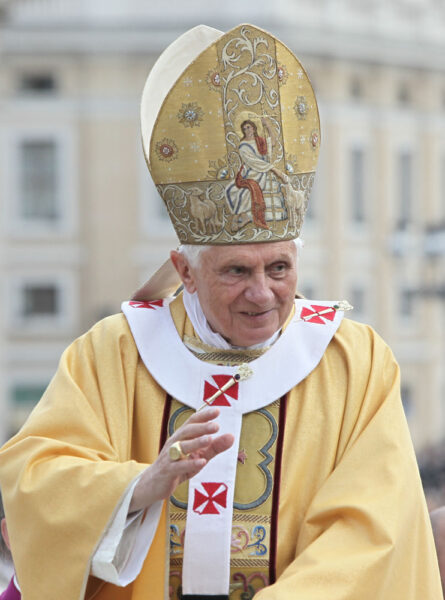
What then should be done? It is hard to say, but here is Benedict XVI, addressing his Schülerkreis, a group of his former students, on “How Can We Speak of God Today?”:
[N]o one can possess the truth. It is the truth that possesses us, it is something alive! We do not possess it, but we are upheld by it. Only if we let ourselves be guided and moved by the truth do we remain in it. Only if we are, with it and in it, pilgrims of the truth, then it is in us and for us. I think we need to learn again about “not possessing the truth”… We must learn to be moved and guided by it. And then it will shine again: if the truth itself guides and penetrates us.
Good advice for all, especially for the Catholic writer.
About the Author
Robert Royal is editor-in-chief of The Catholic Thing and president of the Faith & Reason Institute in Washington, D.C. His most recent books are The Martyrs of the New Millennium: The Global Persecution of Christians in the Twenty-First Century, Columbus and the Crisis of the West y A Deeper Vision: The Catholic Intellectual Tradition in the Twentieth Century.