


By Auguste Meyrat
Although the idea of a midlife crisis seems like an outdated concept these days, there is still much to say about it. It may manifest differently in today’s men, but they still find themselves forced to confront certain personal challenges that arise around the age of forty.
This is because, at this point in their lives, men often have to take responsibility for everything and everyone everywhere: at home, at work, and in the community. To manage these responsibilities successfully, the man in his maturity learns to develop routines, clear moral structures, and a stoic perspective. This approach to life may seem boring and repetitive, but it also ensures the necessary stability and progress that allow for lasting satisfaction.
However, there comes a time when the man must distance himself from routines and responsibilities and reflect on their meaning. What goals does that father, employee, citizen, Christian, or neighbor still have for himself? After all, many of these goals were set when he was a young man unconsciously adopting the ways of the adults around him. Perhaps those beliefs have become too small for him, or maybe they no longer fit his world. Or perhaps they still hold, but require greater refinement.
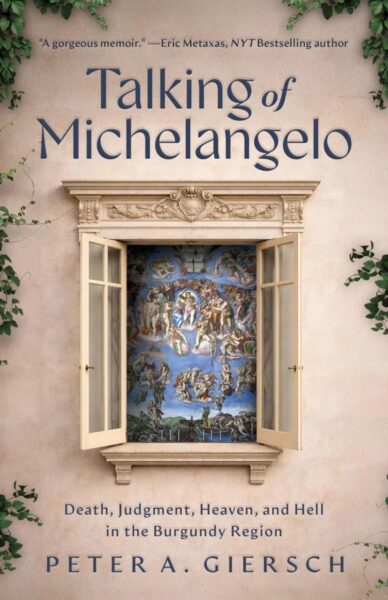
Such is the theme of Peter Giersch’s new book, Talking of Michelangelo: Death, Judgment, Heaven, and Hell in the Burgundy Region. Just as he turns 40, Giersch—father of five, former teacher, business consultant, and active Catholic—decides to visit France to participate in a spiritual retreat. What begins as an amusing and light travel diary, however, deepens into an emotionally tense spiritual renewal that fundamentally changes Giersch.
Unlike many spiritual memoirs, Talking of Michelangelo is not an optimistic tale about a troubled individual who finds joy in his religious beliefs. Rather, it is something more unusual and provocative: it is the story of a complacent but virtuous individual who experiences an intense disturbance in his faith.
Judging by its beginning, one would never suspect this kind of conflict in a man like Peter Giersch. From any angle, he seems like a Catholic version of Ned Flanders, Homer Simpson’s goofy Christian neighbor. He is upright, devout, and even displays a corny sense of humor. The mere prospect of this type of person undertaking a retreat in France mostly portends gentle reflections on gratitude, grace, and good food.
And much of the book lives up to this expectation. As he heads to France, he recalls past trips, the people he met on them, and offers a thoughtful analysis of a decadent French comedy he watches on the plane.
When he arrives in Paris, he reunites with old friends, attends Mass at Notre Dame, and enjoys some hand-rolled cigarettes. He contemplates exquisite views of the city, visits the Louvre and the Eiffel Tower, and recounts the time he worked as an extra in a World War II movie.
So far, so good. Giersch is obviously an intelligent and cultured person with a wealth of interesting experiences. And he is not a stuffy intellectual pedant, but a straightforward guy like any of us; his story progresses pleasantly.
All of this changes when he leaves Paris and heads to the monastery of Flavigny, which hosts a week-long Ignatian retreat. As if reflecting his emotional state, the weather turns unusually cold and rainy. Giersch admits that he began the retreat with no small amount of condescension, boasting of his accomplishments to the man directing the program, Fr. Andre. The monk does not seem impressed and treats Giersch like everyone else. At first, Giersch follows the program, reflecting on the sermons and the mental exercises he is asked to perform.
But when he raises a personal matter (related to contraception) to Fr. Andre, he learns that he is in a state of mortal sin. This revelation activates his conscience and a sudden doubt about the existence of God. The narrative soon veers into a stream of reflections and arguments that Giersch develops furiously in his mind to calm the existential panic that seizes his soul.
He finally finds peace after confessing, which has more to do with God’s forgiveness than with his own mental exhaustion. Unfortunately, the reader may experience a similar fatigue in trying to follow Giersch’s frantic and tangled lines of reasoning. Perhaps he is trying to recreate the tumult of his midlife crisis or show how similar it was to the protagonist of T.S. Eliot’s poem “The Love Song of J. Alfred Prufrock” (from which the book’s title comes). Either way, the reader ends up feeling as much relief as Giersch himself when the retreat concludes and he returns home.
In the end, Giersch feels humbled, but also deeply moved. Presumably, he has learned to value his blessings and not take his faith for granted, but his previous joy and confidence have vanished. The book ends with a scene of his young son reasoning that life is probably not a dream. For his part, Giersch seems to have finished with this episode of his life, finally speechless.
Some readers might find the lack of resolution unsatisfying, but it is true to life itself and, ultimately, it is a merit of Giersch to maintain the honesty of his story. Many of the troubling questions raised by a midlife crisis are not answered immediately with a few good arguments and a couple of moments of rest. In most cases, they pursue the person for years as the innumerable demands of maturity return and that so-desired spiritual closure awaits deeper developments.
Overall, Talking of Michelangelo is an intriguing memoir that appeals to something identifiable and significant, addressing an aspect of spiritual life that rarely receives much attention. The narrative is not always fluid and predictable, but neither is the reality Giersch describes. Finding true happiness and achieving spiritual wisdom requires personal sacrifice and deep reflection, though doing so in a country as beautiful as France helps.
About the author
Auguste Meyrat is an English teacher in the Dallas area. He holds a master’s in Humanities and a master’s in Educational Leadership. He is the principal editor of The Everyman and has written essays for The Federalist, The American Thinker, and The American Conservative, as well as for the Dallas Institute of Humanities and Culture.