


By Elizabeth A. Mitchell
Recently, while teaching that rarest and most elusive concept of civic education to a group of fourth and fifth graders, I presented the «Preamble» of the United States Constitution. We listed, on that endangered specimen of communicative forums—the blackboard—the reasons for establishing our Constitution: «to form a more perfect Union, establish Justice, insure domestic Tranquility, provide for the common defense, promote the general Welfare, and secure the Blessings of Liberty to ourselves and our Posterity». The students were enthusiastic about the clarity and comprehensiveness of the «Preamble».
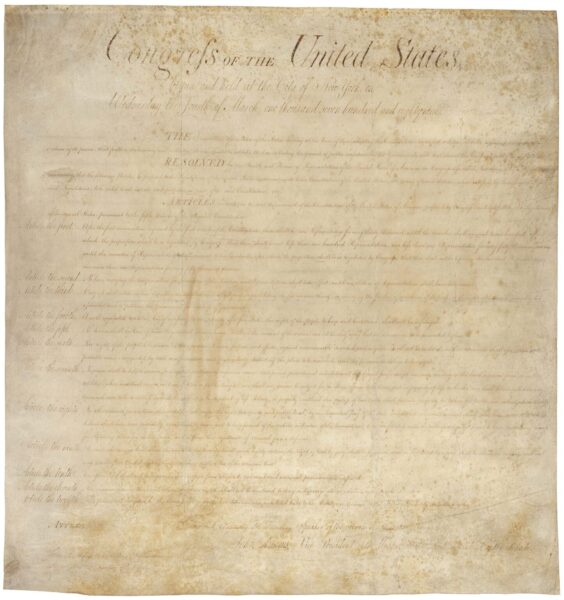
After this foray into foundational consciousness, we moved on to assimilate the «First Amendment» of the Constitution, including the words «Congress shall make no law… abridging the freedom of speech, or of the press; or the right of the people peaceably to assemble».
The chalk had barely touched the blackboard when a hand shot up in the first row. A 10-year-old girl interjected: «But you could be killed».
This fifth-grade civics student was not objecting to the lofty ideals of the «First Amendment», nor contradicting the sentiment embodied in the declaration. She was trying to alert me to the reality of its application.
I hurried to reassure her with the usual platitudes, reiterating that we are certainly glad that the «First Amendment» protects our right to free and safe expression.
I thought I had quelled all the anticonstitutional confusion when another urgent hand interrupted me. A petite 9-year-old girl interjected: «Yes, Dr. E., but you could be killed».
It was not so much the children’s statements, nor the urgency of their desire to warn me, that scandalized me. It was the certainty with which they now believe that their right to speak is a relic of the past, a dusty textbook lesson that is no longer applicable or attainable.
They were natural in their tone, as if patiently explaining to me, the well-intentioned but somewhat outdated person at the front of the room, the new normal.
I’m not sure that we, the older and (supposedly) wiser generation, are aware of how much the worldview of the younger generation has been shaken, deconstructed, and reshaped in recent years, but especially in recent months.
And what can our response be?
Are these children voicing aloud what we have all unconsciously accepted, but have not yet admitted to ourselves?
I recalled a situation during a recent brutal snowstorm, when a young man got trapped in his car upon exiting our building’s garage. He jumped out to clear the snow from the tires, and the car doors locked automatically. He looked, bewildered, into the car, where his dashboard and his means of managing life lay out of reach. The key in the ignition on, the digital access card for the building, and, most importantly and frustratingly, the Alexa app on his phone. I saw the young man yelling through the closed car window, ordering Alexa to call a tow truck.
This was a job for real people. I put on my snow boots and ventured outside.
After the tow truck arrived and unlocked the car door, we still had a Prius stuck in a snowbank. I offered to maneuver while my new friend (ironically named Alex) pushed the car from behind. Slowly, two more people, a young man and a young woman, approached to offer help.
While the two young people pushed the car, I rolled down the window and received instructions. That’s when I heard the young woman shout into the wind: «Where are the people?».
«Excuse me—I stared at her—, what people?».
«The people who come to help», she said stunned, looking around helplessly.
«We are the people», I told her.
She stared at me.
And yet, this statement is perhaps the response we also owe to those shrewd but as yet untested fourth and fifth graders. We are the people. «We the People of the United States… do ordain and establish this Constitution for the United States of America».
The establishment, maintenance, and protection of our way of life is not someone else’s job. The task cannot be performed by other people somewhere out there. And the freedom to embrace the task cannot be taken away by other people. The task is ours.
Historically, the most mobilizing moments in a people’s life often arise under pressure. The early Christians proclaimed the Faith when openly professing Christianity was a capital offense. The English martyrs forged an underground Church that preserved the embers of the true Faith despite political persecution. The Minutemen of Lexington and Concord had muskets and conviction, not power or prestige.
And they all knew, every day, as they carried out their mission, that «they could be killed».
Today, the most benign of circumstances justifies heroism. Now we lock the school’s main entrance during Mass. Public figures of various kinds increase security and change their private routes and routines. The villagers of Nigeria know the risk of kidnapping while teaching and attending school. Guests at the White House Correspondents’ Dinner dive under tables for cover. Nothing is safe. There are no guarantees.
And perhaps that’s what we need to admit to ourselves and to the younger generation.
Perhaps it is necessary to add a warning to the First Amendment in honor of the brave men, living and dead, who fought, as Lincoln told us, to consecrate our rights and ideals. Nothing shall abridge the freedom of speech, nor the right of the people peaceably to assemble… but you could be killed.
We must decide if what we are and what we value is worth risking our lives to promote it. We are truly privileged, as Americans and as a religious people, if the answer is yes.
About the author
Dr. Elizabeth A. Mitchell, S.C.D., received her doctorate in Institutional Social Communication from the Pontifical University of the Holy Cross in Rome, where she worked as a translator for the Holy See Press Office and «L’Osservatore Romano». She is Dean of Students at Trinity Academy, an independent Catholic school in Wisconsin, and advisor to the International Santa Gianna and Pietro Molla Center for the Family and Life, as well as theological advisor to Nasarean.org. Her new book is «St. Edith Stein’s Aesthetic. Beauty and Sanctity: Masterpiece of the Divine Artist«.