


By Fr. Paul D. Scalia
Today it is commonly known as Good Shepherd Sunday. It presents us with one of the most familiar and beautiful descriptions of God. The Mass prayers speak of Him as the «valiant» and «kind» shepherd. For this reason, today is also the World Day of Prayer for Vocations. Upon hearing about the one Good Shepherd, we should feel moved to ask for more shepherds according to His own Heart.
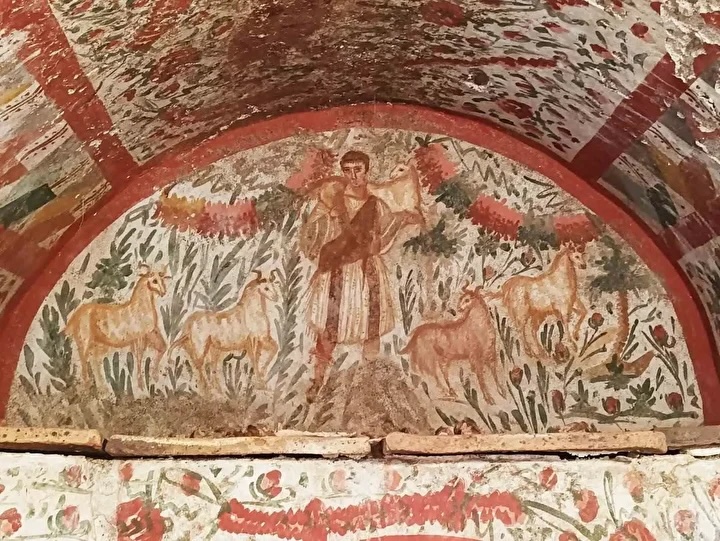
The problem is that the Good Shepherd does not appear in today’s Mass. In the Gospel (John 10:1-10), Jesus does not say «I am the Good Shepherd,» but «I am the gate for the sheep.» Which is not such a warm and inviting image. Christian art has many representations of the Good Shepherd, but are there any of the Gate? And «Gate Sunday» does not sound the same as «Good Shepherd Sunday.» Still, this image (and more than that) of the gate captures not only what Christ is for us, but also what must be asked for, instilled, and demanded of the Church’s shepherds.
«Amen, amen, I say to you, I am the gate for the sheep.» This verse is one of Christ’s great «I am» statements in the Gospel of John. Jesus makes the first one while walking on the water: «It is I. Do not be afraid» (Jn 6:20). Then comes a whole series: I am… the bread of life… the light of the world… the good shepherd… the way, the truth, and the life… the true vine. With each statement, Jesus reveals more fully what was first proclaimed to Moses on Mount Sinai: «Thus you shall say to the Israelites, ‘I AM has sent me to you'» (Exodus 3:14). He reveals more of what the Lord is for His people.
«Amen, amen, I say to you, I am the gate for the sheep.» We must understand the analogy well because, like the others, this is not just an image. Jesus is not like bread; bread is like Him. He is not like light; light is like Him. Likewise, He is not like a gate; a gate is like Him—and points to the reality of what He is for us—.
An evocative detail of shepherding in our Lord’s time is that the shepherd would gather his flock in the sheepfold and then lie down across the opening, thus becoming, in a real sense, the gate for the sheep. Jesus is not just a gate; He is the Gate to which all those other shepherds pointed.
A gate protects. A shepherd could lie down with his body against part of the wall or fence to keep out what does not belong or is not for the flock. As the gate, Jesus is the guardian and guarantee of good shepherds. He keeps out the «thieves and robbers.» This reminds us of the reality that, throughout the history of the Church, there have always been supposed shepherds who do not want the flock «to have life and have it more abundantly,» but have come only «to steal and slaughter and destroy.» In every age and era of the Church, there have been wolves in shepherds’ clothing.
But a gate also opens and thus gives access to the flock inside the sheepfold. That is how true shepherds enter: «Whoever enters through the gate is the shepherd of the sheep.» The gate is open, but like a kind of path that only those who shepherd the flock rightly can traverse. An authentic and authoritative shepherd is the one who passes through the gate, the one who approaches the flock—not on his own terms or with his own wisdom or for his own glory—but through Christ Himself. A true shepherd conforms to the measure of the gate.
In fact, this entire passage is directed more to those who claim to be shepherds than to the sheep. John notes: «Although Jesus used this figure of speech, they did not realize what he was trying to tell them.» That is, Jesus is not speaking so much to the crowds—to the flock—but to those who claim to shepherd the flock.
Obviously, this also constitutes an examination of conscience for us priests (or maybe I’m just being too sensitive). The temptation to use the flock for one’s own selfish benefit—for material gain, emotional comfort, or applause—can creep slowly and imperceptibly into a priest’s heart. The purifying question for a priest is whether I am entering the sheepfold on my own terms and for my own benefit… or through Christ, the Gate.
Shepherding Christ’s flock means entering the sheepfold through Him; that is, knowing Him, being one with Him, assuming His likeness. Those who pass through the gate are willing to know, embrace, and imitate Christ’s humility. The true shepherd is the one «who enters through Christ, who imitates the suffering of Christ, who knows the humility of Christ» (St. Augustine).
«Amen, amen, I say to you, I am the gate for the sheep.» Our Lord utters these words in the Jerusalem Temple. Curiously, one of the main entrances to the Temple was called the Sheep Gate. It was through this gate that the sheep were brought into the Temple for sacrifice and worship. Christ is the true Sheep Gate. He is the One through whom we pass to offer our sacrifices to the Father.
About the author
Fr. Paul Scalia is a priest of the Diocese of Arlington, Virginia, where he serves as Episcopal Vicar for the Clergy and Pastor of Saint James in Falls Church. He is the author of «That Nothing May Be Lost: Reflections on Catholic Doctrine and Devotion» and editor of «Sermons in Times of Crisis: Twelve Homilies to Stir Your Soul«.