


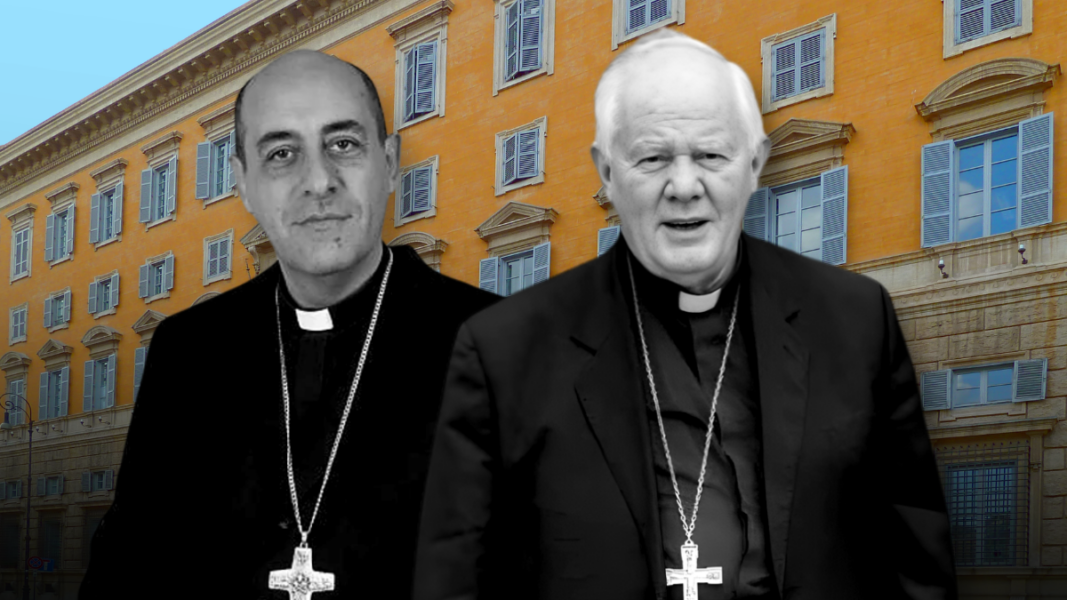
On March 26, 2026, a notarial letter was hand-delivered to the Apostolic Nunciature in Lima. Its formal recipient: the Apostolic Nuncio in Peru, Mons. Paolo Rocco Gualtieri. Its content: a formal complaint against Mons. Antonio Santarsiero Rosa, OSJ, bishop of the diocese of Huacho and then general secretary of the Peruvian Episcopal Conference, for alleged systematic sexual abuses—including a minor in the minor diocesan seminary—and psychological maltreatment of persons under his authority. The file was simultaneously forwarded to the Dicastery for the Doctrine of the Faith, presided over by Cardinal Víctor Manuel Fernández.
It was not the first time these facts had reached Rome. According to the dossier, documented communications about the same facts had been sent to the Vatican authorities in 2024 and 2025, with no known public response or record of action.
On April 8, 2026, Infovaticana published the complaint. On April 9, the Peruvian Episcopal Conference, presided over by Mons. Carlos Enrique García Camader, announced that Santarsiero was stepping away from the General Secretariat «to dedicate himself to clarifying the facts». On April 14, the bishop, along with his Vicar Alejandro Alvites, convened and presided over a meeting with the entire diocesan clergy in the auditorium of the I. E. P. Liceo Español San Juan Bautista de Hualmay, Huaura province. There, instead of maintaining the minimum reserve required in any ongoing sanction procedure, he publicly identified his own victims before the presbytery and promoted the signing of a statement of support.
Meanwhile, the victims—formal complainants in an open canonical procedure—have received nothing. Neither a notification of admission to processing. Nor a summons for supplementary proceedings. Nor the opening of a channel of communication and assistance. Nor a single word of accompaniment from the ecclesiastical authority handling the case. Handling it? Absolute silence.
And, while that silence drags on, the investigated party travels to Rome.
What the canonical legislator did not make explicit
Anyone who reviews the 1983 Code of Canon Law, the norms De delictis reservatis, the motu proprio Vos estis lux mundi—in its 2019 wording and in the consolidated 2023 version—and the Vademecum of the Dicastery for the Doctrine of the Faith on handling abuse cases will find a system carefully articulated around the investigated party: right to defense, presumption of innocence, legal assistance, appeals. They will not find, however, a clear and enforceable procedural status for the victim. Not because the legislator decided to exclude them—it would be absurd to think so—but because there are principles so elementary, so obvious, so structural to the very concept of «process» in any civilized legal tradition, that the canonical legislator, presumably, did not consider it necessary to spell them out in detail.
Well then: what is not made explicit, in the current canonical practice, simply is not applied.
Upon the legislator’s silence, diocesan practice has built a regime in which the victim:
— Is not informed of the admission of the complaint.
— Is not assigned a file number.
— Is not notified of the procedural phase in which the process is.
— Is not allowed to submit writings.
— Is not allowed to provide supplementary evidence.
— Is not allowed to propose witnesses or proceedings.
— Is not allowed to make even a minimally reasonable follow-up of the case.
— Is not given notice of decisions that directly affect them.
— Is not informed of the filing, referral to Rome, or sanction imposed, except in the generic—or not so formal—terms that the authority deems appropriate.
Imagine, for a moment, transferring this model to the criminal sphere of the State. Imagine a victim of a serious crime who comes to report it and is told that they cannot appear in the procedure, that they will not be notified of anything, that they cannot provide evidence, that they will not have a copy of the proceedings, that they cannot appeal the filing, and that they will find out about the outcome, if at all, through the press. Can you imagine the absurdity? Can you imagine a judicial body seriously defending that such a thing is compatible with a process worthy of the name?
Well, that is, today, the de facto reality of canon law applied to sexual abuse cases.
Dozens of cases, the same pattern
The person writing this follows, along with other professionals, dozens of files opened in Spain and Latin America. The dynamic is always the same: the complaint is received, an internal procedure is initiated from which the victim hears nothing more, an investigation is conducted of which only the ecclesiastical authority and, if applicable, the investigated party are aware, and it is concluded—with sanction, filing, or referral to Rome—in an act of which the victim finds out, if they find out, through third parties or the press.
Therefore, this is not about local pathologies attributable to specific bishops, poorly organized curias, or negligent instructors. This is about a structural pattern. And a structural pattern requires a structural explanation.
The usual justification is the lack of resources. There is no personnel. No means. No budget. It is worth dismantling this argument calmly.
First, the alleged insufficiency of resources does not exempt, in any known legal system, compliance with the essential guarantees of the process. An overloaded body may take longer; what it cannot do is decide to dispense with notifying the parties. The scarcity of means affects the pace, not the substance.
Second, the elementary acts that are being omitted—acknowledgment of receipt, assignment of file number, notification of the procedural phase, opening a bidirectional communication channel—do not require extraordinary resources. They require will. The diocese of Huacho has been perfectly capable of convening its entire clergy in a parish hall and promoting the signing of a statement of support for the investigated bishop. The logistical capacity exists. The question is whom it decides to direct it toward.
Third, and perhaps most relevant: the zero cost of a receipt notification contrasts with the enormous cost—pastoral, legal, reputational, and human—of the institutional revictimization produced by silence. The supposed economy of means turns out, in the end, to be infinitely more expensive for the Church itself.
The core of the problem: a law without a victim
It is worth formulating the diagnosis with the utmost clarity possible: the current canonical criminal law, in its practical application, has consolidated a conception of the process in which the victim is the object of the procedure, not a subject of it. They are the source of the notitia criminis, but cease to exist procedurally the moment that news is incorporated into the file. They are the origin of the machinery, but are considered extraneous to its functioning.
This conception is incompatible with three principles that belong to the hard core of any minimally guarantee-based procedural system, and that do not need to be explicit in a specific canon to be enforceable, because they are part of the very definition of a fair process:
1. The principle of audience. Whoever has a legitimate interest in the procedure has the right to be heard in it. The victim of an abuse has, without question, a legitimate—and qualified—interest in the procedure followed against their aggressor. Denying them audience is not an organizational opportunity decision; it is a structural violation.
2. The principle of contradiction. A procedural truth cannot be built on the exclusive basis of information provided by one party. The initial complaint does not exhaust the victim’s possible contribution: new elements, new evidence, new testimonies, contradictions in the investigated party’s version that only the victim can point out may arise. Closing the door after the complaint is equivalent to deliberately renouncing an essential source of evidence.
3. The principle of information. Without information, there is no defense, no protection, no possibility of reacting to harmful decisions. A victim who does not know what phase their procedure is in, what decisions have been made, what deadlines apply, and what remedies are available, is a victim who has been emptied of any supposed right that is claimed to be recognized for them.
How long?
The question that remains hanging in the air is whether the Church is willing to continue maintaining this state of affairs. Whether it is willing to continue handling cases like that of Huacho, that of Lute in Chiclayo, and so many others, under a procedural model that, applied in any other forum, would be declared null and void outright for violation of essential guarantees.
What is not being asked is to mimetically transfer the categories of civil or criminal procedural law of the State to the canonical sphere. What is being asked is the minimum: that receipt be acknowledged, that a file number be assigned, that the procedural phase be reported, that a bidirectional communication channel be opened, that the victim be allowed to provide evidence and propose proceedings, that they be notified of decisions that affect them, that they be given a copy of the file when requested, and that they be allowed to appeal if applicable.
The minimum. The elemental. What is inherent to the very concept of process.
As long as this does not happen, cases like Huacho or that of Lute in Chiclayo will continue to cast a shadow over the Church that no statement, no commission, no institutional management can dispel. The problem is not communicational. It is structural. And it demands immediate normative and practical correction.