


By Casey Chalk
It’s easy to get lost in biblical numerological speculation, as even a superficial study of the Church Fathers demonstrates. St. Irenaeus tried to explain the number of the beast from Revelation 13:17–18 by adding up the numerical value of the Greek letters in the names “Evanthas,” “Lateinos,” and “Teitan” to obtain the ominous 666. St. Augustine argues the meaning of the 153 fish caught by the Apostles (John 21:11): there are the Ten Commandments, the number seven means holiness, ten plus seven are seventeen, and if all the numbers from 1 to 17 are added up (for example, 1+2+3, etc.) they equal 153. St. Cyril, on the other hand, divides the number 153 into 100 (the great number of Gentiles who will be saved), 50 (the small number of Jews who will be saved), and 3 (the Trinity).
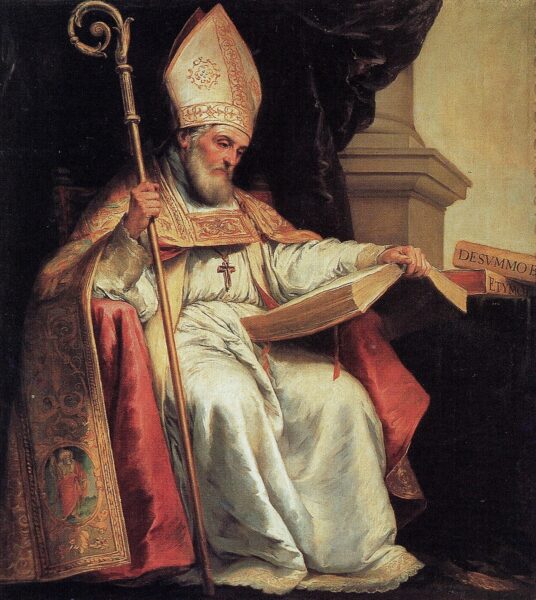
In the face of such apparently unfounded speculations, it’s easy to fall into the temptation to throw in the towel and conclude that seeking spiritual meaning in the various numbers of Sacred Scripture is not a particularly fruitful endeavor. However, the writings of the Father and Doctor of the Church St. Isidore of Seville (560-636)—whose feast we celebrate earlier this month—should give us pause. His work The Mystical Meaning of Numbers in Sacred Scripture helps clarify why the use of numbers in the Bible is important in exegesis and theology.
St. Isidore was one of the most renowned men of the seventh century. Born into a pious family (his brothers Leander and Fulgentius and his sister Florentina are also saints), Isidore was eventually appointed Apostolic Vicar for all of Spain by Pope St. Gregory the Great.
He convened a Church Council in Spain (the Second Council of Seville) in response to the heresy of the Acephali, who rejected the teachings of the Council of Chalcedon on the union of the divine and human natures in Christ. He also convened the Fourth Council of Toledo, which linked the Spanish monarchy to the Catholic Church and established seminaries for the training of the clergy.
Just sixteen years after his death, the Church in Spain in Toledo unanimously agreed that he should be declared both a saint and a Doctor of the Church. Due to his writings on numbers, Pope St. John Paul II declared Isidore the patron saint of the internet in 1997.
Sacred Scripture teaches: “But thou hast ordered all things in measure, and number, and weight.” (Wisdom 11:21) Inspired by this, Isidore’s Etymologies see a symbolic value in numbers:
The importance of numbers should not be overlooked, for in many passages of the Sacred Scriptures mystical meanings shine through them with splendor and illumination. . . . And if number and quantity were removed from creation, all things would lose their forms and cease to exist.
In The Mystical Meaning of Numbers in Sacred Scripture, Isidore guides us through such interpretations, from the numbers one to twelve.
The one, for example, “represents both indivisibility and completeness,” whose exemplar and archetype is God himself, the origin of all things: “The one or unity is the seed and foundation of all subsequent numbers. For from unity all later numbers emanate or are created.” Of course, the most perfect example of unity is God, as the Shema affirms: “Hear, O Israel: The Lord our God, the Lord is one.” (Deut. 6:4) The Church is also one, though the sins of its members undoubtedly damage that unity, just as the sins of the individual Christian damage the integrity of the whole human person created in the image of God.
The two is the first number that can be divided and therefore “represents the possibility of a fundamental opposition,” giving rise to potential conflict: good and evil, light and darkness, life and death.
The Old Testament is full of examples of such oppositions: Cain and Abel, Saul and David, Israel and Judah. Jesus employs it constantly in his parables: the wheat and the tares, the sheep and the goats, the two sons. Isidore’s analysis also anticipates a response to Protestant thought: “There are two aspects or means that lead man to the blessedness of life, namely, faith and good works. Faith is a grace or gift of divinity, while good works proceed from a righteous way of living on the part of the human being involved.”
The Trinity comes to us by contemplating the number three. Isidore observes that other philosophical and religious traditions also affirm a divine triad: Neoplatonism (Monad, Intellect, Soul) and Hinduism (Brahma, Vishnu, Shiva). It would seem, then, that not only Sacred Scripture, but “the organization and structure of the world and the universe itself” is imbued with the number three.
Then, there are in turn four Gospels, four cardinal points seen in the four rivers flowing from paradise (cf. Gen. 2:10-14); four elements and four cardinal virtues.
In the Bible, the seven has a mystical meaning, often understood as a sign of fullness. Genesis, for example, tells us that seven days make up a week. Our Lord tells St. Peter that we must forgive our neighbor not seven times, but seventy times seven, indicating the unlimited nature of divine mercy. (Mt. 18:21-22). St. John addresses letters to seven particular churches in Revelation, representing the totality of the Church. And, as a warning, the seven can also serve as an inversion of the good: Jesus warns of seven unclean spirits that return to a man (Luke 11:26); there are seven deadly sins to counter the seven virtues and the seven gifts of the Holy Spirit.
It is true that poring over the pages of Scripture in search of spiritual ideas based on various numbers can degenerate into the strangest of speculations. Witness the Millerites’ “Great Disappointment,” who believed (based on deceptive biblical calculations) that Jesus would return on October 22, 1844, or the radio evangelist Harold Camping, who predicted that October 21, 2011, would be the final destruction of the world.
Nevertheless, as St. Isidore’s exegesis also makes clear, there is a divinely ordered use of numbers in the Bible that, when properly understood, illuminates the meaning of Scripture and the history of salvation.
About the author
Casey Chalk is the author of The Obscurity of Scripture and The Persecuted. He is a contributor to Crisis Magazine, The American Conservative, and New Oxford Review. He holds a B.A. in History and M.A. from the University of Virginia and an M.A. in Theology from Christendom College.