


By Stephen P. White
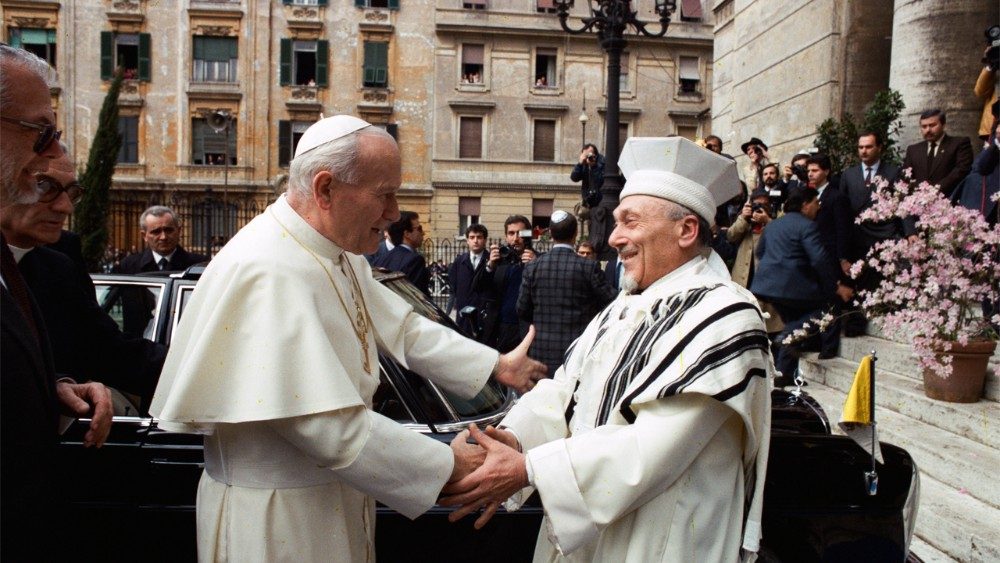
Forty years ago, Pope John Paul II made a historic visit to the Great Synagogue of Rome. He was the first bishop of Rome to visit a synagogue (though it is to be assumed that Peter, at least, showed up at one from time to time). John Paul’s visit, so laden with symbolism and historical importance, was much more than an occasion for “interreligious dialogue,” a phrase that sometimes can suggest a lowest common denominator approach to religious belief.
Much more than a “celebration of differences,” as current language might put it, this was an encounter of brothers, as Pope John Paul II famously expressed it on that occasion:
The Church of Christ discovers its “bond” with Judaism “by scrutinizing its own mystery”… The Jewish religion is not “extrinsic” to us, but in a certain way is “intrinsic” to our own religion. Therefore, with Judaism we have a relationship which we do not have with any other religion. You are our preferred brothers and, in a certain sense, it could be said that you are our elder brothers.
As we know—or should know from history, the Scriptures, and perhaps from personal experience—the friendship between brothers can be something sublime. In the same way, few things are more bitter than enmity between brothers.
This affirmation of brotherhood between Christians and Jews is perhaps more significant than we might recognize at first glance.
Forty years ago (and 1986 was itself barely forty years after the end of World War II), for a pope to claim brotherhood with the Jewish people was an unequivocal gesture of reconciliation, of friendship. The fact that it came from a Polish pope made it all the more moving.
From John Paul II’s childhood home in Wadowice to the open gates of the “Golgotha of the modern world” (as he called the Nazi extermination camp of Auschwitz-Birkenau) there are just under 18 miles. That enduring symbol of the Holocaust was in Karol Wojtyla’s native diocese, the diocese he himself led as archbishop before his election as pope.
The point is that the horrors of the Holocaust, which were inflicted especially (though far from exclusively) on the Jews, were much more than abstractions of history for Pope John Paul II. These atrocities happened to his neighbors, his friends, and in his own backyard. For the Polish pope, accepting an invitation to Rome’s synagogue held great personal significance.
In this context, the kinship—the brotherhood—of Christians and Jews was, in the eyes of Pope John Paul II, much more than a mere postwar piety articulated as a vague humanistic affinity. It was a kinship rooted in the historical faith in the God of Abraham. It was also a kinship marked and tested by profound suffering: that of seeking the face of God amid the worst horrors that human beings inflict on one another.
This kinship of Christians and Jews has always held greater theological importance for Christianity than for Judaism. In short, according to Christianity’s own claims, the truth of the Christian faith depends on the truth of Judaism. The Church cannot forget, as Nostra aetate says, that she “is nourished from the root of the good olive tree onto which have been grafted the branches of the wild olive tree that are the Gentiles.” For all Christians, it is important that the God of Abraham, Isaac, and Jacob is truly the Lord.
The reverse is not true. The truth of Christianity is not a theological (much less historical) requirement for Judaism. This means that the Jewish willingness to relate to Christians as brothers always carries a kind of generosity and selflessness. For this reason, it is worth noting that Pope John Paul II was invited to Rome’s synagogue by Rabbi Elio Toaff, a detail that could easily be overlooked but which has its own importance.
For Christians to claim kinship with Jews is, in a certain sense, a kind of imposition. I do not mean that it is impertinent for Christians to claim such kinship, but rather that it is an assertion that demands a response, as all such assertions do. To claim kinship is to assert a mutual obligation. To accept friendship is to submit to a debt of mutual responsibility.
Christians can and should see Jews as our brothers. We can and should hold them in the esteem due to a people with whom God has made unbreakable promises. And we must understand that, in responding to that sense of kinship—a kinship that their own tradition does not oblige them to recognize—our Jewish friends are not making a small concession.
Moreover, and this is a delicate point, Judaism is much less interested in gaining converts than Christianity is, an important difference that, in my experience, is much more likely to be overlooked by Christians than by Jews. When it comes to interreligious dialogue, Jews and Christians sit at the table on remarkably different terms.
That said, there are good reasons for Jews to seek interreligious dialogue with Christians, even if these are not primarily religious. To put it bluntly, Jewish communities are interested, particularly where they are a small minority, in being on good terms with their more numerous neighbors. Peaceful coexistence is the least that Christians and Jews should be able to offer each other. History provides too many painful counterexamples to ignore.
And here lies one of the great lessons of Pope John Paul II’s visit to the Roman synagogue, a lesson that remains relevant today. Catholics like to insist that grace builds on nature and perfects it. True friendship—sincere, selfless, and for its own sake—can be a natural good, but natural friendship has a way of being transformed into that highest of the theological virtues: Charity. We Christians should understand that forming such friendships with our Jewish brothers and sisters provides a solid foundation upon which God’s grace can act in all of us.
About the author
Stephen P. White is executive director of the National Shrine of St. John Paul II and a fellow at Catholic Studies at the Ethics and Public Policy Center.