


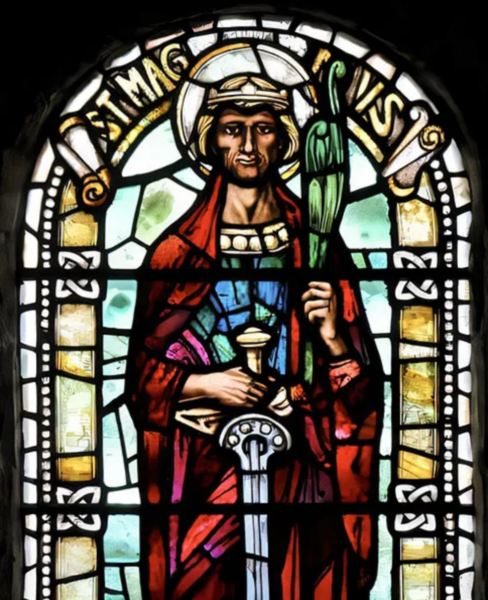
By Amy Fahey
Today marks more than nine centuries since the death of Saint Magnus, a jarl or earl of the Orkneys, those wind-swept islands off the coast of mainland Scotland. His holy life is recounted in the Saga Orkneyinga, which captures, in a sober and forceful language, his Christian witness in an era when violence and ambition regularly disrupted the lives of humble peasants and fishermen.
The creative energies of the Orcadian writer and convert George Mackay Brown were ignited by the story of Saint Magnus, giving rise to numerous poems, a play, an opera (with composer Peter Maxwell Davies), and short stories. Magnus’s muse is nowhere more evident than in Mackay Brown’s 1973 novel, Magnus.
It is a strange work, at once innovative and imitative, that advances through a succession of intertwined voices and symbols: the up and down of the oars, scythes, weapons, the singing of psalms, the net of light, the harp and the loom. I’m not sure it can even be called a novel. It is more a dramatic meditation, a stylized and lyrical evocation of meaning, closer to poetry. Perhaps unhelpfully, Brown himself says in his memoirs: «Realism is the enemy of creative imagination.»
He presents the martyrdom of Saint Magnus, betrayed by his cousin and rival earl, Hakon, as an example of a broader pattern: «At certain times and in certain circumstances, men still long for a spectacular sacrifice,» says Mackay Brown. «They search everywhere for a victim and a scapegoat to stand between the tribe and the wrath of inexorable Fate.»
In his memoirs, For the Islands I Sing, Mackay Brown reveals his motives for a strange transposition that occurs when the novel reaches the martyrdom:
Suddenly, one morning, while thinking about ways to tell the story of the real martyrdom on Egilsay in 1117, it occurred to me that the whole story would seem remote and disconnected from our situation in the 20th century to a modern reader. The truth must be that such incidents are not isolated chance events in time, but repetitions of some archetypal pattern; an image or event imprinted on the human spirit from the beginning of his time on earth, which will continue to repeat itself again and again in every life without exception until history finally yields a meaning. I didn’t have to go far to find a parallel: a concentration camp in central Europe in the spring of 1944.
With this shift to Nazi Germany, Mackay Brown highlights the terrifying everydayness of evil, the presumption that violence and brutality are a default setting for humanity and challenge resistance.
Thus, Magnus’s murder is presented in the novel as something administrative, procedural. Lifolf the cook, who has been conscripted by Earl Hakon to carry out the actual killing, repeatedly declares: «Of course, it had nothing to do with me. … One doesn’t argue with one’s superiors inside the wire fences.»
Shakespeare offers striking parallels in the «officials» of King Lear. The captain, who surrenders his humanity to carry out Edmund’s order for Cordelia’s execution, ironically claims he cannot «draw a cart nor eat dried oats» like a beast of burden, but if «it is men’s work, I’ll do it.»
In defiant opposition to the contagious violence of Lear stands the gesture of the anonymous servants who tend to Gloucester immediately after his eyes are gouged out. One dies trying to stop the brutality; the other two tend to the blinded earl by bringing «lint and egg whites / to apply to his bleeding face.» At risk of displeasure or death, they affirm their humanity.
In the Saga Orkneyinga, Magnus makes a final offer, telling Hakon and his men that he is more concerned for their souls than for his own life: «Have me mutilated in whatever way you choose, instead of taking my life, or blind me and lock me in a dungeon.» But they long for a final solution, one that ensures no further acts of violence occur.
In this original version, Lifolf is not banal about the evil he is asked to commit. Hakon first asks his standard-bearer, Ofeig, to perform the execution, «but he refused angrily.» When he asks his cook, «Lifolf began to weep aloud.» Magnus consoles him: «Don’t be afraid, you are doing this against your will and the man who gives the order is more sinful than you.» Then he commends his soul to God and «offers himself as a sacrifice».
Sigrid Undset found the parallels between Magnus’s time and her own obvious, without need for imaginative leaps or historical breaks. She writes:
We, who live in a more organized civilization (while it lasts), often try to slyly evade God’s stern demands to get a little more than our neighbors of the material benefits of this world, or we strive for man’s «recognition,» and we endeavor, as far as possible, to avoid the «contempt of the Cross.» It is likely that in our hearts we are no less preoccupied with ourselves than the violent friends of Saint Magnus; in a more cautious and much more civilized way, we commit the same sins that our ancestors perpetrated brutally and in broad daylight.
«The reason his personality stands out so sharply,» Undset continues, «is because he appears in such strong contrast to the world in which he lived. He was a man in opposition. … Everyone around him had one essential goal: to rule and be their own masters. Saint Magnus was the only man of his time who always thought… just the opposite.»
The life and death of Pope Saint Magnus remind us that, amid conflict and moral confusion, we need a voice, however soft and small, that urges the path of peace and personal sacrifice. Such a voice will always clash with those who long for an illusory and dangerous «final solution» or who succumb to reckless rhetoric.
The «banality of evil» need not be the default setting: in the face of those who have cauterized their moral sense, there must be those who still «see with feeling,» whose reaction to suffering and violence is not to turn away and say «it was no concern of mine,» but to run for the lint and egg whites, and to be willing to embrace the «contempt of the Cross».
About the author
Amy Fahey is an associate professor at the Thomas More College of Liberal Arts. Her essay, «Sigrid Undset, Novelist of Mercy,» appears in the forthcoming volume, Women of the Catholic Imagination (Word on Fire, 2024).